

This chemistry question involves key chemical concepts and calculations. The detailed solution below walks through each step, from identifying the reaction type to computing the final answer.
ScanSolve AI Answer
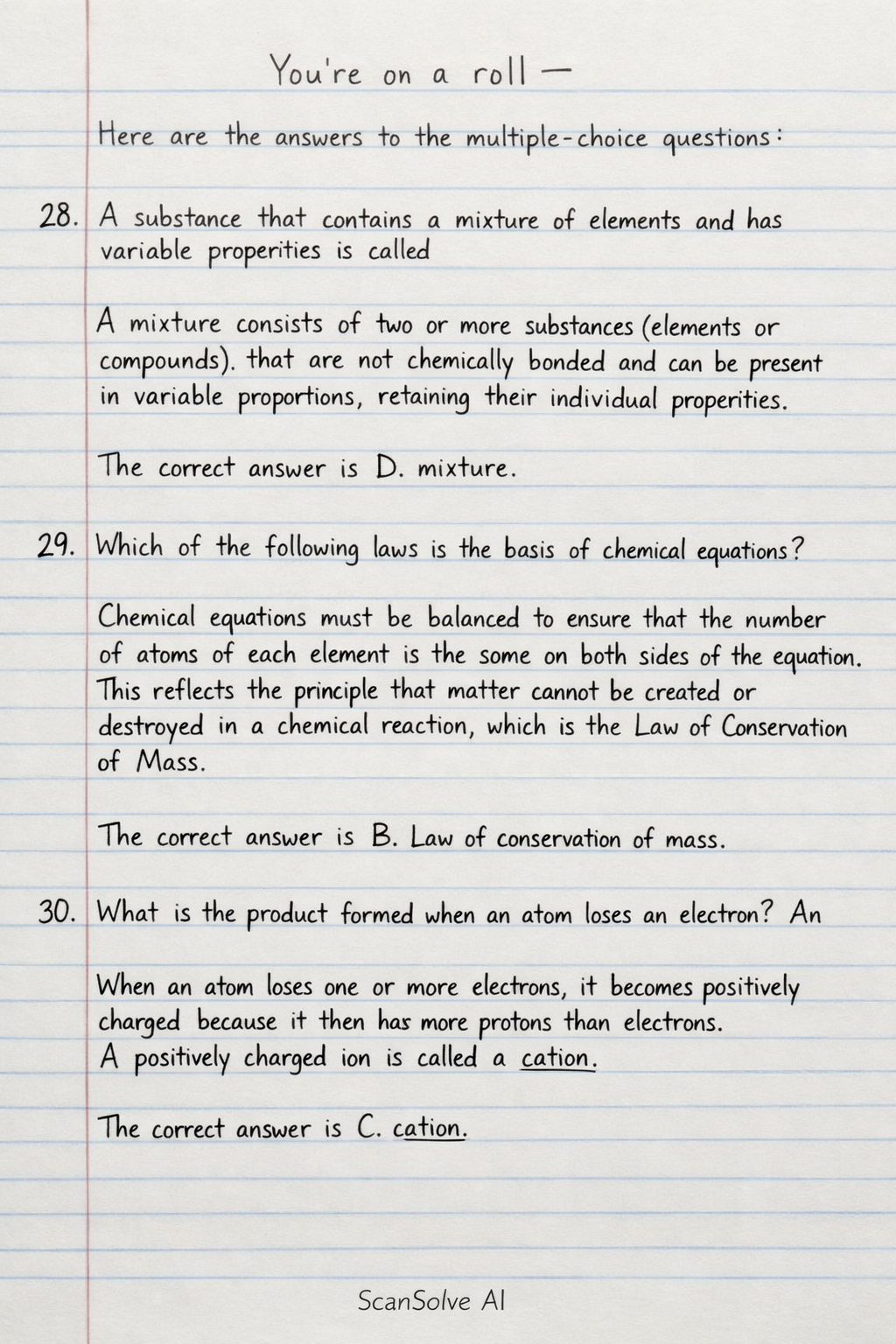
Here are the answers to the multiple-choice questions: 28. A substance that contains a mixture of elements and has variable properties is called A mixture consists of two or more substances (elements or compounds) that are not chemically bonded and can be present in variable proportions, retaining their individual properties. The correct answer is D. mixture. 29. Which of the following laws is the basis of chemical equations? Chemical equations must be balanced to ensure that the number of atoms of each element is the same on both sides of the equation. This reflects the principle that matter cannot be created or destroyed in a chemical reaction, which is the Law of Conservation of Mass. The correct answer is B. Law of conservation of mass. 30. What is the product formed when an atom loses an electron? An When an atom loses one or more electrons, it becomes positively charged because it then has more protons than electrons. A positively charged ion is called a cation. The correct answer is C. cation. 31. How many covalent bonds are formed by oxygen? Oxygen is in Group 16 of the periodic table, meaning it has 6 valence electrons. To achieve a stable octet (8 valence electrons), it needs to gain or share 2 electrons. It typically forms 2 covalent bonds (e.g., in H_2O where it forms two single bonds, or in O_2 where it forms one double bond, which counts as two shared electron pairs). The correct answer is B. 2. 32. Which of the following products is/are obtained from a polymer industry? I. Polythene products: Polythene is a synthetic polymer, so products made from it are from the polymer industry. II. Textile fibres: Many textile fibres (e.g., nylon, polyester) are synthetic polymers. III. Laundry starch: Starch is a natural polymer (polysaccharide) obtained from plants, not typically from the synthetic polymer industry. IV. Perfumes: Perfumes are mixtures of aromatic compounds, not polymers. Therefore, I and II are products of the polymer industry. The correct answer is B. I and II only. 33. An element of carbon has ^12C and ^13C. This is an example of the law of ^12C and ^13C are isotopes of carbon, meaning they are atoms of the same element with different mass numbers (due to different numbers of neutrons). While the existence of isotopes doesn't directly exemplify one of these laws, it is consistent with the laws of chemical combination. The Law of Definite Proportions states that a chemical compound always contains exactly the same proportion of elements by mass. This law holds true because, for macroscopic samples, the average atomic mass of an element (which accounts for its isotopes) is constant. The correct answer is A. definite proportions. 34. What is the likely formula of a compound formed between element G in group two and element V in group seven? Element G is in Group 2, so it forms a G^2+ ion. Element V is in Group 7 (halogens), so it forms a V^- ion. To form a neutral compound, two V^- ions are needed to balance the charge of one G^2+ ion. The formula is GV_2. The correct answer is B. GV_2. 35. The functional group in RCHO is what The functional group -CHO is characteristic of an aldehyde. R represents an alkyl or aryl group. The correct answer is D. aldehyde. 36. All the following substances are covalent compounds except A. CO_2 (Carbon dioxide): Carbon and oxygen are non-metals, forming covalent bonds. B. HNO_3 (Nitric acid): Hydrogen, nitrogen, and oxygen are non-metals, forming covalent bonds. C. NO_2 (Nitrogen dioxide): Nitrogen and oxygen are non-metals, forming covalent bonds. D. Na_2CO_3 (Sodium carbonate): Sodium (Na) is an alkali metal, and the carbonate ion (CO_3^2-) is a polyatomic ion. This compound is formed by ionic bonds between Na^+ ions and CO_3^2- ions. The correct answer is D. Na_2CO_3. 37. The process of separation of an insoluble particle in water is called Filtration is a physical or mechanical operation that separates insoluble solid particles from a fluid (liquid or gas) by interposing a medium through which only the fluid can pass. The correct answer is A. filtration. Drop the next question.