
We read your photo as:
Which of the following questions does the provided solution answer: How many grams of Na are present in 30 g of NaOH? How many liters of H₂ can be produced by the decomposition of 3 moles of NH₃ at ST
Chemistry
ScanSolve AI Answer
Answer
C
17 g
Step-by-step solution
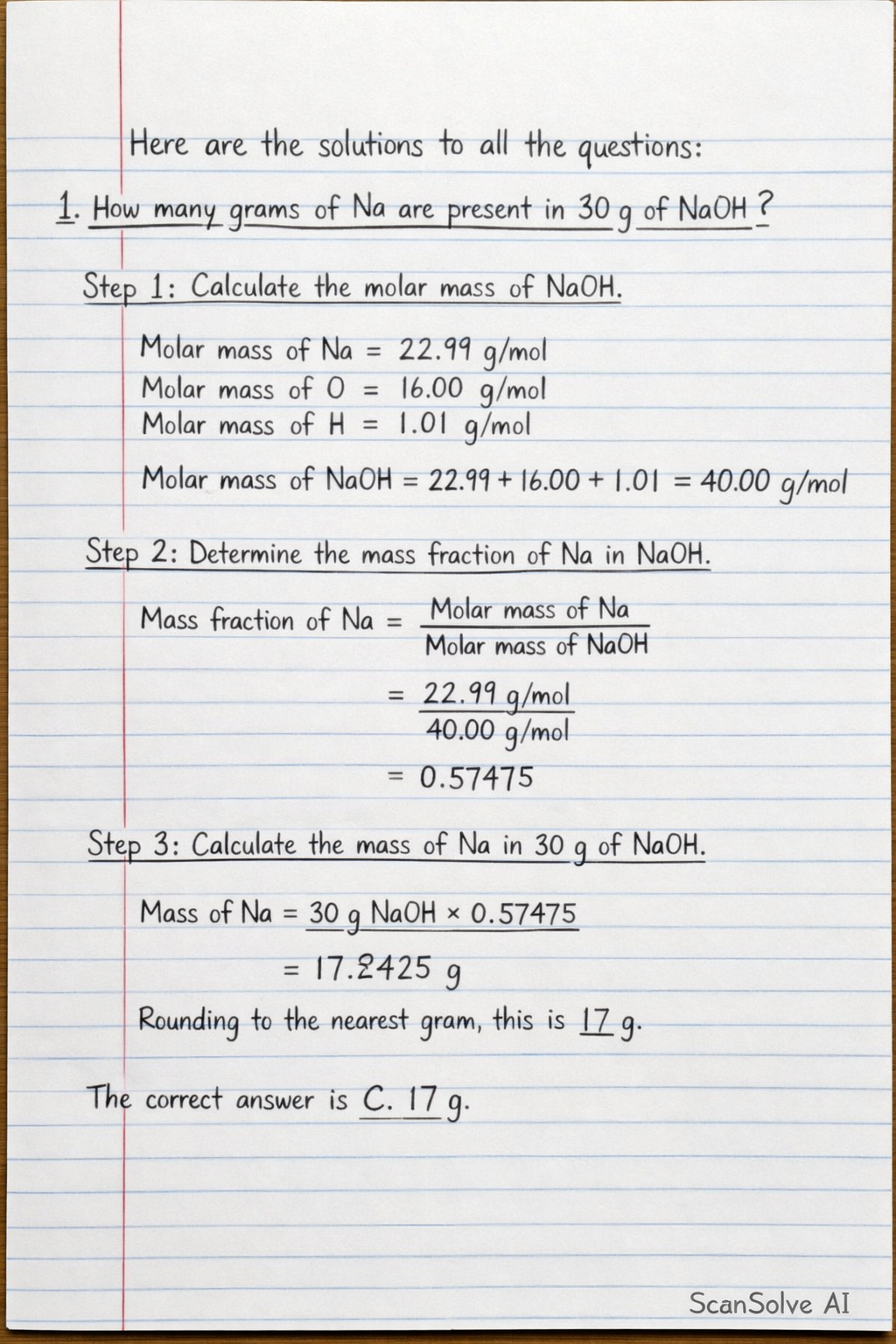
5 stepsHere are the solutions to all the questions:
How many grams of Na are present in 30 g of NaOH?
- Step 1: Calculate the molar mass of NaOH. Molar mass of Na = Molar mass of O = Molar mass of H = Molar mass of NaOH =
- Step 2: Determine the mass fraction of Na in NaOH. Mass fraction of Na =
- Step 3: Calculate the mass of Na in 30 g of NaOH. Mass of Na = Rounding to the nearest gram, this is .
The correct answer is C. 17 g.
How many liters of H₂ can be produced by the decomposition of 3 moles of NH₃ at STP?
- Step 1: Write the balanced chemical equation for the decomposition of NH₃.
- Step 2: Use stoichiometry to find the moles of H₂ produced from 3 moles of NH₃. From the equation, 2 moles of produce 3 moles of . Moles of
- Step 3: Convert moles of H₂ to liters at STP. At Standard Temperature and Pressure (STP), 1 mole of any ideal gas occupies . Volume of Rounding to the nearest liter, this is .
The correct answer is D. 101 L.
If you collected a sample of 3.50 moles of hydrogen gas, H₂, and heated it in a 10.00 liter container to a temperature of 300K, how much pressure would the H₂ exert on the container?
- Step 1: Identify the given values. Number of moles () = Volume () = Temperature () = Ideal gas constant () =
- Step 2: Use the Ideal Gas Law () to solve for pressure ().
- Step 3: Substitute the values and calculate . Rounding to three significant figures, .
The correct answer is C. 8.62 atm.
Molarity is defined as the number of
Molarity is a measure of the concentration of a solute in a solution. It is defined as the number of moles of solute dissolved per liter of solution.
The correct answer is C. moles of solute per liter of solution.
A 22 gram sample of an unknown gas occupies 11.2 liters at standard temperature and pressure. Which of the following could be the identity of the gas?
- Step 1: Calculate the moles of the gas at STP. At STP, 1 mole of any ideal gas occupies . Moles of gas =
- **Step 2: Calculate the molar
Was this helpful?
Try one yourself
A new problem that tests the same skill.
Still stuck on this one?
Ask a follow-up, and the answer starts from this question.
Got a different question?Ask your own question
More Chemistry Questions
QHow many grams of Na are present in 30 g of NaOH?QII. Write an equation for the reaction in which sodium hydroxide was produced. (b) If the mass of…QCalculate the moles of sodium hydroxide (NaOH) used.QA mixture of NaOH and NaCl weighs 2.0g and is dissolved in 250 cm3 of water. A 25.0 cm3 aliquot is…QCalculate the mass of sodium hydroxide produced from 2.3 g of sodium reacting with water.
Handwritten Step-by-Step Solution
Get this as a handwritten image on WhatsApp — like a tutor wrote it for you.
Try on WhatsApp