
We read your photo as:
Which of the following reactions is accompanied by a decrease in entropy?
ScanSolve AI Answer
Step-by-step solution
4 stepsAnalyze the change in the number of moles of gas for each reaction.
A decrease in entropy () typically occurs when the number of moles of gas decreases.
-
A. Reactant moles of gas = 1 Product moles of gas = 2 Change in moles of gas () = . Entropy increases.
-
B. Reactant moles of gas = Product moles of gas = 2 Change in moles of gas () = . Entropy decreases.
-
C. Reactant moles of gas = 0 Product moles of gas = 1 Change in moles of gas () = . Entropy increases.
-
D. Reactant moles of gas = 0 (both are liquids) Product moles of gas = 3 Change in moles of gas () = . Entropy increases.
The reaction accompanied by a decrease in entropy is B.
The final answer is
-
Calculate the molar mass of anhydrous copper (II) oxosulphate (VI), which is .
Given atomic masses: , , .
Calculate the number of moles of .
Given mass of .
Calculate the heat of solution.
Heat generated = .
Since heat was generated, the process is exothermic, and the enthalpy change would be . However, the options provide the magnitude.
The final answer is
Still stuck on this one?
Ask a follow-up, and the answer starts from this question.
More Chemistry Questions
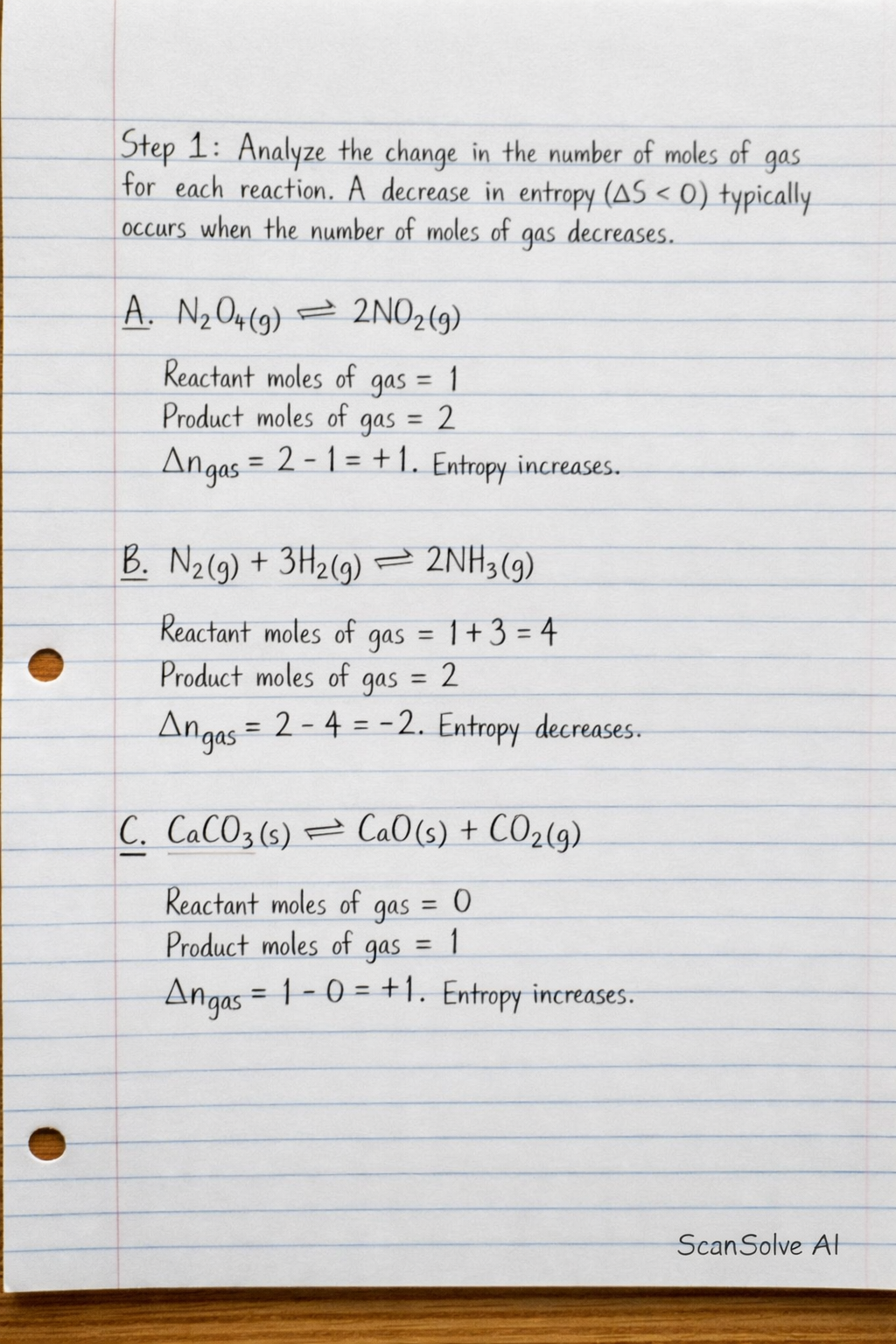
Handwritten Step-by-Step Solution
Get this as a handwritten image on WhatsApp — like a tutor wrote it for you.
Try on WhatsApp