

This chemistry question involves key chemical concepts and calculations. The detailed solution below walks through each step, from identifying the reaction type to computing the final answer.
ScanSolve AI Answer
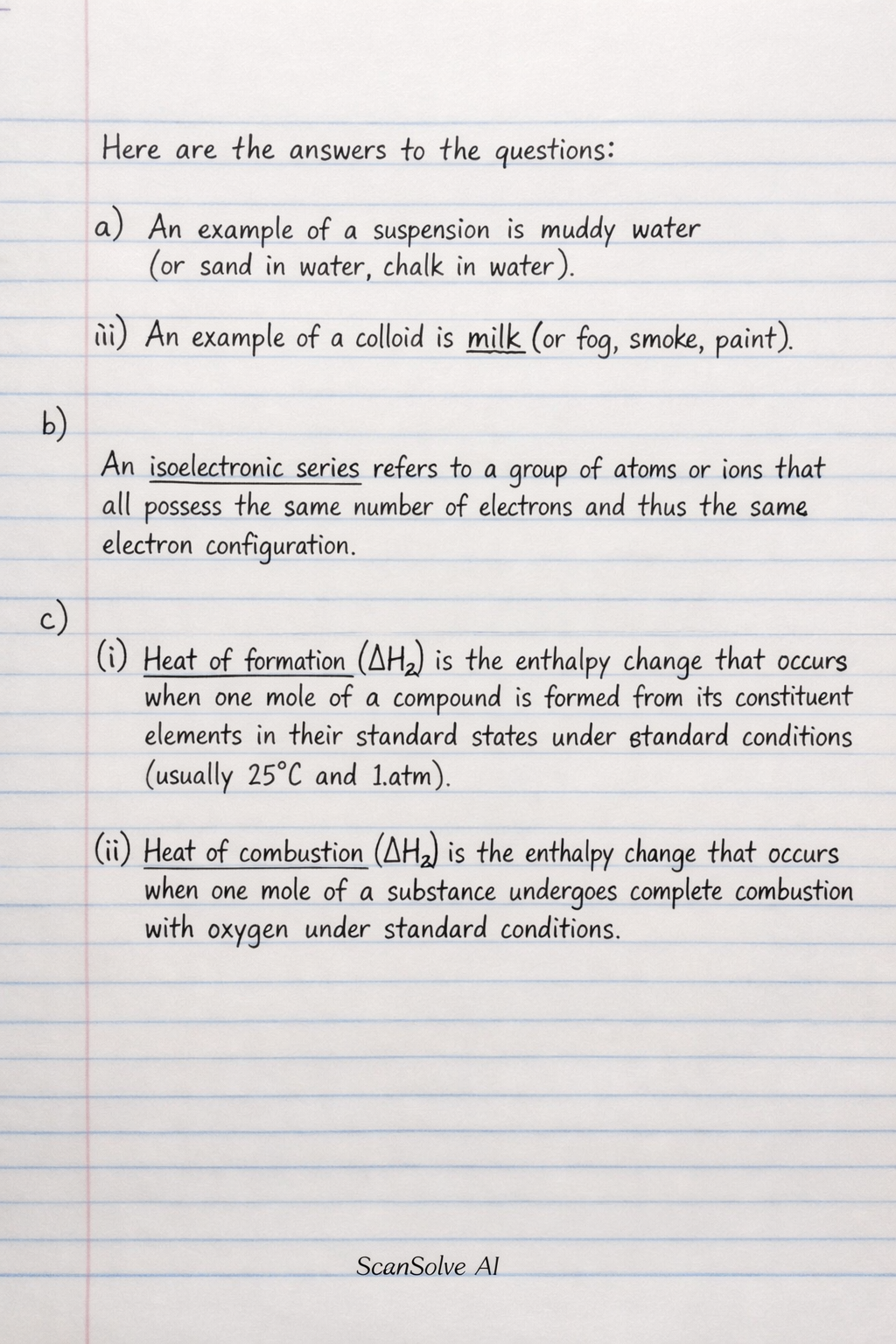
Here are the answers to the questions: a) (i) An example of a suspension is muddy water (or sand in water, chalk in water). (ii) An example of a colloid is milk (or fog, smoke, paint). b) An isoelectronic series refers to a group of atoms or ions that all possess the same number of electrons and thus the same electron configuration. c) (i) Heat of formation ( H_f) is the enthalpy change that occurs when one mole of a compound is formed from its constituent elements in their standard states under standard conditions (usually 25^ and 1 atm). (ii) Heat of combustion ( H_c) is the enthalpy change that occurs when one mole of a substance undergoes complete combustion with oxygen under standard conditions. d) Helium is generally not used as a rocket fuel because it is an inert gas and does not combust to release energy. Hydrogen, on the other hand, is a highly effective rocket fuel due to its high energy density and specific impulse when combusted with an oxidizer like oxygen. However, if the question is referring to the use of gases within a rocket system, helium is often preferred over hydrogen as a pressurant for cryogenic fuel tanks (like liquid hydrogen or liquid oxygen tanks) because: • Helium is inert and non-flammable, making it much safer to handle and store compared to highly flammable and explosive hydrogen. • Helium has an extremely low boiling point, allowing it to remain gaseous and effectively pressurize tanks even at the very low temperatures required for cryogenic fuels without condensing. What's next? 📸