We read your photo as:

Pour la réaction 2A(g) + 4B(g) <=> 3C(g) + D(g), si les quantités initiales sont 5 mol de A, 6 mol de B, 1 mol de C et 2 mol de D, et qu'à l'équilibre il reste 3 mol de D, quelles sont les quantités d

Chemistry

ScanSolve AI Answer

Step-by-step solution

5 steps

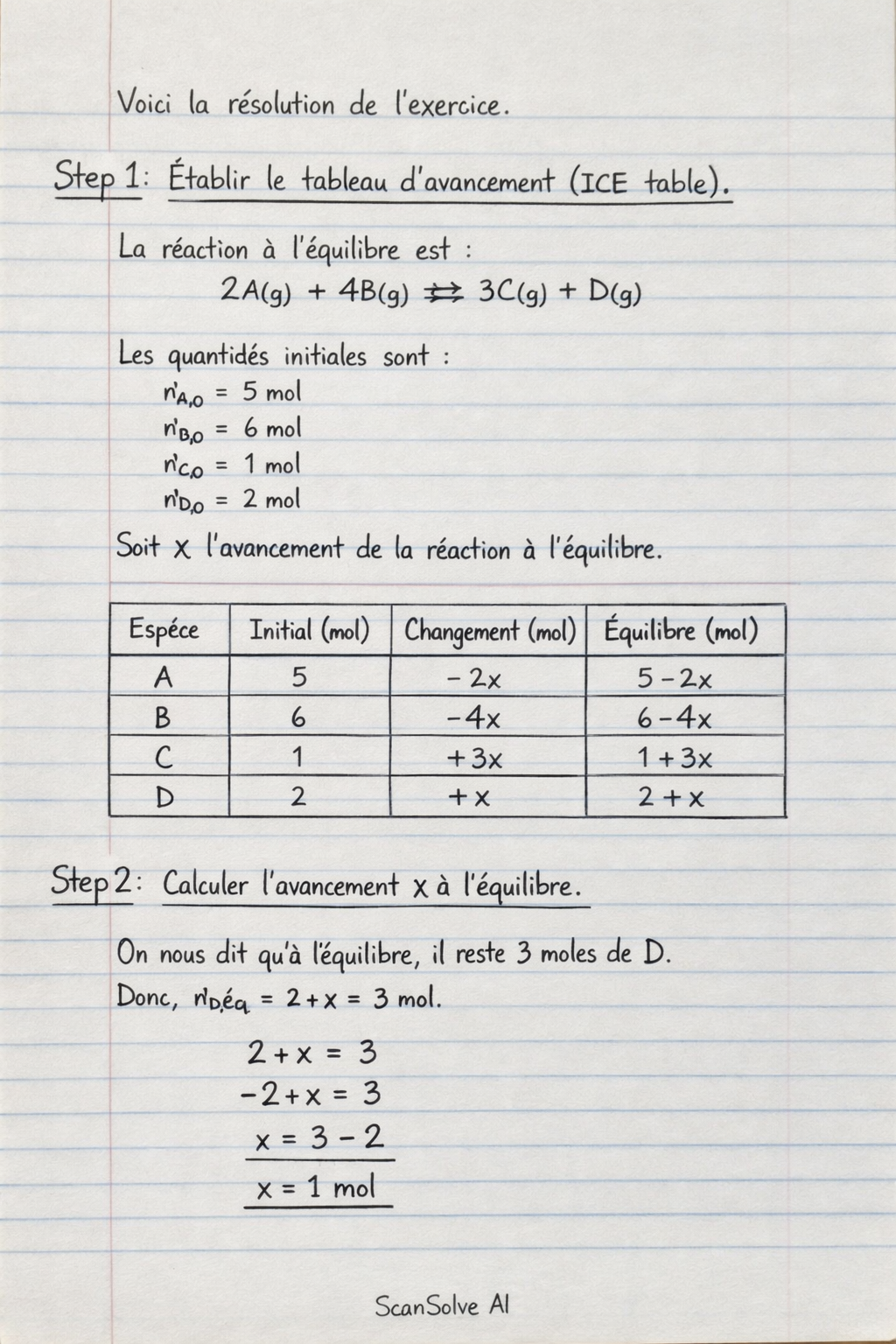
Voici la résolution de l'exercice.

  1. Établir le tableau d'avancement (ICE table).

    La réaction à l'équilibre est :

    2A(g)+4B(g)⇌3C(g)+D(g)2A_{(g)} + 4B_{(g)} \rightleftharpoons 3C_{(g)} + D_{(g)}

    Les quantités initiales sont :
    nA,0=5 moln_{A,0} = 5 \text{ mol}
    nB,0=6 moln_{B,0} = 6 \text{ mol}
    nC,0=1 moln_{C,0} = 1 \text{ mol}
    nD,0=2 moln_{D,0} = 2 \text{ mol}

    Soit xx l'avancement de la réaction à l'équilibre.

    EspèceInitial (mol)Changement (mol)Équilibre (mol)
    A5−2x-2x5−2x5 - 2x
    B6−4x-4x6−4x6 - 4x
    C1+3x+3x1+3x1 + 3x
    D2+x+x2+x2 + x
  2. Calculer l'avancement xx à l'équilibre.

    On nous dit qu'à l'équilibre, il reste 3 moles de D.
    Donc, nD,eq=2+x=3 moln_{D,eq} = 2 + x = 3 \text{ mol}.
    En résolvant pour xx:

    x=3−2=1 molx = 3 - 2 = 1 \text{ mol}
  3. Calculer les quantités de matière de A, B et C à l'équilibre.

    En utilisant la valeur de x=1 molx = 1 \text{ mol} dans les expressions d'équilibre :

    nA,eq=5−2x=5−2(1)=3 moln_{A,eq} = 5 - 2x = 5 - 2(1) = 3 \text{ mol} nB,eq=6−4x=6−4(1)=2 moln_{B,eq} = 6 - 4x = 6 - 4(1) = 2 \text{ mol} nC,eq=1+3x=1+3(1)=4 moln_{C,eq} = 1 + 3x = 1 + 3(1) = 4 \text{ mol}

    Les quantités de matière à l'équilibre sont : nA=3 moln_A = \textbf{3 mol}, nB=2 moln_B = \textbf{2 mol}, nC=4 moln_C = \textbf{4 mol}.

  4. Calculer la quantité de matière totale à l'équilibre.

    La quantité de matière totale à l'équilibre est la somme des moles de tous les gaz :

    ntotal,eq=nA,eq+nB,eq+nC,eq+nD,eqn_{total,eq} = n_{A,eq} + n_{B,eq} + n_{C,eq} + n_{D,eq} ntotal,eq=3 mol+2 mol+4 mol+3 moln_{total,eq} = 3 \text{ mol} + 2 \text{ mol} + 4 \text{ mol} + 3 \text{ mol} ntotal,eq=12 moln_{total,eq} = 12 \text{ mol}
  5. Calculer la pression totale à l'équilibre.

    Nous utilisons la loi des gaz parfaits : PtotalV=ntotal,eqRTP_{total}V = n_{total,eq}RT.
    Où :
    V=20 LV = 20 \text{ L}
    T=300 KT = 300 \text{ K}
    ntotal,eq=12 moln_{total,eq} = 12 \text{ mol}
    R=0.08206 L⋅atm⋅mol−1⋅K−1R = 0.08206 \text{ L} \cdot \text{atm} \cdot \text{mol}^{-1} \cdot \text{K}^{-1} (constante des gaz parfaits)

    En réarrangeant la formule pour PtotalP_{total} :

    Ptotal=ntotal,eqRTVP_{total} = \frac{n_{total,eq}RT}{V} Ptotal=(12 mol)×(0.08206 L⋅atm⋅mol−1⋅K−1)×(300 K)20 LP_{total} = \frac{(12 \text{ mol}) \times (0.08206 \text{ L} \cdot \text{atm} \cdot \text{mol}^{-1} \cdot \text{K}^{-1}) \times (300 \text{ K})}{20 \text{ L}} Ptotal=295.416 L⋅atm20 LP_{total} = \frac{295.416 \text{ L} \cdot \text{atm}}{20 \text{ L}} Ptotal=14.7708 atmP_{total} = 14.7708 \text{ atm}

    En arrondissant à trois chiffres significatifs :

    Ptotal≈14.8 atmP_{total} \approx \textbf{14.8 atm}

    Les quantités de matière à l'équilibre sont :
    nA=3 moln_A = \boxed{\textbf{3 mol}}
    nB=2 moln_B = \boxed{\textbf{2 mol}}
    nC=4 moln_C = \boxed{\textbf{4 mol}}
    La pression totale à l'équilibre est :
    Ptotal=14.8 atmP_{total} = \boxed{\textbf{14.8 atm}}

Was this helpful?

Still stuck on this one?

Ask a follow-up, and the answer starts from this question.

Got a different question?Ask your own question
Handwritten step-by-step solution preview

Handwritten Step-by-Step Solution

Get this as a handwritten image on WhatsApp — like a tutor wrote it for you.

Try on WhatsApp