
Prepare me a comprehensive note on the following topics in chemistry with Sierra Leone NCTVA standard: 1. Organic chemistry 2. Nature of matter and separating technique 3. Laws of chemical combination 4. Experiment discoveries of atomic particles 5. Hydrocarbons and industrial chemistry 6. Volumetric analysis 7. Chemical equilibrium 8. Oxygen and it's compound 9. Halogens and their compound 10. Alkanols, alkanoic, alkanoates 11. Radioactivity 12. Extraction and properties of transition metals 13. Water and solution
ScanSolve AI Answer
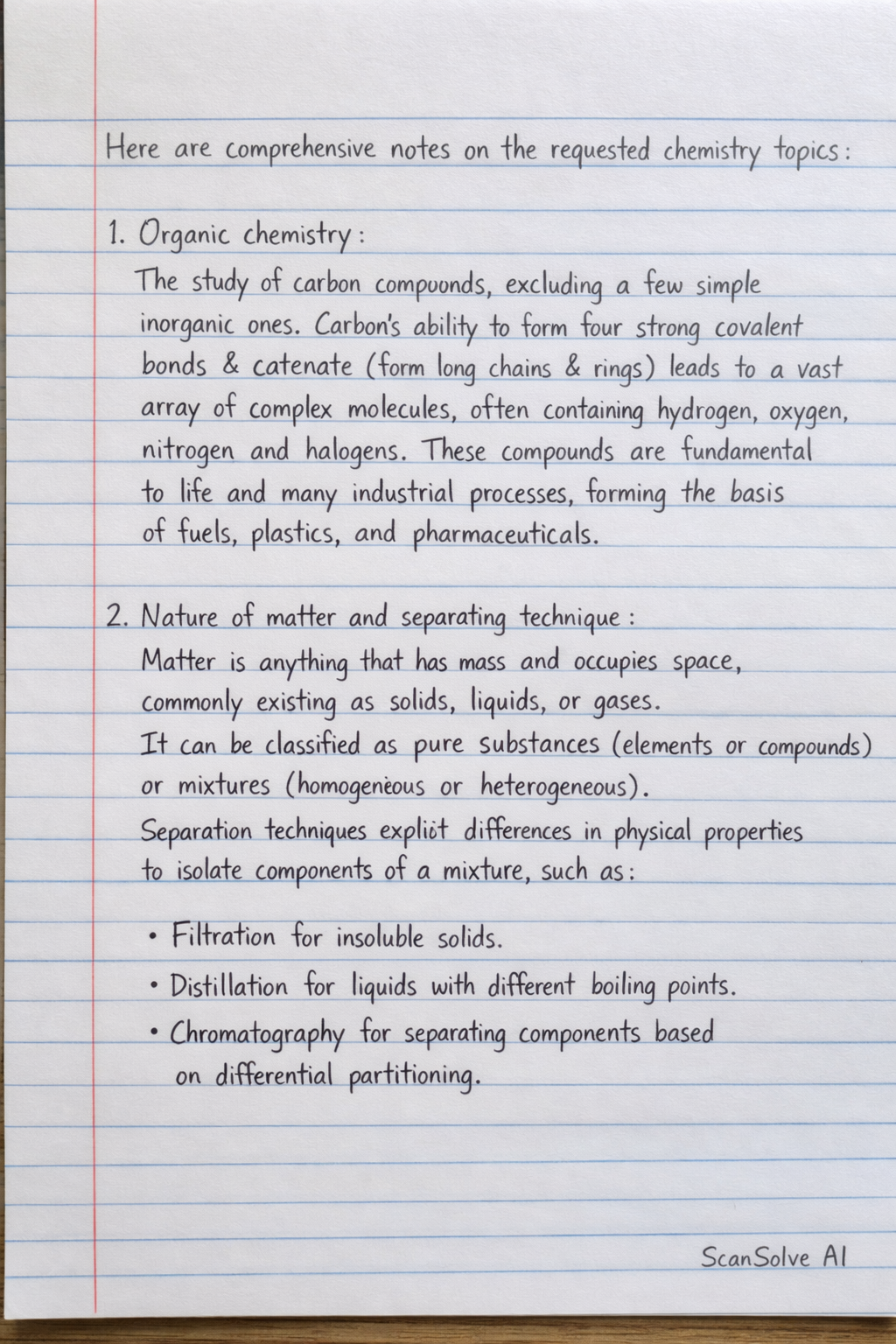
Here are comprehensive notes on the requested chemistry topics:
-
Organic chemistry: The study of carbon compounds, excluding a few simple inorganic ones. Carbon's ability to form four strong covalent bonds and catenate (form long chains and rings) leads to a vast array of complex molecules, often containing hydrogen, oxygen, nitrogen, and halogens. These compounds are fundamental to life and many industrial processes, forming the basis of fuels, plastics, and pharmaceuticals.
-
Nature of matter and separating technique: Matter is anything that has mass and occupies space, commonly existing as solids, liquids, or gases. It can be classified as pure substances (elements or compounds) or mixtures (homogeneous or heterogeneous). Separation techniques exploit differences in physical properties to isolate components of a mixture, such as filtration for insoluble solids, distillation for liquids with different boiling points, and chromatography for separating components based on differential partitioning.
-
Laws of chemical combination: These fundamental laws govern how elements combine to form compounds. The Law of Conservation of Mass states that mass is neither created nor destroyed in a chemical reaction. The Law of Definite Proportions indicates that a pure chemical compound always contains the same elements in the same proportion by mass. The Law of Multiple Proportions applies when two elements form more than one compound, stating that the masses of one element that combine with a fixed mass of the other are in simple whole-number ratios.
-
Experiment discoveries of atomic particles: The understanding of atomic structure evolved through key experiments. J.J. Thomson discovered the negatively charged electron using cathode ray tubes. Ernest Rutherford's gold foil experiment led to the discovery of the positively charged nucleus and the proton, showing that most of an atom's mass is concentrated in a tiny central region. James Chadwick later discovered the neutral neutron.
-
Hydrocarbons and industrial chemistry: Hydrocarbons are organic compounds composed solely of carbon and hydrogen atoms, forming the basis of many fuels and petrochemicals. They are classified as alkanes (single bonds), alkenes (at least one double bond), and alkynes (at least one triple bond). Industrial chemistry involves the large-scale production of chemicals, often starting from crude oil through processes like fractional distillation to separate hydrocarbons by boiling point and cracking to break larger molecules into smaller, more useful ones.
-
Volumetric analysis: A quantitative analytical technique used to determine the concentration of a substance in solution. It typically involves titration, where a solution of known concentration (standard solution) is gradually added to a solution of unknown concentration until the reaction is complete. An indicator is often used to signal the endpoint of the reaction, which is close to the equivalence point where reactants have reacted stoichiometrically.
-
Chemical equilibrium: A state in a reversible reaction where the rate of the forward reaction equals the rate of the reverse reaction, resulting in no net change in reactant and product concentrations. This is a dynamic equilibrium where reactions continue to occur in both directions. Le Chatelier's principle describes how a system at equilibrium responds to a disturbance (change in temperature, pressure, or concentration) by shifting to counteract the change and re-establish equilibrium.
-
Oxygen and its compounds: Oxygen is a highly reactive non-metal, essential for respiration and combustion, existing as a diatomic molecule (). It forms oxides with most elements, which can be acidic (e.g., ), basic (e.g., ), amphoteric (e.g., ), or neutral (e.g., ). Water () is its most important compound, crucial for life and as a solvent.
-
Halogens and their compounds: The halogens are Group 17 elements (fluorine, chlorine, bromine, iodine, astatine), highly reactive non-metals that readily gain an electron to form halide ions. Their reactivity decreases down the group. They form halides with metals (e.g., ) and various covalent compounds with non-metals, including hydrogen halides (e.g., ) and interhalogen compounds. Chlorine is widely used for water purification and as a bleaching agent.
-
Alkanols, alkanoic, alkanoates: Alkanols (alcohols) contain the hydroxyl functional group (), making them polar and capable of hydrogen bonding, leading to higher boiling points than corresponding alkanes. Alkanoic acids (carboxylic acids) contain the carboxyl functional group (), making them weak acids that react with bases and metals. Alkanoates (esters) are derivatives of alkanoic acids formed by reaction with alkanols, characterized by the ester functional group (), often having pleasant, fruity smells.
-
Radioactivity: The spontaneous emission of radiation from the unstable nuclei of certain atoms. This process, known as radioactive decay, can involve the emission of alpha particles (, helium nuclei), beta particles (, electrons or positrons), or gamma rays (, high-energy electromagnetic radiation). The half-life is the time taken for half of the radioactive nuclei in a sample to decay. Radioactivity has applications in medicine, energy, and dating, but also poses health risks due to ionizing radiation.
-
Extraction and properties of transition metals: Transition metals are elements in the d-block of the periodic table, characterized by partially filled d-orbitals. They typically exhibit variable oxidation states, form colored compounds in solution, and act as catalysts in many reactions. Their extraction often involves reduction of their ores, such as the use of a blast furnace for iron, or electrolysis for more reactive metals like copper.
-
Water and solution: Water () is a polar molecule with unique properties due to hydrogen bonding, making it an excellent universal solvent. A solution is a homogeneous mixture formed when a solute dissolves in a solvent. Solubility is the maximum amount of solute that can dissolve in a given amount of solvent at a specific temperature, forming saturated, unsaturated, or supersaturated solutions. Water's high specific heat capacity and latent heat of vaporization are also crucial for regulating temperature.
Still stuck on this one?
Ask a follow-up, and the answer starts from this question.
More Chemistry Questions
Handwritten Step-by-Step Solution
Get this as a handwritten image on WhatsApp — like a tutor wrote it for you.
Try on WhatsApp