
This chemistry question involves key chemical concepts and calculations. The detailed solution below walks through each step, from identifying the reaction type to computing the final answer.
ScanSolve AI Answer
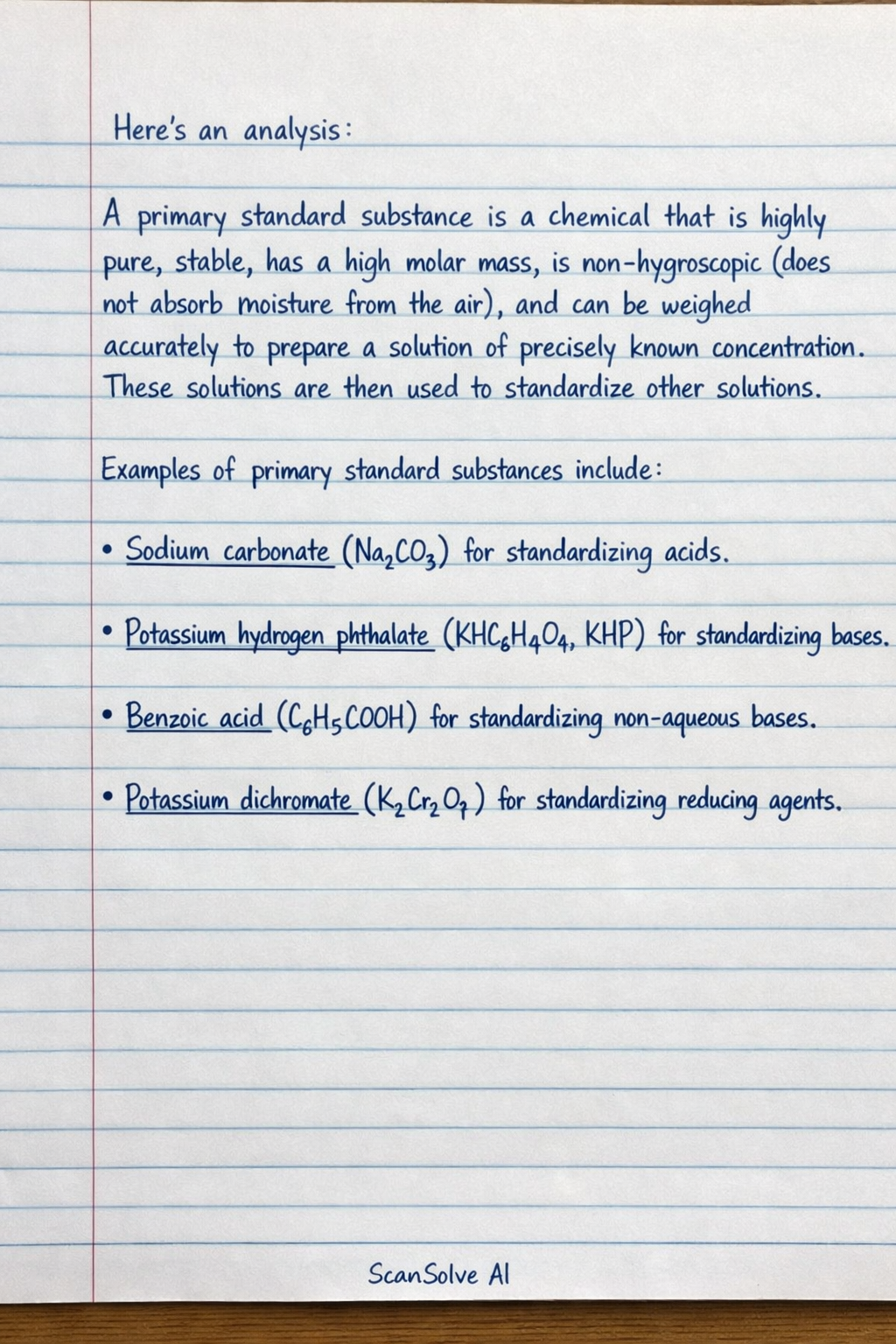
A primary standard substance is a chemical that is highly pure, stable, has a high molar mass, is non-hygroscopic (does not absorb moisture from the air), and can be weighed accurately to prepare a solution of precisely known concentration. These solutions are then used to standardize other solutions. Examples of primary standard substances include: • Sodium carbonate (Na_2CO_3) for standardizing acids. • Potassium hydrogen phthalate (KHC_8H_4O_4, KHP) for standardizing bases. • Benzoic acid (C_6H_5COOH) for standardizing non-aqueous bases. • Potassium dichromate (K_2Cr_2O_7) for standardizing reducing agents. Drop the next question.