
We read your photo as:
Provide the IUPAC names for the following coordination compounds: i. [CrCl2(H2O)4]NO3 ii. [Pd(ONO)2(H2O)2I2] iii. (NH4)3[Fe(CN)6]
ScanSolve AI Answer
Answers
5 partsStep-by-step solution
19 stepsHere are the names for the given coordination compounds:
Part i· 3 steps
Identify the ligands and their charges.
Chloro () has a -1 charge, aqua () is neutral. The counter ion is nitrate (), which has a -1 charge.
Determine the oxidation state of chromium (Cr).
Name the complex cation and anion.
Ligands are named alphabetically: aqua, chloro.
Name: Dichlorotetraaquachromium(III) nitrate
Part ii
Identify the ligands and their charges.
Nitrito-O () has a -1 charge, aqua () is neutral, iodo () has a -1 charge. This is a neutral complex.
Determine the oxidation state of palladium (Pd).
Name the complex.
Ligands are named alphabetically: aqua, iodo, nitrito-O.
Name: Diaquadiododinitrito-O-palladium(IV)
Part iii
Identify the cation and ligands.
The cation is ammonium (). The ligand is cyano (), which has a -1 charge.
Determine the charge of the complex anion.
Since there are three ions, the complex anion must have a -3 charge.
Determine the oxidation state of iron (Fe).
Name the complex.
The metal in an anionic complex ends with "-ate".
Name: Ammonium hexacyanoferrate(III)
Part iv
Identify the cation and ligands.
The cation is ammonium (). The ligand is cyano (), which has a -1 charge.
Determine the charge of the complex anion.
Since there are four ions, the complex anion must have a -4 charge.
Determine the oxidation state of iron (Fe).
Name the complex.
The metal in an anionic complex ends with "-ate".
Name: Ammonium hexacyanoferrate(II)
Part v
Identify the ligand and counter ion.
The ligand is ammine (), which is neutral. The counter ion is bromide (), which has a -1 charge.
Determine the charge of the complex cation.
Since there are three ions, the complex cation must have a +3 charge.
Determine the oxidation state of chromium (Cr).
Name the complex cation and anion.
Name: Hexaamminechromium(III) bromide
Part vi· 1 step
Identify the ligands and their charges.
Cyano () has a -1 charge, nitrito-O () has a -1 charge, ammine () is neutral. This is a neutral complex.
Try one yourself
A new problem that tests the same skill.
Still stuck on this one?
Ask a follow-up, and the answer starts from this question.
More Chemistry Questions
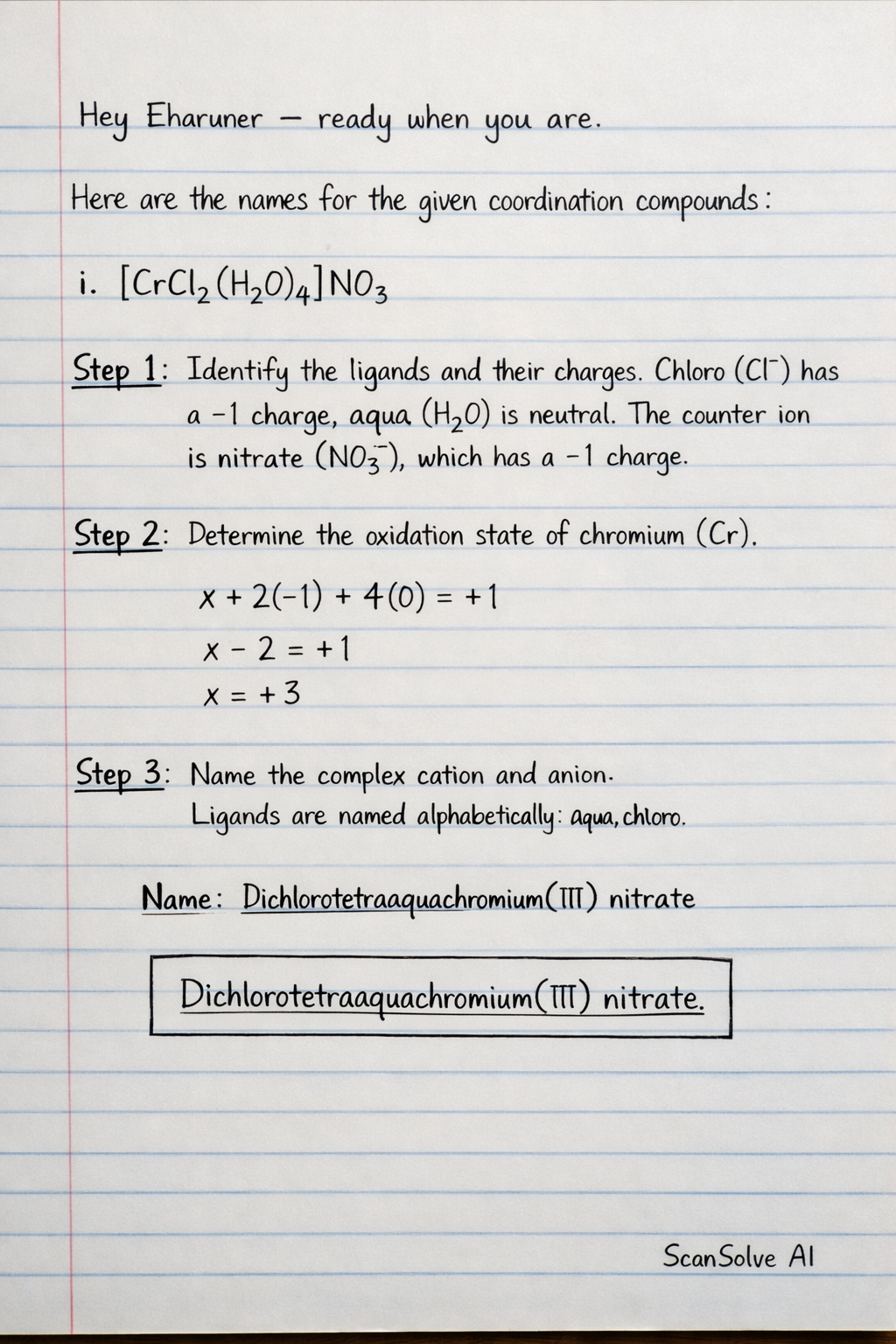
Handwritten Step-by-Step Solution
Get this as a handwritten image on WhatsApp — like a tutor wrote it for you.
Try on WhatsApp