

This chemistry question involves key chemical concepts and calculations. The detailed solution below walks through each step, from identifying the reaction type to computing the final answer.
ScanSolve AI Answer
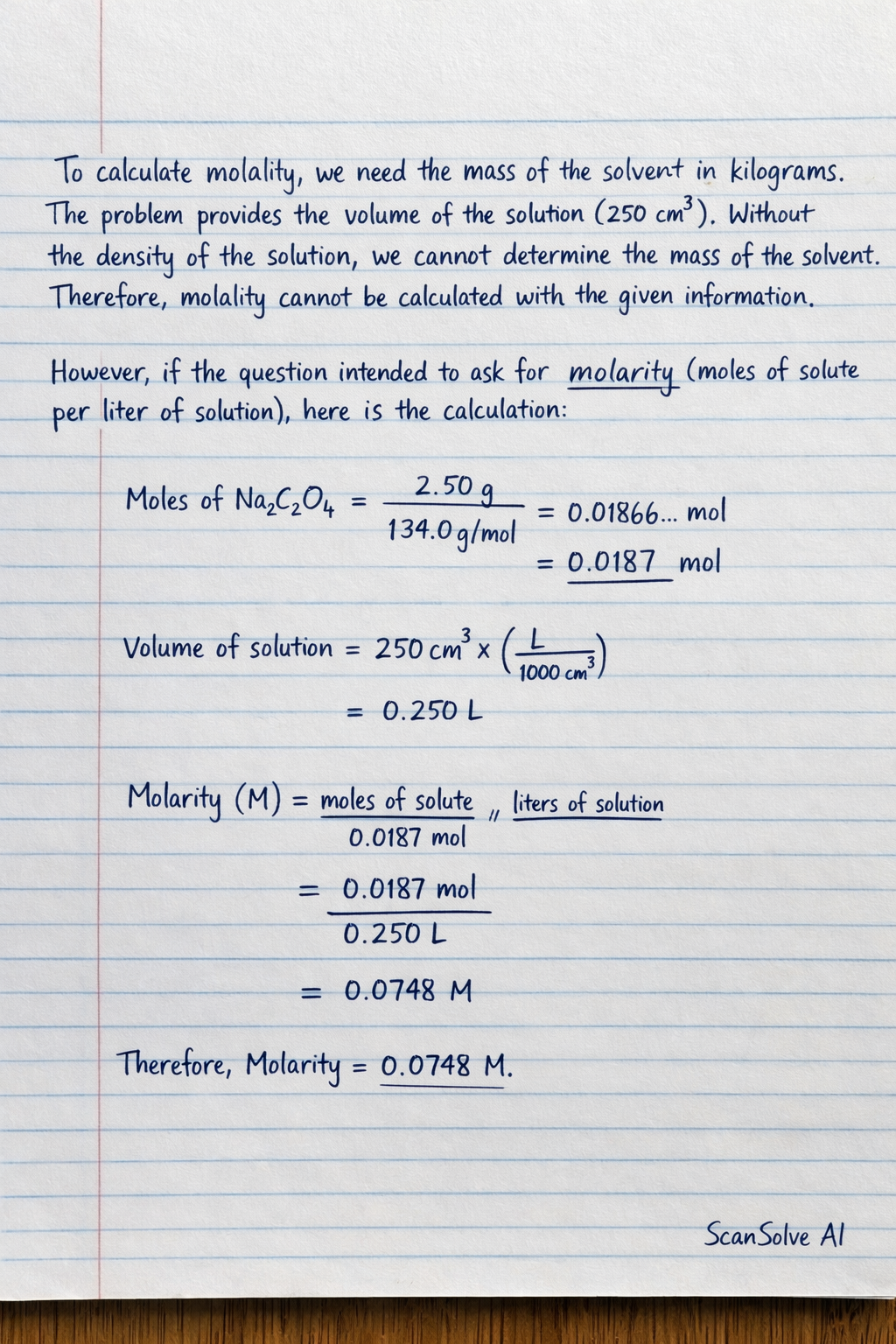
It looks like my previous message was cut off. I'll complete the remaining parts of your questions and address the ones that were not fully answered. a) ii) Calculate the molality of the solution containing 2.50g of Na oxalate C2O4 in 250 cm³ of solution. To calculate molality, we need the mass of the solvent in kilograms. The problem provides the volume of the solution (250 cm³). Without the density of the solution, we cannot determine the mass of the solvent. Therefore, molality cannot be calculated with the given information. However, if the question intended to ask for molarity (moles of solute per liter of solution), here is the calculation: Step 1: Calculate the molar mass of sodium oxalate (Na_2C_2O_4). Molar mass of Na = 22.99 g/mol Molar mass of C = 12.01 g/mol Molar mass of O = 16.00 g/mol M(Na_2C_2O_4) = (2 × 22.99) + (2 × 12.01) + (4 × 16.00) M(Na_2C_2O_4) = 45.98 + 24.02 + 64.00 = 134.00 g/mol Step 2: Calculate the number of moles of Na_2C_2O_4. Moles = MassMolar mass = 2.50 g134.00 g/mol ≈ 0.01866 mol Step 3: Convert the volume of the solution to dm^3 (liters). Volume = 250 cm^3 = 250 × 10^-3 dm^3 = 0.250 dm^3 Step 4: Calculate the molarity. Molarity = Moles of soluteVolume of solution (dm^3) = 0.01866 mol0.250 dm^3 Molarity ≈ 0.0746 mol dm^-3 The molarity of the solution is 0.0746 mol dm^-3. b) 0.13g of a liquid was evaporated in a 500cm³ flask at 25°C. If the pressure of the liquid was found to be 152mmHg, what is the relative molecular mass of the liquid? Step 1: Convert the given values to appropriate units for the ideal gas law. Mass (m) = 0.13 g Volume (V) = 500 cm^3 = 0.500 L Temperature (T) = 25^ = 25 + 273.15 = 298.15 K Pressure (P) = 152 mmHg Convert pressure from mmHg to atmospheres (atm): P = 152 mmHg × 1 atm760 mmHg = 0.20 atm The ideal gas constant (R) is 0.0821 L atm mol^-1 K^-1. Step 2: Use the ideal gas law to find the number of moles (n). The ideal gas law is PV = nRT. Rearranging for n: n = (PV)/(RT) = (0.20 atm) × (0.500 L)(0.0821 L atm mol^-1 K^-1) × (298.15 K) n = (0.10)/(24.47) ≈ 0.004086 mol Step 3: Calculate the relative molecular mass (M_r). The number of moles (n) is also equal to massmolar mass. n = (m)/(M_r) M_r = (m)/(n) M_r = 0.13 g0.004086 mol ≈ 31.81 g/mol Rounding to two significant figures (due to 0.13 g and 0.20 atm): The relative molecular mass of the liquid is 32 g/mol. c) Indium has a half life of 12.23 years. This is a statement of fact and does not contain a question to be answered. g) i) How does electronic affinity of group VII element down the group? Electronic affinity generally decreases down Group VII. This trend occurs because as you move down the group, the atomic radius increases, meaning the outermost electrons are further from the nucleus. The increased shielding effect from inner electron shells also reduces the effective nuclear charge experienced by an incoming electron. Both factors lead to a weaker attraction for an additional electron, thus decreasing the energy released (or increasing the energy required) when an electron is added to the atom. The other questions (a ✂️ _That answer was long and got cut off. Reply continue and I'll finish it._