

This chemistry question involves key chemical concepts and calculations. The detailed solution below walks through each step, from identifying the reaction type to computing the final answer.
ScanSolve AI Answer
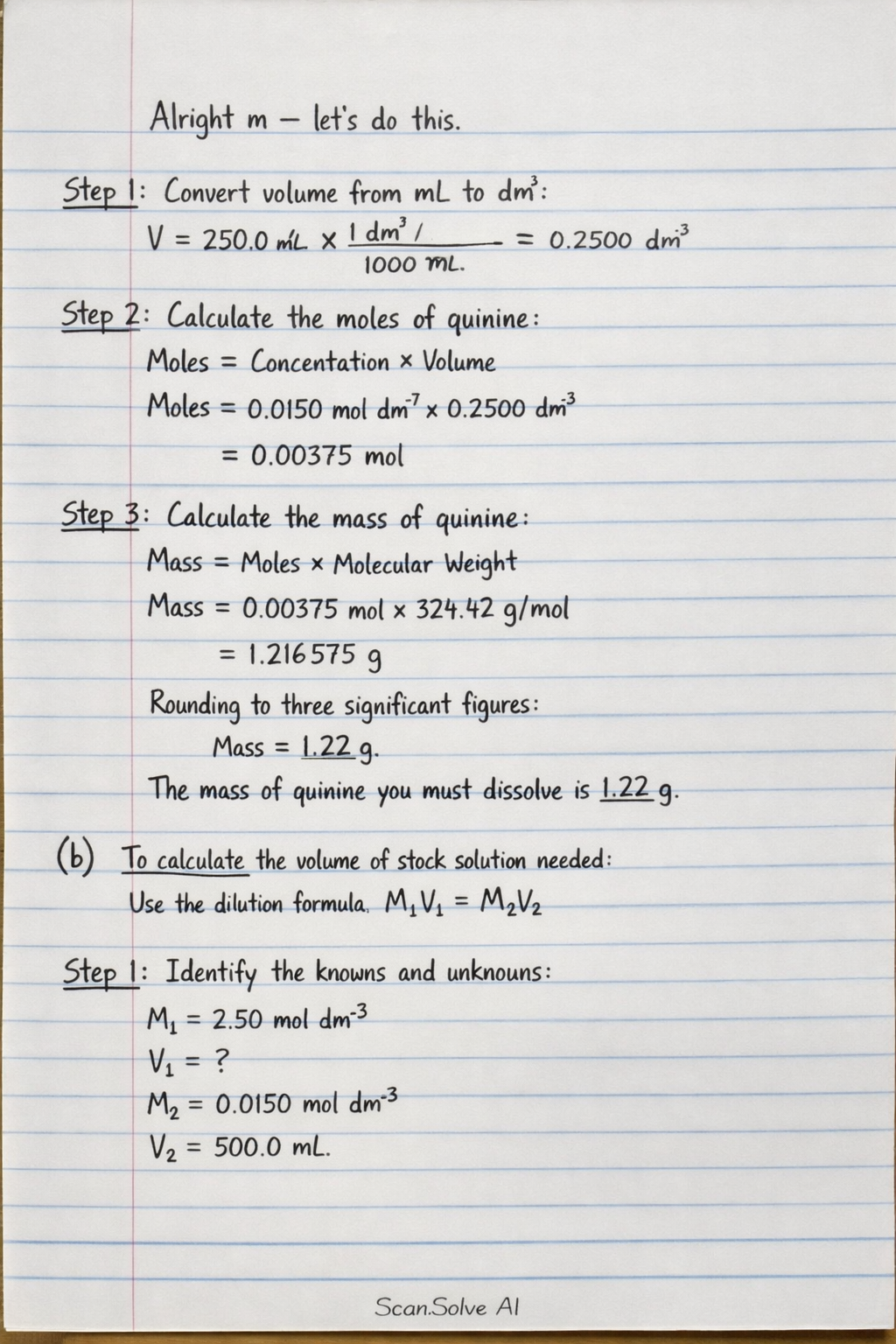
a) To calculate the mass of quinine needed, first convert the volume to dm³, then calculate the moles, and finally the mass. Step 1: Convert volume from mL to dm³. V = 250.0 mL × 1 dm^31000 mL = 0.2500 dm^3 Step 2: Calculate the moles of quinine. Moles = Concentration × Volume Moles = 0.0150 mol dm^-3 × 0.2500 dm^3 = 0.00375 mol Step 3: Calculate the mass of quinine. Mass = Moles × Molecular Weight Mass = 0.00375 mol × 324.42 g/mol = 1.216575 g Rounding to three significant figures based on the given concentration: Mass = 1.22 g The mass of quinine you must dissolve is 1.22 g. b) To calculate the volume of stock solution needed, use the dilution formula M_1V_1 = M_2V_2. Step 1: Identify the knowns and unknowns. M_1 = 2.50 mol dm^-3 V_1 = ? M_2 = 0.0150 mol dm^-3 V_2 = 500.0 mL Step 2: Apply the dilution formula and solve for V_1. M_1V_1 = M_2V_2 (2.50 mol dm^-3) × V_1 = (0.0150 mol dm^-3) × (500.0 mL) V_1 = (0.0150 mol dm^-3) × (500.0 mL)2.50 mol dm^-3 V_1 = 7.50 mol mL2.50 mol V_1 = 3.00 mL The volume of stock solution needed is 3.00 mL. c) To calculate the percent by mass of Bromine, divide the atomic mass of Bromine by the molecular mass of the derivative and multiply by 100%. Step 1: Identify the mass of Bromine in one mole of C₂₀H₂₃BrN₂O₂. Mass of Br = 79.90 g/mol Step 2: Calculate the percent by mass of Bromine. Percent by mass of Br = Mass of BrMolecular Weight of C_20H_23BrN_2O_2 × 100\% Percent by mass of Br = 79.90 g/mol404.32 g/mol × 100\% Percent by mass of Br = 0.19760096 × 100\% Percent by mass of Br = 19.760096\% Rounding to two decimal places: Percent by mass of Br = 19.76\% The percent by mass of Bromine in the monobrominated derivative is 19.76\%. d) To find the moles of quinine alkaloid, first convert the dose to grams, then calculate moles of quinine sulfate, and finally use the mole ratio to find moles of quinine alkaloid. Step 1: Convert the dose of quinine sulfate from mg to g. Mass of quinine sulfate = 650 mg × 1 g1000 mg = 0.650 g Step 2: Calculate the moles of quinine sulfate. Moles of quinine sulfate = MassMolecular Weight Moles of quinine sulfate = 0.650 g782.96 g/mol = 0.00083015 mol Step 3: Use the mole ratio to find moles of quinine alkaloid. The hint states that each mole of quinine sulfate salt contains 2 moles of quinine alkaloid. Moles of quinine alkaloid = Moles of quinine sulfate × 2 Moles of quinine alkaloid = 0.00083015 mol × 2 = 0.0016603 mol Rounding to three significant figures: Moles of quinine alkaloid = 0.00166 mol There are 0.00166 mol of actual quinine alkaloid in a single 650 mg dose.