

This chemistry question involves key chemical concepts and calculations. The detailed solution below walks through each step, from identifying the reaction type to computing the final answer.
ScanSolve AI Answer
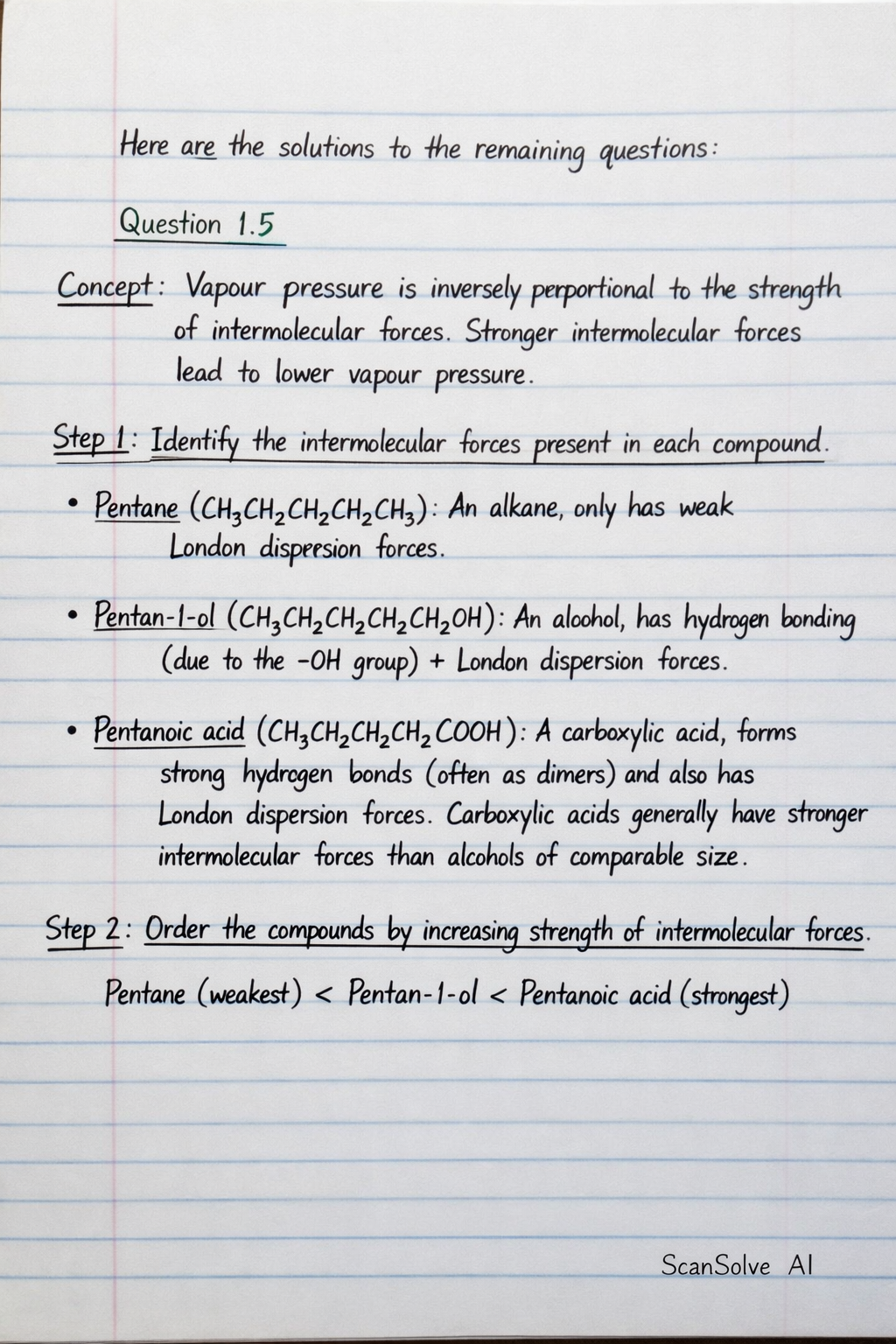
Here are the solutions to the remaining questions: Question 1.5 Concept: Vapour pressure is inversely proportional to the strength of intermolecular forces. Stronger intermolecular forces lead to lower vapour pressure. Step 1: Identify the intermolecular forces present in each compound. Pentane (CH_3CH_2CH_2CH_2CH_3): An alkane, only has weak London dispersion forces*. Pentan-1-ol (CH_3CH_2CH_2CH_2CH_2OH): An alcohol, has hydrogen bonding* (due to the -OH group) in addition to London dispersion forces. Pentanoic acid (CH_3CH_2CH_2CH_2COOH): A carboxylic acid, forms strong hydrogen bonds* (often as dimers) and also has London dispersion forces. Carboxylic acids generally have stronger intermolecular forces than alcohols of comparable size. Step 2: Order the compounds by increasing strength of intermolecular forces. Pentane (weakest) < Pentan-1-ol < Pentanoic acid (strongest) Step 3: Order the compounds by increasing vapour pressure. Since stronger intermolecular forces lead to lower vapour pressure, the order of increasing vapour pressure is the reverse of the order of intermolecular force strength. Pentanoic acid (lowest VP) < Pentan-1-ol < Pentane (highest VP) The correct option is A. A Pentanoic acid; Pentan – 1 – ol; Pentane Question 1.6 Concept: Identifying organic compounds based on their molecular formula and chemical reactions. Step 1: Analyze the given information about compound X. Molecular formula: C_4H_8O_2. When heated with excess ethanol in the presence of concentrated sulfuric acid, a sweet-smelling compound forms. This is characteristic of an esterification reaction*, where a carboxylic acid reacts with an alcohol to form an ester. This suggests X is a carboxylic acid. When compound X reacts with sodium carbonate solution, carbon dioxide is produced. This is a characteristic reaction of carboxylic acids* (and other acids) with carbonates. Step 2: Deduce the functional group of compound X. Both reactions indicate that compound X is a carboxylic acid. Step 3: Determine the structure and name of the carboxylic acid with molecular formula C_4H_8O_2. A carboxylic acid contains the -COOH functional group. If X is a 4-carbon carboxylic acid, its name would be Butanoic acid. Let's check the molecular formula for Butanoic acid: CH_3CH_2CH_2COOH. Counting atoms: 4 carbons, (3+2+2+1) = 8 hydrogens, 2 oxygens. This matches the given molecular formula C_4H_8O_2. Step 4: Evaluate the given options. A Ethyl Ethanoate: This is an ester (CH_3COOCH_2CH_3). Its molecular formula is C_4H_8O_2. While it has the correct molecular formula, it is an ester, not a carboxylic acid, and would not react with sodium carbonate to produce CO_2. B Butanoic acid: This is a carboxylic acid (CH_3CH_2CH_2COOH). Its molecular formula is C_4H_8O_2. It fits all the reaction descriptions. C Butyl Ethanoate: This is an ester (CH_3COOCH_2CH_2CH_2CH_3). Its molecular formula is C_6H_12O_2, which does not match. D Ethyl Butanoate: This is an ester (CH_3CH_2CH_2COOCH_2CH_3). Its molecular formula is C_6H_12O_2, which does not match. Therefore, compound X is Butanoic acid. The correct option is B. B Butanoic acid