
We read your photo as:
Write the rate expression for the formation of CO2 and H2O and the disappearance of CH4 and O2 in the reaction CH4(g) + 2O2(g) -> CO2(g) + 2H2O(g).
ScanSolve AI Answer
This answer stops before the end.
It was cut off when it was first written. Ask ScanSolve this question again for the full working.
Here are the solutions to the problems:
1. Reaction:
The general rate expression for a reaction is given by:
where the negative sign indicates the disappearance of reactants and the positive sign indicates the formation of products.
a) The formation of and
Step 1: Write the rate expression for the formation of .
The stoichiometric coefficient for is 1.
Step 2: Write the rate expression for the formation of .
The stoichiometric coefficient for is 2.
b) The disappearance of and
Step 1: Write the rate expression for the disappearance of .
The stoichiometric coefficient for is 1.
Step 2: Write the rate expression for the disappearance of .
The stoichiometric coefficient for is 2.
2. Reaction:
a) The formation of
Step 1: Write the rate expression for the formation of .
The stoichiometric coefficient for is 2.
b) The disappearance of and
Step 1: Write the rate expression for the disappearance of .
The stoichiometric coefficient for is 1.
Step 2: Write the rate expression for the disappearance of .
The stoichiometric coefficient for is 3.
3. Reaction:
Given: Molecular oxygen is reacting at the rate of .
This means .
From the stoichiometry, the overall reaction rate is .
a) At what rate is being formed?
Step 1: Relate the rate of formation of to the overall reaction rate.
Step 2: Calculate the rate of formation of .
b) At what rate is reacting?
Step 1: Relate the rate of reaction of to the overall reaction rate.
Step 2: Calculate the rate of reaction of .
4. Reaction:
Given: Molecular hydrogen is being formed at the rate of .
This means .
Step 1: Calculate the overall reaction rate from the rate of formation of .
Still stuck on this one?
Ask a follow-up, and the answer starts from this question.
More Chemistry Questions
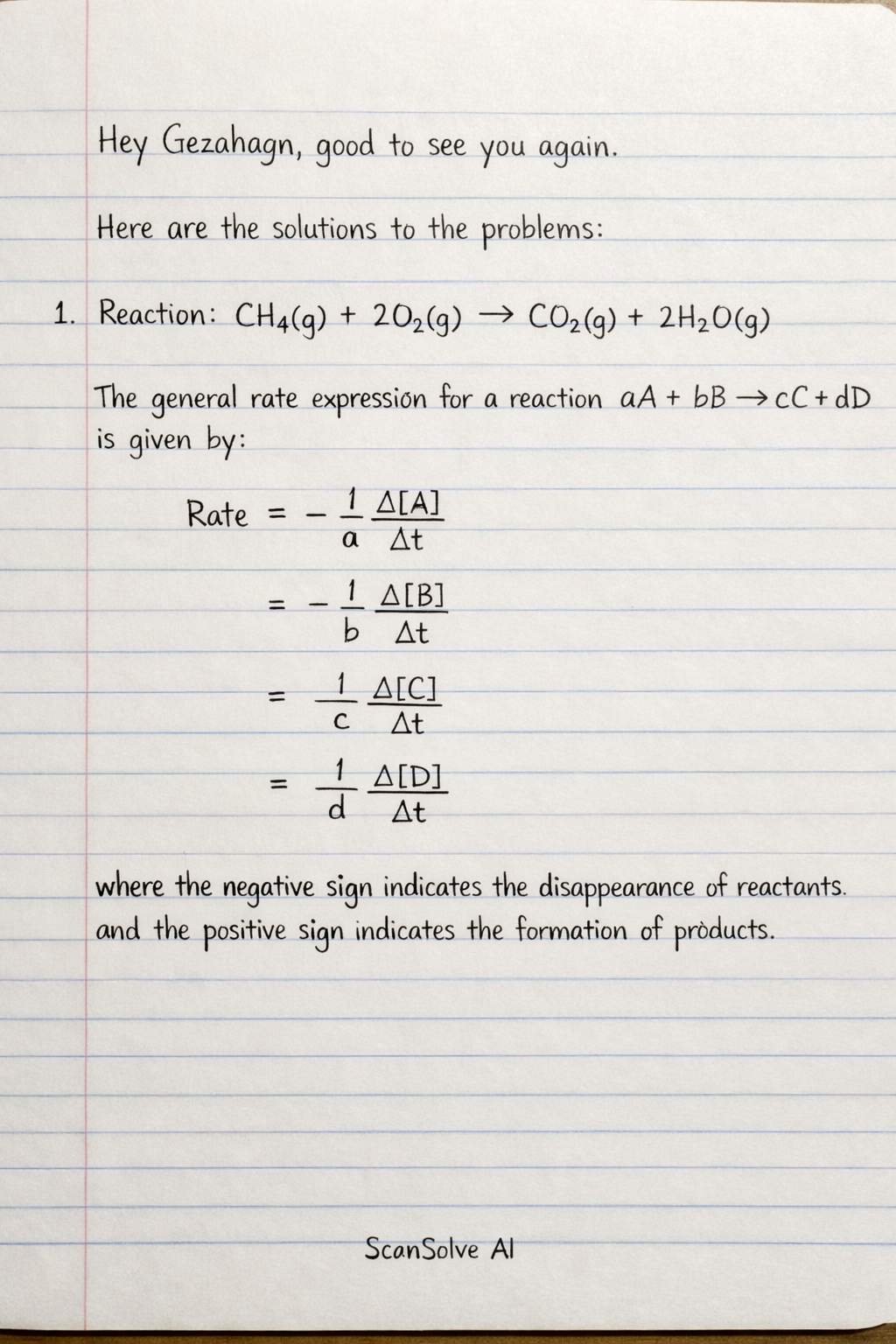
Handwritten Step-by-Step Solution
Get this as a handwritten image on WhatsApp — like a tutor wrote it for you.
Try on WhatsApp