
We read your photo as:
Calculate the relative atomic mass of an element given two isotopes, and answer questions related to the decomposition of hydrogen peroxide.
ScanSolve AI Answer
Step-by-step solution
2 steps23.
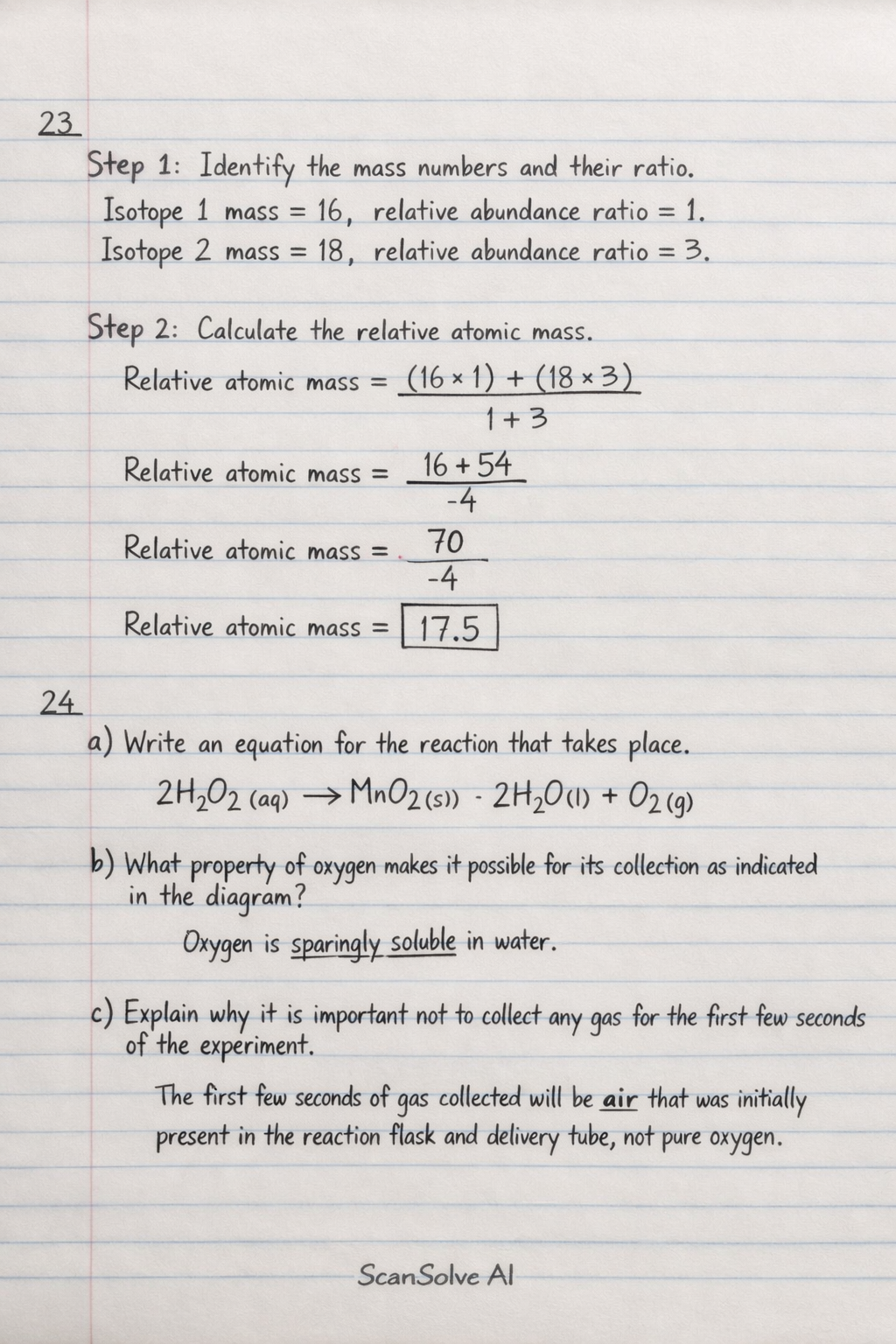
Identify the mass numbers and their ratio.
Isotope 1 mass , relative abundance ratio .
Isotope 2 mass , relative abundance ratio .Calculate the relative atomic mass.
24.
a) Write an equation for the reaction that takes place.
b) What property of oxygen makes it possible for its collection as indicated in the diagram.
Oxygen is sparingly soluble in water.c) Explain why it is important not to collect any gas for the first few seconds of the experiment.
The first few seconds of gas collected will be air that was initially present in the reaction flask and delivery tube, not pure oxygen.d) Give the role of manganese (IV) oxide in the experiment.
Manganese (IV) oxide acts as a catalyst, speeding up the decomposition of hydrogen peroxide without being consumed in the reaction.e) Give two uses of oxygen gas.
- Used in respiration by living organisms.
- Used in welding and cutting metals (oxy-acetylene torches).
- Used in medical applications for patients with breathing difficulties.
- Supports combustion.
25.
Element A has atomic number 6 (Carbon). Electron configuration: 2, 4.
Element B has atomic number 1 (Hydrogen). Electron configuration: 1.
When these two elements combine, they form covalent bonds by sharing electrons to achieve stable electron configurations. For example, in methane (), carbon shares its four valence electrons with four hydrogen atoms, and each hydrogen shares its one electron with carbon.Illustration of bonding (e.g., methane):
Or using dots and crosses:
26.
Solid sodium chloride does not conduct electricity because its ions ( and ) are held in fixed positions within a crystal lattice and are not free to move. In contrast, when sodium chloride is dissolved in water, the ions dissociate and become mobile, allowing them to carry charge and conduct electricity.27.
a) In which period of the periodic table is element Q? Give a reason.
Element Q has an atomic number of 5. Its electron configuration is 2, 3. It has two electron shells, which means it is in Period 2 of the periodic table.b) Explain why the atomic radius of P is greater than that of Q.
Elements P (atomic number 3) and Q (atomic number 5) are both in Period 2. Across a period, the nuclear charge increases (P has 3 protons, Q has 5 protons) while the number of electron shells remains the same. The increased nuclear attraction pulls the valence electrons closer to the nucleus, resulting in a smaller atomic radius for Q compared to P.
Still stuck on this one?
Ask a follow-up, and the answer starts from this question.
More Chemistry Questions
Handwritten Step-by-Step Solution
Get this as a handwritten image on WhatsApp — like a tutor wrote it for you.
Try on WhatsApp