
We read your photo as:
Why are Scandium(III) and Zinc(II) ions colorless in aqueous solution?
ScanSolve AI Answer
Answer
The color of transition metal ions in aqueous solution arises from d-d electronic transitions. For these transitions to occur, the metal ion must have partially filled d-orbitals ( to configuration).
-
Scandium () has an atomic number of 21, with an electron configuration of . When it forms the ion, it loses all three valence electrons, resulting in an electron configuration of . Since there are no d-electrons, no d-d transitions can occur.
-
Zinc () has an atomic number of 30, with an electron configuration of . When it forms the ion, it loses its two electrons, resulting in an electron configuration of . Since the d-orbitals are completely filled, there are no empty d-orbitals for electrons to be promoted to, so no d-d transitions can occur.
Because both and lack partially filled d-orbitals, they cannot undergo d-d transitions and therefore appear colorless.
Still stuck on this one?
Ask a follow-up, and the answer starts from this question.
More Chemistry Questions
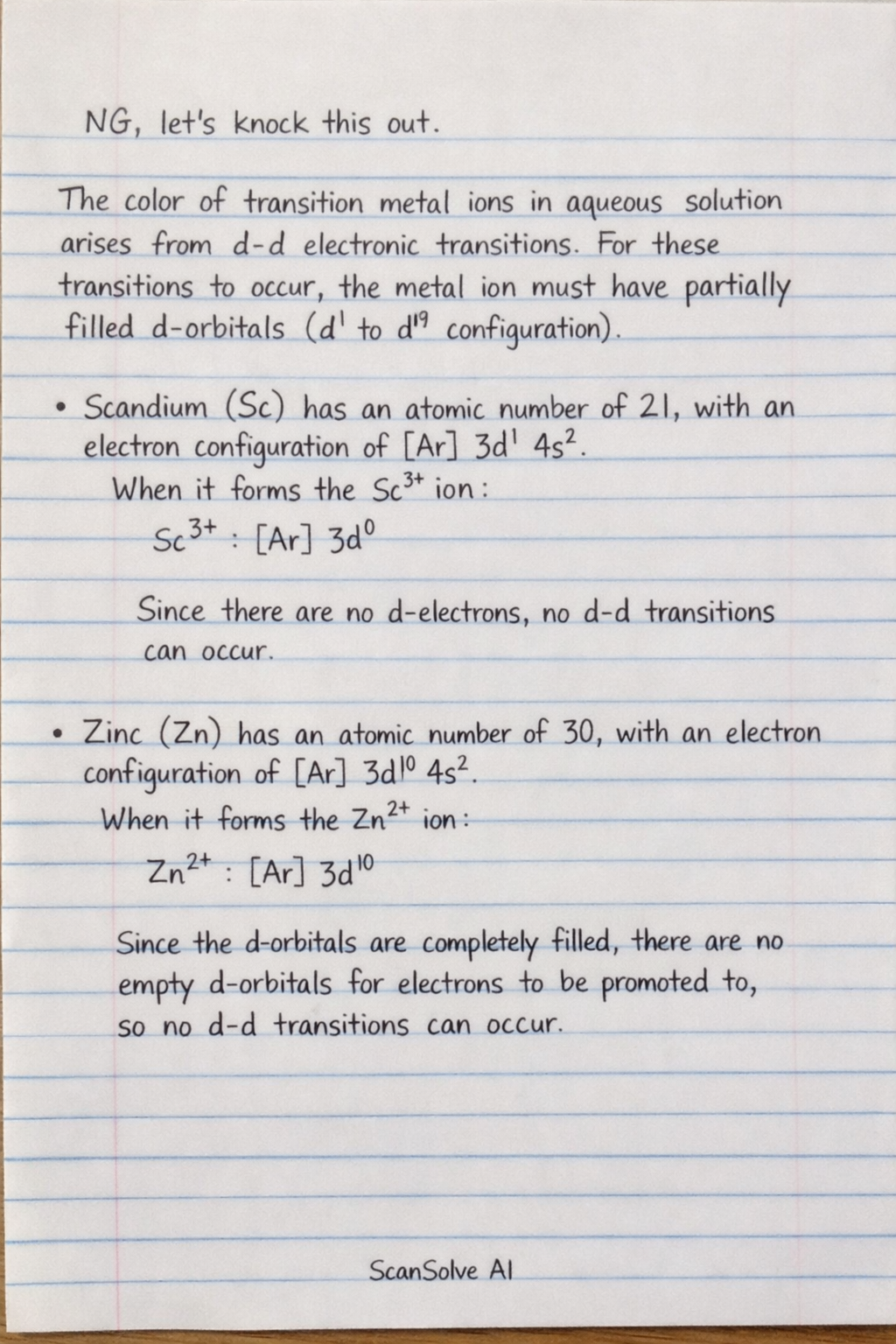
Handwritten Step-by-Step Solution
Get this as a handwritten image on WhatsApp — like a tutor wrote it for you.
Try on WhatsApp