
We read your photo as:
Which species is the weakest oxidizing agent, given the following standard electrode potentials: R2+/R = -2.38 V, S+/S2+ = +2.87 V, T2+/T = +0.34 V, U2+/U = -2.90 V, V+/V2+ = +0.80 V?
ScanSolve AI Answer
Step-by-step solution
8 stepsI)
Understand what an oxidizing agent is.
An oxidizing agent is a species that gains electrons (gets reduced) in a redox reaction. The standard electrode potential () measures the tendency of a species to be reduced.
Relate to oxidizing strength.
A more positive indicates a stronger tendency for reduction, meaning the species is a stronger oxidizing agent. Conversely, a more negative indicates a weaker tendency for reduction, meaning the species is a weaker oxidizing agent.
Identify the species with the most negative .
From the table, the standard electrode potentials for the oxidizing agents (species on the left side of the half-equations) are:
- R: V
- S: V
- T: V
- U: V
- V: V
The most negative value is V, which corresponds to U.
State the weakest oxidizing agent and explain.
The weakest oxidizing agent is U.
Explanation: U has the most negative standard electrode potential ( V), indicating it has the least tendency to gain electrons and be reduced. Therefore, it is the weakest oxidizing agent among the given species.II)
Understand how to maximize e.m.f.
The electromotive force (e.m.f) of a cell is calculated as . To produce the highest e.m.f, we need to select the half-cell with the most positive to act as the cathode (where reduction occurs) and the half-cell with the most negative to act as the anode (where oxidation occurs).
Identify the half-cell with the most positive .
The most positive value in the table is V, corresponding to the half-cell:
Identify the half-cell with the most negative .
The most negative value in the table is V, corresponding to the half-cell:
State the two half-cells.
The two half-cells that will produce the highest e.m.f are:
The highest e.m.f produced would be:
Still stuck on this one?
Ask a follow-up, and the answer starts from this question.
More Chemistry Questions
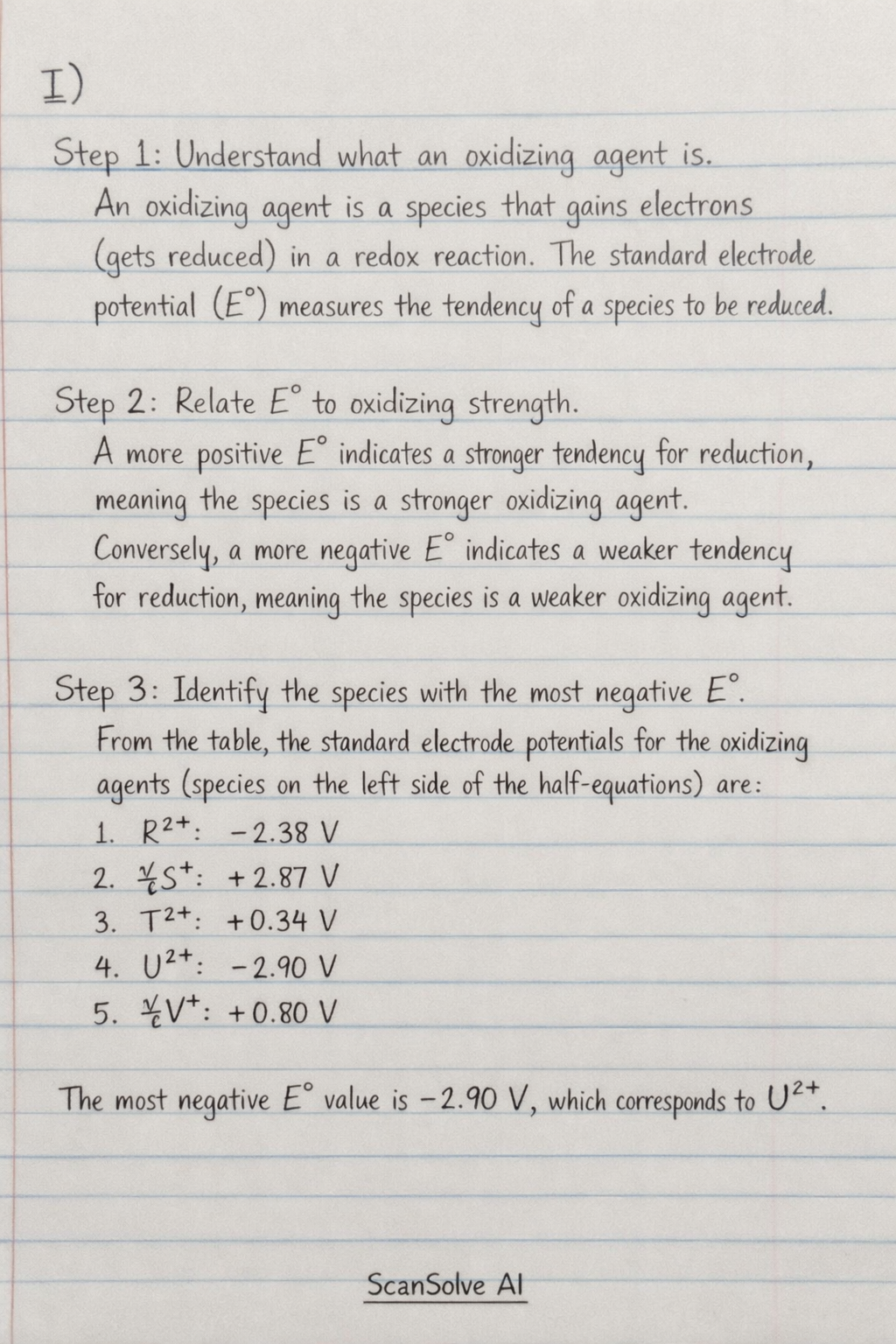
Handwritten Step-by-Step Solution
Get this as a handwritten image on WhatsApp — like a tutor wrote it for you.
Try on WhatsApp