
We read your photo as:
Define a standard solution. A disproportionation reaction
ScanSolve AI Answer
This answer stops before the end.
It was cut off when it was first written. Ask ScanSolve this question again for the full working.
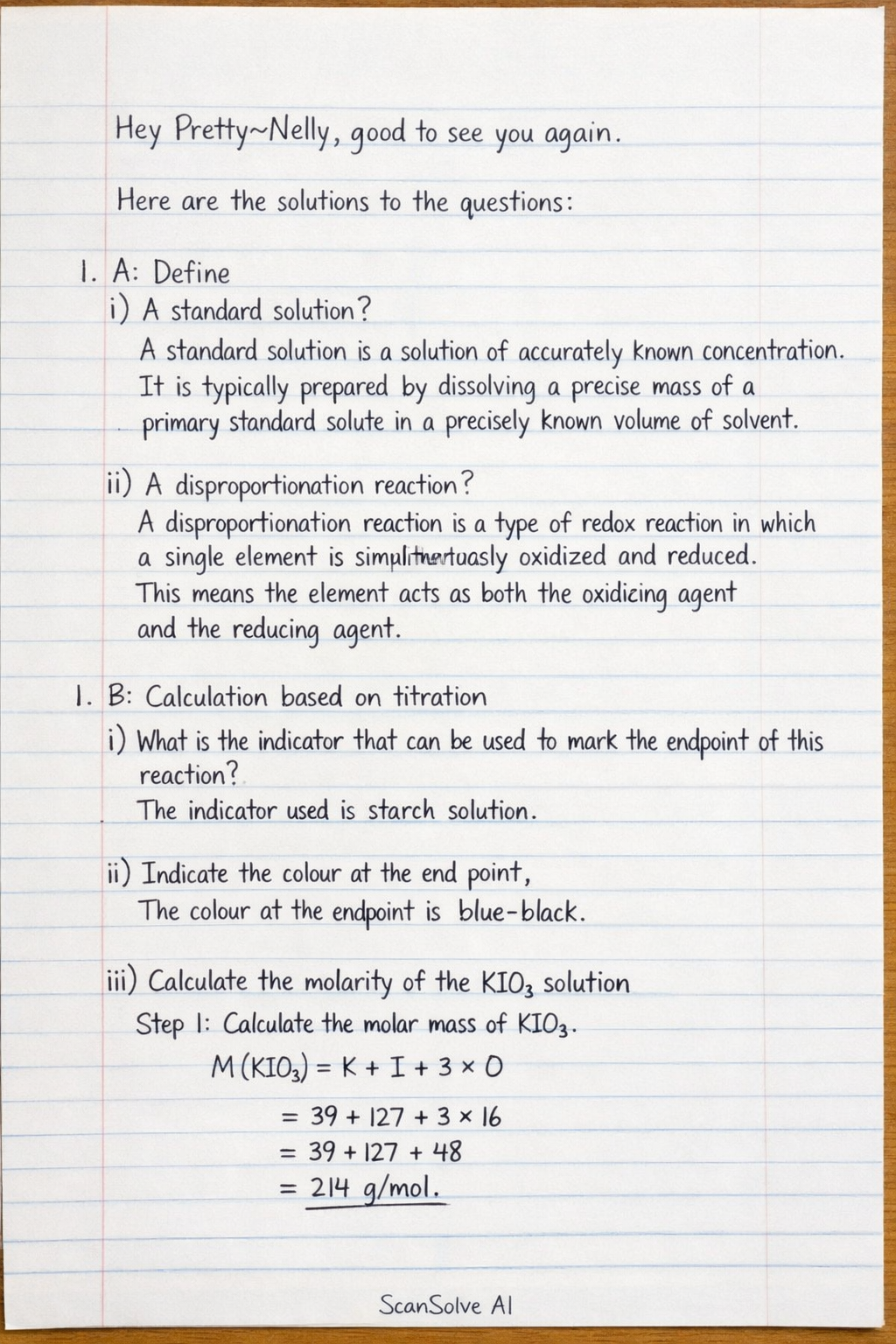
Here are the solutions to the questions:
1. A: Define
i) A standard solution?
A standard solution is a solution of accurately known concentration. It is typically prepared by dissolving a precise mass of a primary standard solute in a precisely known volume of solvent.
ii) A disproportionation reaction?
A disproportionation reaction is a type of redox reaction in which a single element is simultaneously oxidized and reduced. This means the element acts as both the oxidizing agent and the reducing agent.
1. B: Calculation based on titration
i) What is the indicator that can be used to mark the endpoint of this reaction?
The indicator used is starch solution.
ii) Indicate the colour at the end point
The colour at the endpoint is blue-black.
iii) Calculate the molarity of the solution
Step 1: Calculate the molar mass of .
Step 2: Calculate the moles of .
Step 3: Calculate the molarity of the solution.
The volume of the solution is .
iv) Write and balance the half equations and hence give the balanced ionic equation for the reaction
A) Reduction half-equation
The oxidation state of iodine in is , and in it is 0. So, is reduced to .
B) Oxidation half-equation
The oxidation state of iodine in is , and in it is 0. So, is oxidized to .
C) Overall balanced ionic equation
To balance the electrons, multiply the oxidation half-equation by 5:
Add the reduction half-equation and the modified oxidation half-equation:
Divide by 2 to simplify:
Still stuck on this one?
Ask a follow-up, and the answer starts from this question.
More Chemistry Questions
Handwritten Step-by-Step Solution
Get this as a handwritten image on WhatsApp — like a tutor wrote it for you.
Try on WhatsApp