
We read your photo as:
Steel is preferred to pure iron in making bridges because steal a. Do not rust b. Has a higher melting point c. Is less dense d. Has greater tensile strength
Chemistry
ScanSolve AI Answer
Here are the answers to the questions in the image:
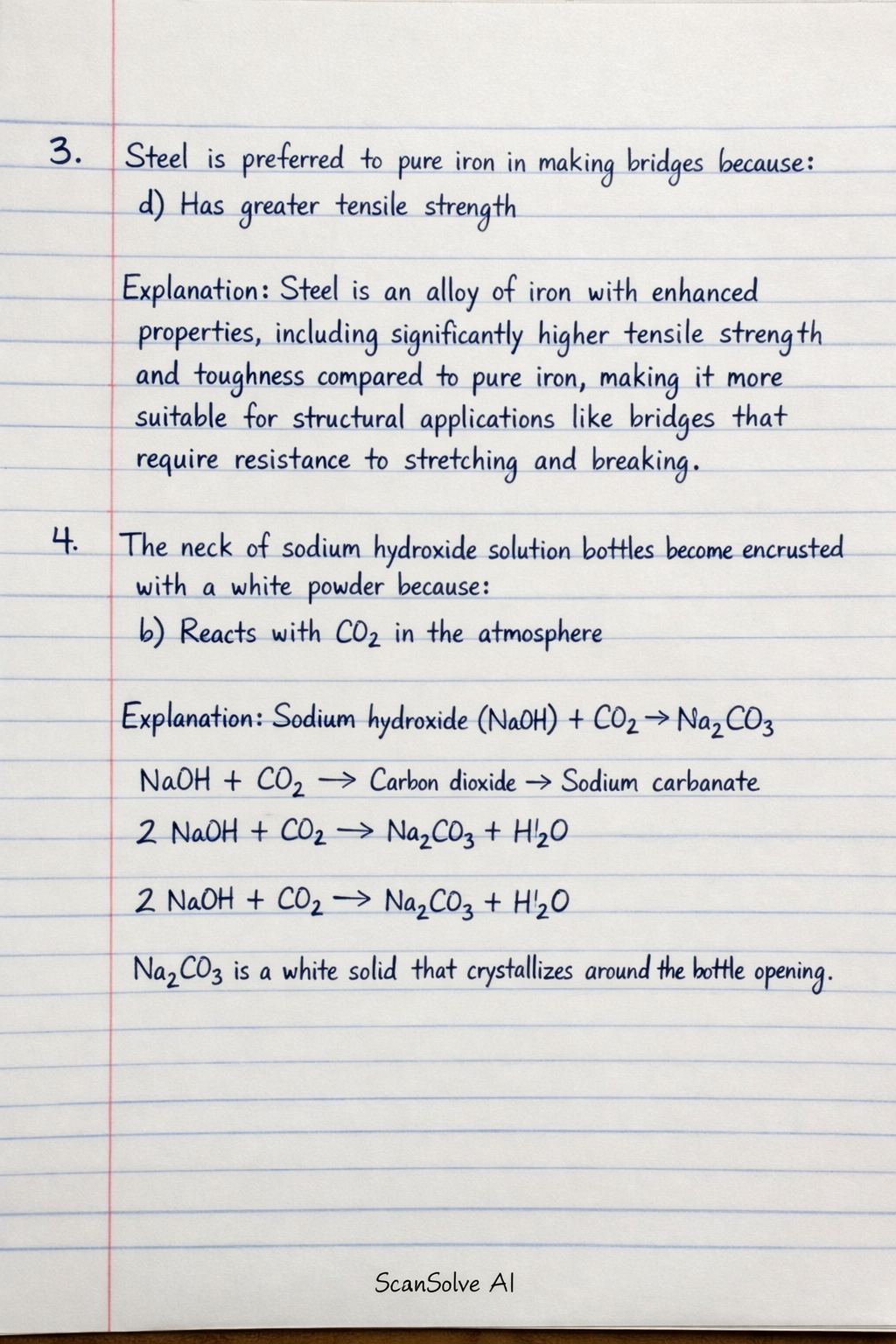
3. Steel is preferred to pure iron in making bridges because steel
- d) Has greater tensile strength
- Explanation: Steel is an alloy of iron with enhanced properties, including significantly higher tensile strength and toughness compared to pure iron, making it more suitable for structural applications like bridges that require resistance to stretching and breaking.
4. The neck of sodium hydroxide solution bottles become encrusted with a white powder because the solution
- b) Reacts with in the atmosphere
- Explanation: Sodium hydroxide () readily reacts with carbon dioxide () from the air to form sodium carbonate (), a white solid that crystallizes around the bottle opening.
5. When iron is finely divided, it will burn in oxygen to form the magnetic oxide with formula:
- c)
- Explanation: When iron burns in oxygen, especially in a finely divided state, it forms iron(II,III) oxide, also known as magnetite, which is a magnetic oxide with the formula .
Was this helpful?
Still stuck on this one?
Ask a follow-up, and the answer starts from this question.
Got a different question?Ask your own question
More Chemistry Questions
QWhy do steel hold a magnet for a long time than ironQConfirm that iron is stronger than wood, and briefly give the primary reason for the difference in…QTwo spoons are kept in a humid environment: one is made of iron and the other is made of stainless…QWhat is steel, and what is it primarily made of?QYes, steel will make good kitchenware. Steel, particularly stainless steel, is highly suitable for…
Handwritten Step-by-Step Solution
Get this as a handwritten image on WhatsApp — like a tutor wrote it for you.
Try on WhatsApp