
We read your photo as:
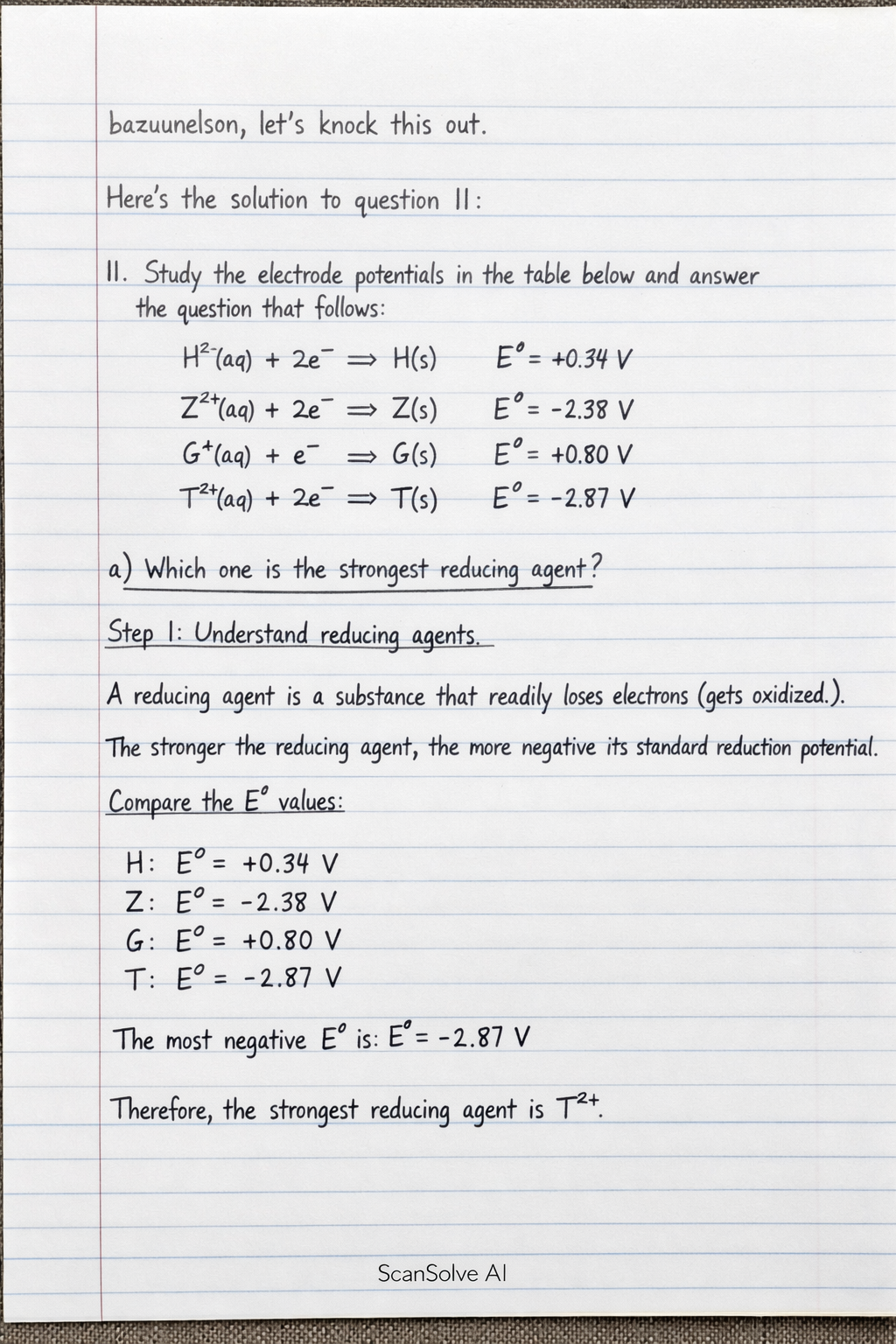
Study the electrode potentials in the table below and answer the question that follow: a) Which one is the strongest reducing agent?
ScanSolve AI Answer
Step-by-step solution
8 stepsHere's the solution to question 11:
11. Study the electrode potentials in the table below and answer the question that follow:
a) Which one is the strongest reducing agent?
Understand reducing agents.
A reducing agent is a substance that readily loses electrons (gets oxidized). The stronger the reducing agent, the more negative its standard reduction potential ().
Compare the values for the elemental forms (H, Z, G, T).
The most negative value corresponds to the strongest reducing agent.
- :
- :
- :
- :
Identify the strongest reducing agent.
The most negative value is , which corresponds to .
a) The strongest reducing agent is:
b) Write the ionic equation for the reaction that takes place when Z is dipped in a solution of G ions.
Determine which species will be oxidized and which will be reduced.
Compare the values for and .
- Since has a more negative value than , will be oxidized (lose electrons) and ions will be reduced (gain electrons).
Write the oxidation and reduction half-reactions.
Oxidation (at anode):
Reduction (at cathode):Balance the electrons and combine the half-reactions.
Multiply the reduction half-reaction by 2 to balance the electrons:
Add the oxidation and balanced reduction half-reactions:c) Calculate the cell value of the reaction in 22.(b) above.
(Assuming "22.(b)" refers to the reaction in 11.(b))Identify the standard electrode potentials for the oxidation and reduction half-reactions.
From part (b), the reaction is:
- Oxidation of :
- Reduction of :
Calculate the standard cell potential ().
c) The cell value is:
Still stuck on this one?
Ask a follow-up, and the answer starts from this question.
More Chemistry Questions
Handwritten Step-by-Step Solution
Get this as a handwritten image on WhatsApp — like a tutor wrote it for you.
Try on WhatsApp