
We read your photo as:
Study the table below and use it to answer the questions that follow: a) Complete the table to show the formulae of the oxides of A, E, G, and L. b) Select an oxide that reacts with both sodium hydrox
ScanSolve AI Answer
Step-by-step solution
11 stepsHere are the solutions to the questions:
7. Study the table below and use it to answer the questions that follow.
Part a· 2 steps
Complete the table to show the formulae of the oxides of A, E, G, and L.
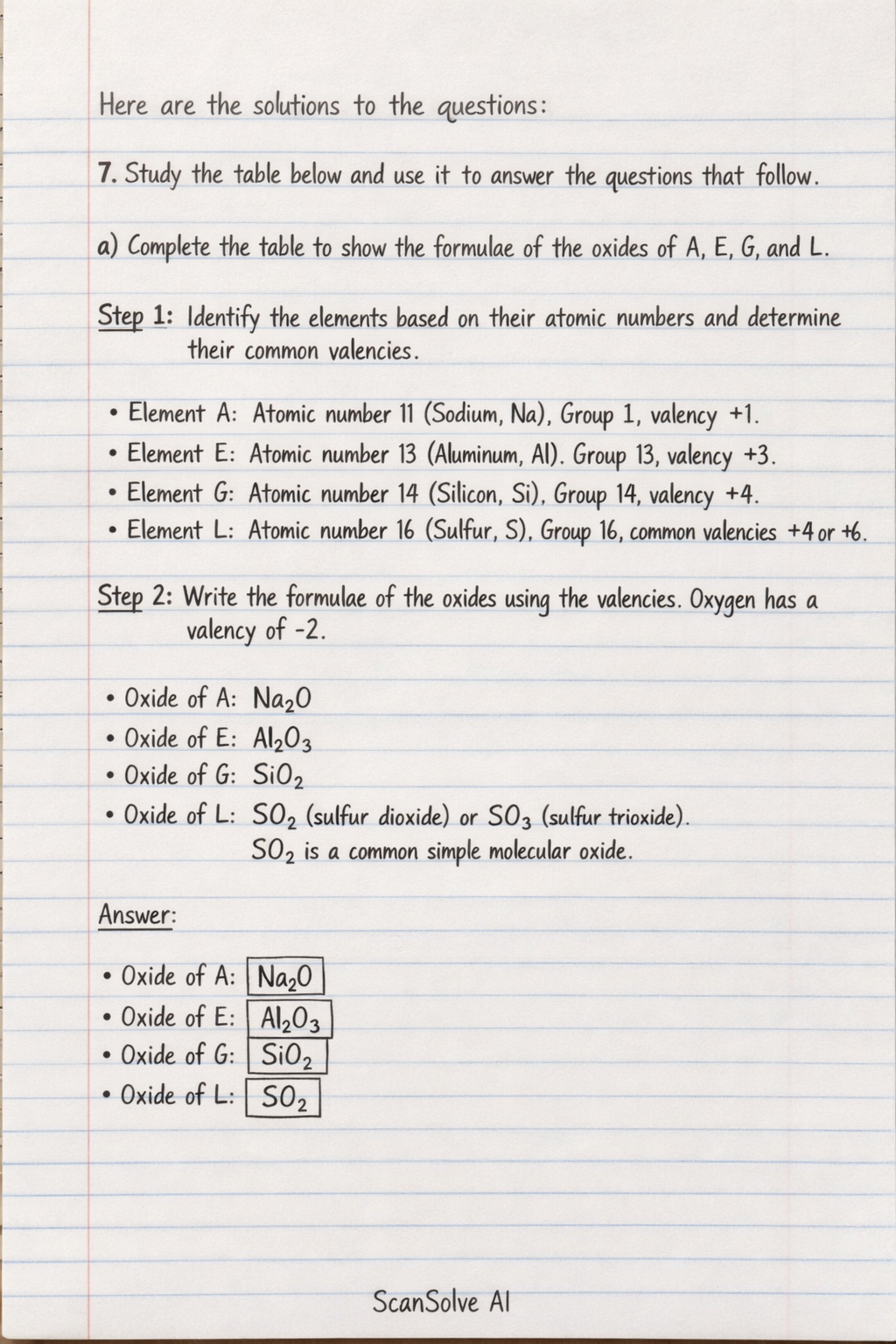
Identify the elements based on their atomic numbers and determine their common valencies.
- Element A: Atomic number 11 (Sodium, Na). Group 1, valency +1.
- Element E: Atomic number 13 (Aluminum, Al). Group 13, valency +3.
- Element G: Atomic number 14 (Silicon, Si). Group 14, valency +4.
- Element L: Atomic number 16 (Sulfur, S). Group 16, common valencies +4 or +6.
Write the formulae of the oxides using the valencies.
Oxygen has a valency of -2.
- Oxide of A:
- Oxide of E:
- Oxide of G:
- Oxide of L: (sulfur dioxide) or (sulfur trioxide). is a common simple molecular oxide. Answer:
- Oxide of A:
- Oxide of E:
- Oxide of G:
- Oxide of L:
Part b· 2 steps
Select an oxide that reacts with both sodium hydroxide solution and dilute hydrochloric acid solution.
An oxide that reacts with both acids and bases is an amphoteric oxide.
From the elements given, Aluminum (E, atomic number 13) forms an amphoteric oxide.
Answer: Oxide of E ()
Part c· 3 steps
Explain the difference in atomic radii between elements E and M.
Identify elements E and M.
- Element E: Atomic number 13 (Aluminum, Al). Atomic radius = 0.130 nm.
- Element M: Atomic number 17 (Chlorine, Cl). Atomic radius = 0.099 nm.
Both elements are in the same period (Period 3) of the periodic table.
Explain the trend in atomic radius across a period.
Answer: Element M has a smaller atomic radius than element E. This is because both elements are in the same period, but element M has a higher nuclear charge (more protons) than element E. The increased nuclear attraction pulls the outer electrons closer to the nucleus, resulting in a smaller atomic radius.
Part d· 2 steps
Write the formula of the compound formed between elements E and M.
Identify elements E and M and their common ionic charges.
- Element E: Aluminum (Al), forms ions.
- Element M: Chlorine (Cl), forms ions.
Combine the ions to form a neutral compound.
Answer:
Part e· 2 steps
Explain the difference in boiling points between the oxides of elements D and L.
Identify the oxides of D and L and their boiling points.
- Oxide of D: (Magnesium oxide). Boiling point of oxide = 3075 °C.
- Oxide of L: (Sulfur dioxide). Boiling point of oxide = -72 °C.
Describe the bonding and structure of each oxide and relate it to the boiling point.
Answer: The oxide of D () has a very high boiling point because it is an ionic compound with a *
Still stuck on this one?
Ask a follow-up, and the answer starts from this question.
More Chemistry Questions
Handwritten Step-by-Step Solution
Get this as a handwritten image on WhatsApp — like a tutor wrote it for you.
Try on WhatsApp