
We read your photo as:
What are the aim, hypothesis, color of potassium permanganate, and explanation of diffusion for this investigation?
ScanSolve AI Answer
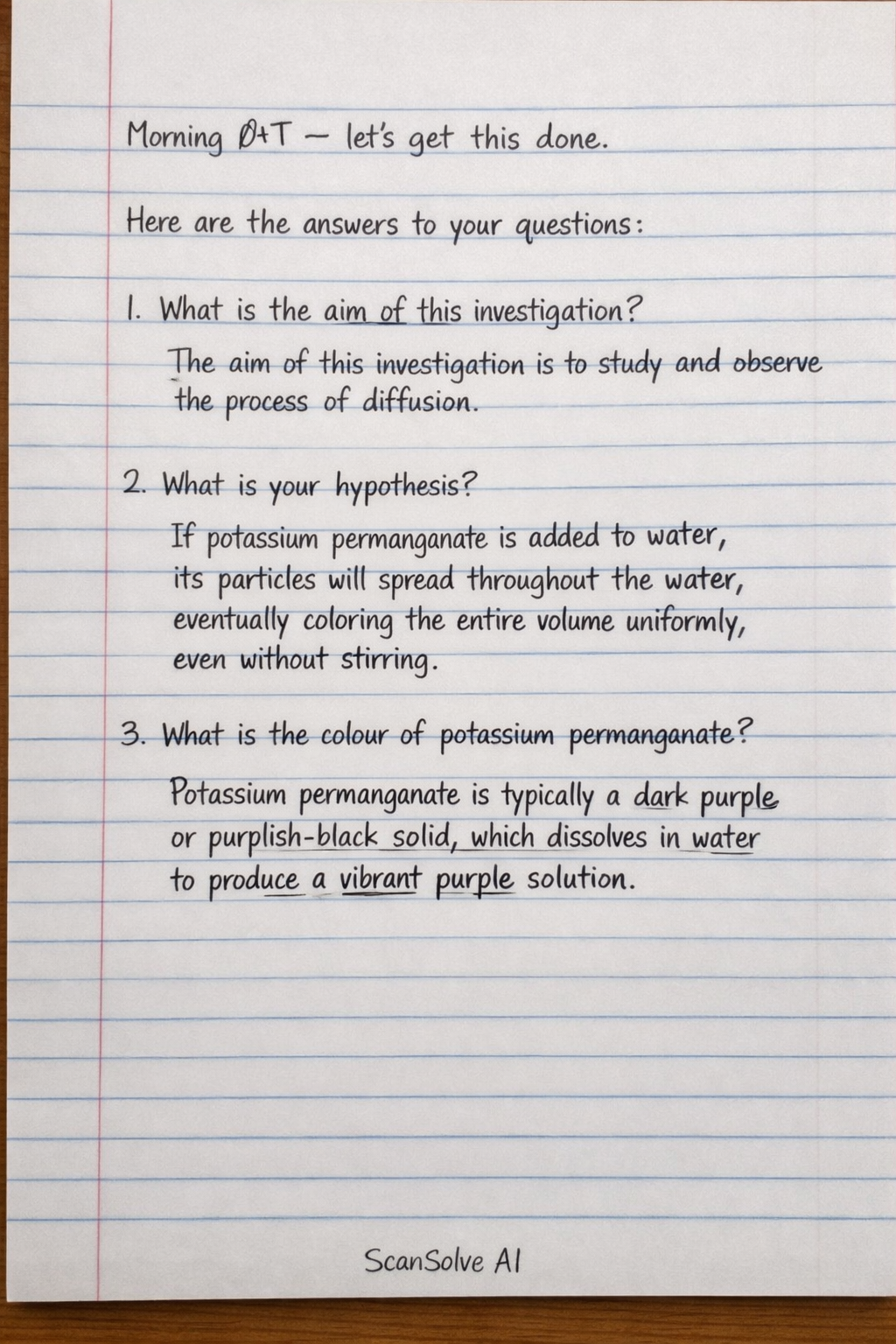
Here are the answers to your questions:
-
What is the aim of this investigation? The aim of this investigation is to study and observe the process of diffusion.
-
What is your hypothesis? If potassium permanganate is added to water, its particles will spread throughout the water, eventually coloring the entire volume uniformly, even without stirring.
-
What is the colour of potassium permanganate? Potassium permanganate is typically a dark purple or purplish-black solid, which dissolves in water to produce a vibrant purple solution.
-
Discuss by using the concept of diffusion why the water ended up being coloured. Diffusion is the net movement of particles from an area of higher concentration to an area of lower concentration. When potassium permanganate is added to water, the potassium permanganate particles (solute) are initially highly concentrated at the point of addition. Both the water molecules and the potassium permanganate particles are in constant, random motion. Due to this random movement, the potassium permanganate particles gradually spread out from the area of high concentration into the surrounding water, which initially has a lower concentration of these particles. This continuous spreading of the purple potassium permanganate particles throughout the water eventually results in the entire volume of water becoming uniformly colored.
-
Do you think the temperature of the water would have an effect on the process? Explain. Yes, the temperature of the water would have an effect on the process.
- Explanation: An increase in temperature provides the water and potassium permanganate particles with more kinetic energy. This increased energy causes the particles to move faster and collide more frequently, leading to a quicker and more rapid spreading of the solute particles throughout the solvent. Therefore, diffusion occurs faster at higher temperatures and slower at lower temperatures.
Still stuck on this one?
Ask a follow-up, and the answer starts from this question.
More Chemistry Questions
Handwritten Step-by-Step Solution
Get this as a handwritten image on WhatsApp — like a tutor wrote it for you.
Try on WhatsApp