
We read your photo as:
What is the colour of the resultant solution at the end point? Calculate the average volume of Q used.
ScanSolve AI Answer
Step-by-step solution
3 stepsThe image shows a chemistry problem involving titration. I will solve question 4.
4. (a) What is the colour of the resultant solution at the end point?
4. (b) Calculate the average volume of Q used.
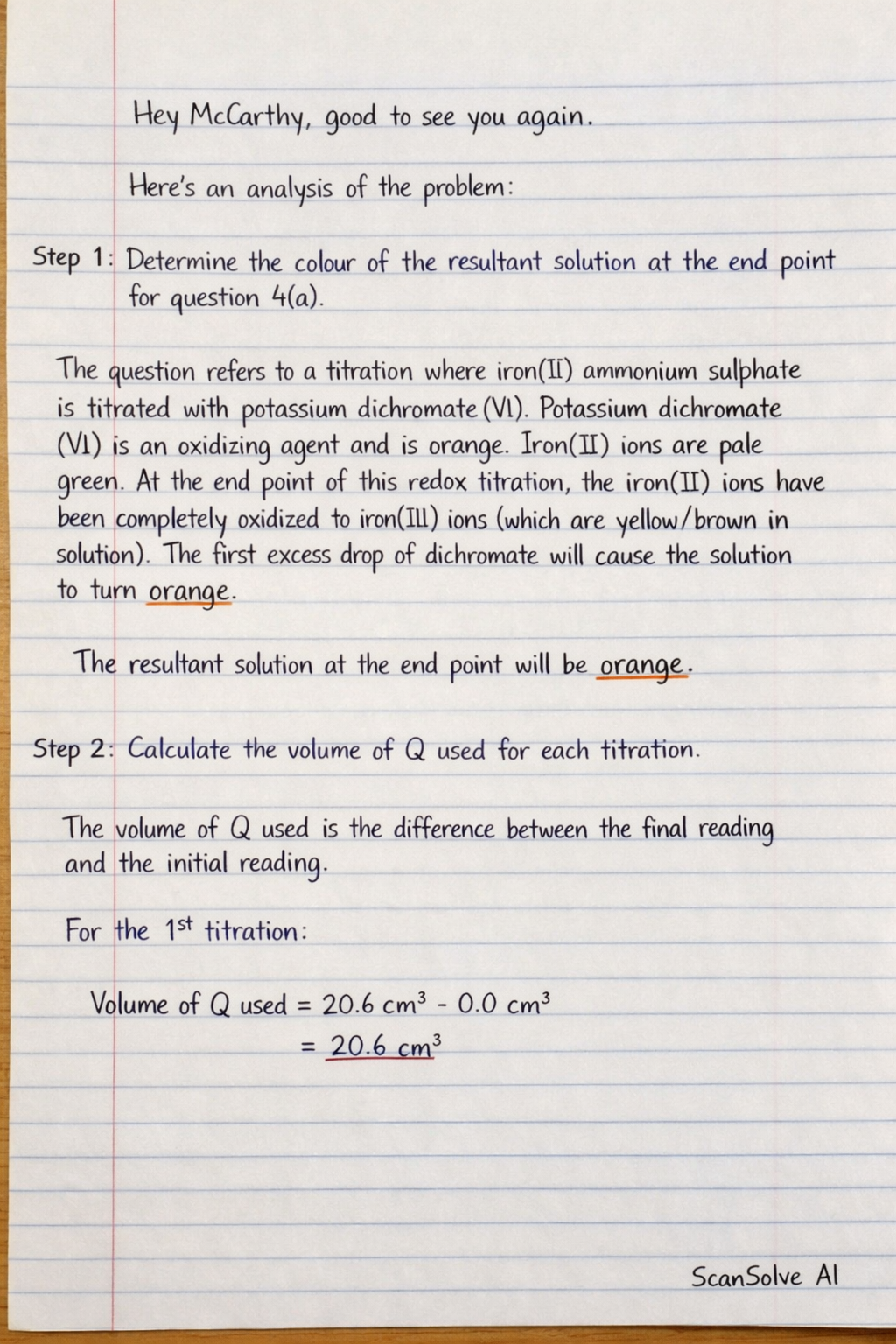
Determine the color of the resultant solution at the end point for question 4(a).
The question refers to a titration where iron(II) ammonium sulphate is titrated with potassium dichromate(VI). Potassium dichromate(VI) is an oxidizing agent and is orange. Iron(II) ions are pale green. At the end point of this redox titration, the iron(II) ions have been completely oxidized to iron(III) ions (which are yellow/brown in solution). The first excess drop of dichromate will cause the solution to turn orange.
The resultant solution at the end point will be orange.
Calculate the volume of Q used for each titration.
The volume of Q used is the difference between the final reading and the initial reading.
For the 1st titration:
For the 2nd titration:
For the 3rd titration:
Calculate the average volume of Q used for question 4(b).
To calculate the average volume, we sum the concordant (close) readings and divide by the number of readings. In titration, concordant readings are usually within of each other. The readings are , , and . The readings and are concordant. The reading is not concordant with the other two. Therefore, we use and for the average.
a) The colour of the resultant solution at the end point is orange.
b) The average volume of Q used is .
Still stuck on this one?
Ask a follow-up, and the answer starts from this question.
More Chemistry Questions
Handwritten Step-by-Step Solution
Get this as a handwritten image on WhatsApp — like a tutor wrote it for you.
Try on WhatsApp