
We read your photo as:
What is the concentration of OH in a solution with an H^+ concentration of 1.3 imes 10⁻⁴ M? What is the pH of 0.1 M hydrochloric acid? When pH falls by 1 unit, what is the change in the hydrogen ion
ScanSolve AI Answer
Step-by-step solution
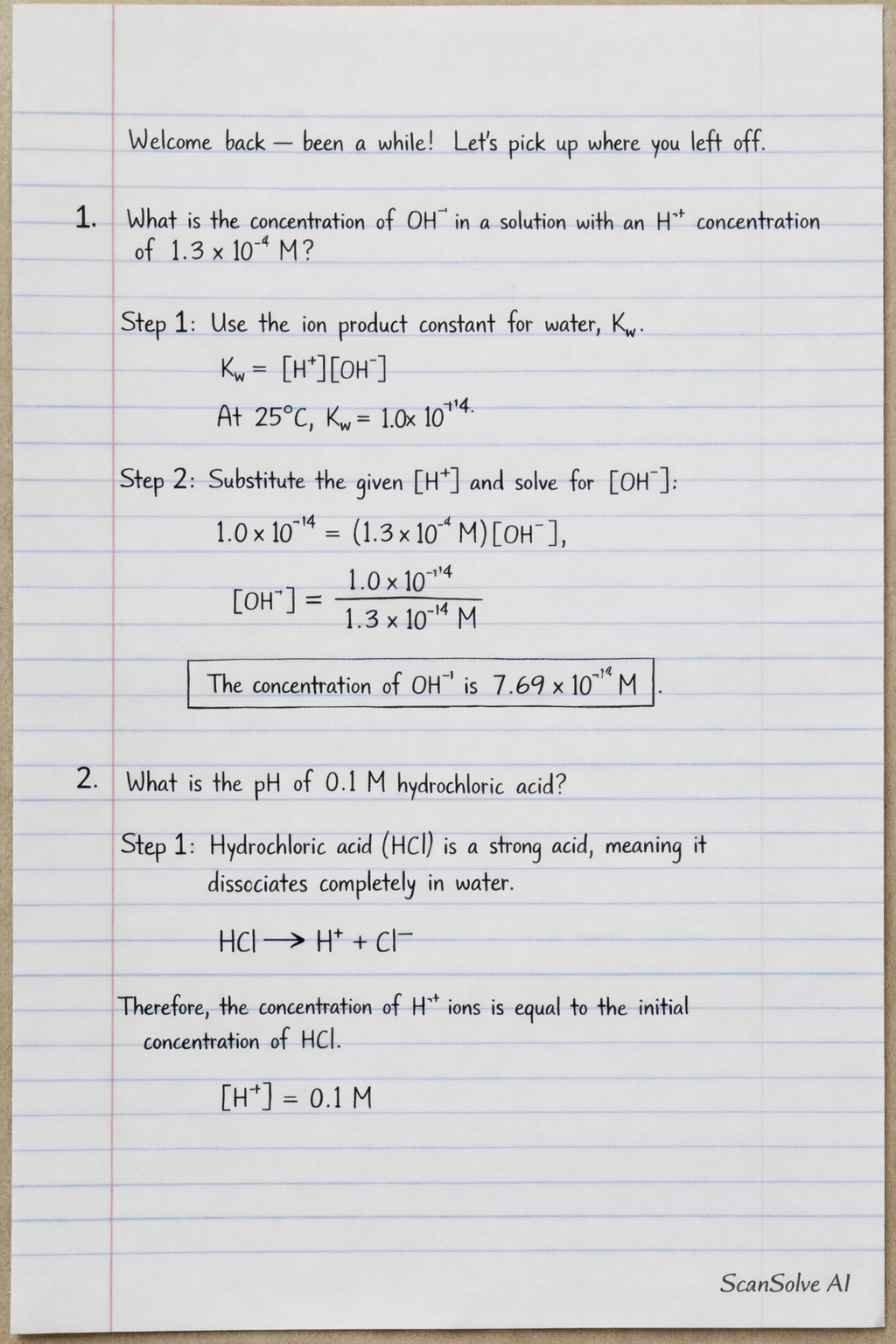
7 steps- What is the concentration of OH in a solution with an H concentration of M?
Use the ion product constant for water, .
$$ K_w = [\text{H}^+][\text{OH}^-] $$ At $25^\circ\text{C}$, $K_w = 1.0 \times 10^{-14}$.Substitute the given and solve for .
$$ 1.0 \times 10^{-14} = (1.3 \times 10^{-4} \text{ M})[\text{OH}^-] $$ $$ [\text{OH}^-] = \frac{1.0 \times 10^{-14}}{1.3 \times 10^{-4} \text{ M}} $$ $$ [\text{OH}^-] \approx 7.69 \times 10^{-11} \text{ M} $$ The concentration of $\text{OH}^-$ is $\boxed{\text{7.69} \times 10^{-11} \text{ M}}$.2. What is the pH of 0.1 M hydrochloric acid?
Hydrochloric acid (HCl) is a strong acid, meaning it dissociates completely in water.
$$ \text{HCl} \to \text{H}^+ + \text{Cl}^- $$ Therefore, the concentration of $\text{H}^+$ ions is equal to the initial concentration of HCl. $$ [\text{H}^+] = 0.1 \text{ M} $$Calculate the pH using the formula .
$$ \text{pH} = -\log(0.1) $$ $$ \text{pH} = -\log(10^{-1}) $$ $$ \text{pH} = 1 $$ The pH of 0.1 M hydrochloric acid is $\boxed{1}$.3. When pH falls by 1 unit, what is the change in the hydrogen ion concentration?
Recall the definition of pH.
$$ \text{pH} = -\log[\text{H}^+] $$ This can be rearranged to $[\text{H}^+] = 10^{-\text{pH}}$.Let the initial pH be and the initial hydrogen ion concentration be .
$$ [\text{H}^+]_1 = 10^{-\text{pH}_1} $$When pH falls by 1 unit, the new pH is .
The new hydrogen ion concentration is . When pH falls by 1 unit, the hydrogen ion concentration increases by a factor of 10.
-
Which equation describes the relationship between pH and pK?
The relationship between pH and pK (specifically pK) for a buffer solution is described by the Henderson-Hasselbalch equation:
-
What determines the pH of buffer?
The pH of a buffer solution is primarily determined by two factors:
- The pK of the weak acid component of the buffer system.
- The ratio of the concentration of the conjugate base to the concentration of the weak acid in the buffer solution.
-
When is a buffer most effective?
A buffer is most effective when the concentration of the weak acid is approximately equal to the concentration of its conjugate base. This occurs when the pH of the buffer is equal to the pK of the weak acid. Buffers are also more effective when the absolute concentrations of the weak acid and conjugate base are high.
-
What do you understand by the term "buffering capacity"?
Buffering capacity refers to the amount of acid or base that a buffer solution can neutralize before its pH changes significantly. It is determined by the absolute concentrations of the weak acid and its conjugate base present in the solution. A higher concentration of buffer components means a greater buffering capacity.
-
Still stuck on this one?
Ask a follow-up, and the answer starts from this question.
More Chemistry Questions
Handwritten Step-by-Step Solution
Get this as a handwritten image on WhatsApp — like a tutor wrote it for you.
Try on WhatsApp