
We read your photo as:
The empirical formula of a compound is CH2O. Which of the following could be its relative molecular mass: 42, 45, 126, 180?
ScanSolve AI Answer
Answer
Step-by-step solution
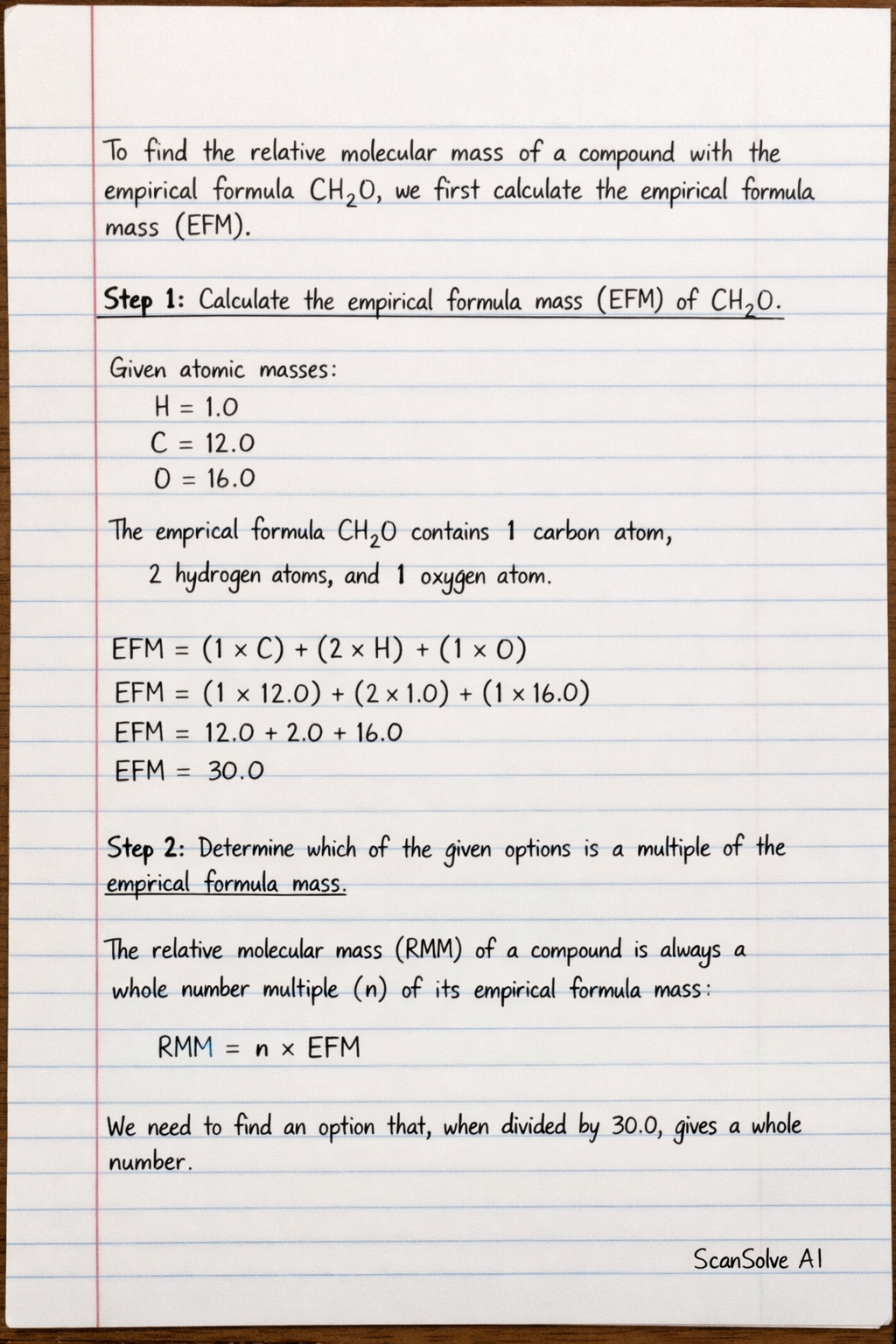
2 stepsTo find the relative molecular mass of a compound with the empirical formula , we first calculate the empirical formula mass (EFM).
Calculate the empirical formula mass (EFM) of .
Given atomic masses:
Relative atomic mass of Hydrogen (H) = 1.0
Relative atomic mass of Carbon (C) = 12.0
Relative atomic mass of Oxygen (O) = 16.0The empirical formula contains 1 carbon atom, 2 hydrogen atoms, and 1 oxygen atom.
Determine which of the given options is a multiple of the empirical formula mass.
The relative molecular mass (RMM) of a compound is always a whole number multiple () of its empirical formula mass:
We need to find an option that, when divided by 30.0, gives a whole number.
Let's check the options:
- (a) (not a whole number)
- (b) (not a whole number)
- (c) (not a whole number)
- (d) (a whole number)
Only option (d) is a whole number multiple of the empirical formula mass. This means that for this compound, , and its molecular formula would be , which is .
The correct option is d).
Try one yourself
A new problem that tests the same skill.
Still stuck on this one?
Ask a follow-up, and the answer starts from this question.
More Chemistry Questions
Handwritten Step-by-Step Solution
Get this as a handwritten image on WhatsApp — like a tutor wrote it for you.
Try on WhatsApp