
We read your photo as:
What is the gas produced from calcium carbide and water, its balanced equation, and the mass of slaked lime from 2.5 g of calcium carbide?
Chemistry
ScanSolve AI Answer
Step-by-step solution
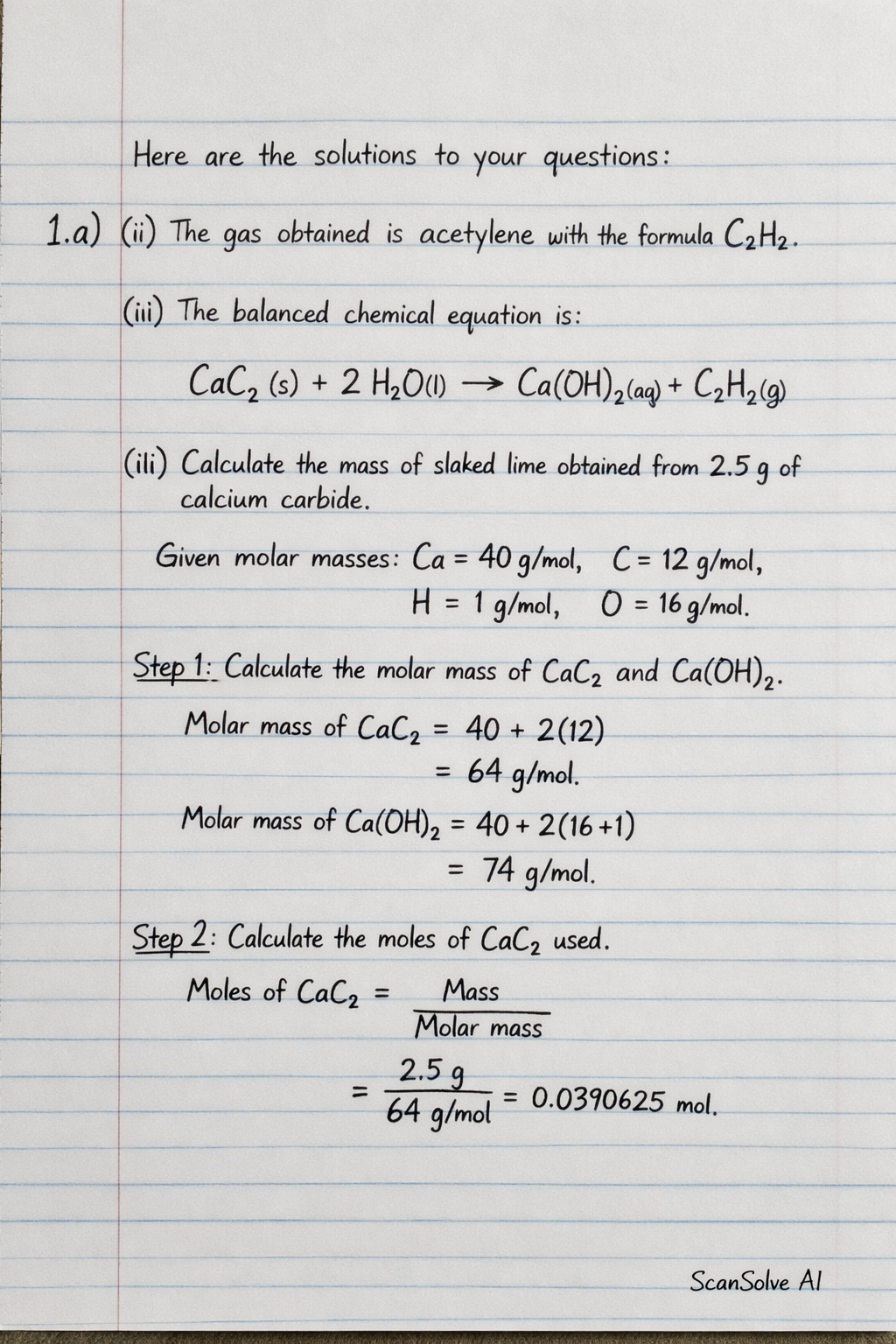
11 stepsHere are the solutions to your questions:
1.a)
- i) The gas obtained is acetylene with the formula .
- ii) The balanced chemical equation is:
- iii) Calculate the mass of slaked lime obtained from of calcium carbide. Given molar masses: , , , .
Calculate the molar mass of and .
Molar mass of $\text{CaC}_2 = 40 + 2(12) = 64 \text{ g/mol}$ Molar mass of $\text{Ca(OH)}_2 = 40 + 2(16+1) = 74 \text{ g/mol}$Calculate the moles of used.
$$ \text{Moles of CaC}_2 = \frac{\text{Mass}}{\text{Molar mass}} = \frac{2.5 \text{ g}}{64 \text{ g/mol}} = 0.0390625 \text{ mol} $$Use the mole ratio from the balanced equation () to find moles of .
$$ \text{Moles of Ca(OH)}_2 = 0.0390625 \text{ mol} $$Calculate the mass of produced.
$$ \text{Mass of Ca(OH)}_2 = \text{Moles} \times \text{Molar mass} = 0.0390625 \text{ mol} \times 74 \text{ g/mol} = 2.890625 \text{ g} $$ The mass of slaked lime obtained is $\boxed{\text{2.89 g}}$.1.b)
- i) Calculate the number of Faradays used. Given: Current , Time .
Convert time to seconds.
$$ t = 15 \text{ min} \times 60 \text{ s/min} = 900 \text{ s} $$Calculate the total charge passed.
$$ Q = I \times t = 2 \text{ A} \times 900 \text{ s} = 1800 \text{ C} $$Calculate the number of Faradays.
(Faraday constant ) The number of Faradays used is .
- ii) Calculate the number of moles of Lithium atoms produced. The reaction at the cathode for lithium hydride electrolysis is: . From the equation, produces .
Moles of electrons passed = Number of Faradays.
$$ \text{Moles of electrons} = 0.01865 \text{ mol} $$Calculate moles of Lithium produced.
$$ \text{Moles of Li} = \text{Moles of electrons} = 0.01865 \text{ mol} $$ The number of moles of Lithium atoms produced is $\boxed{\text{0.0187 mol}}$.- iii) Calculate the volume of gas produced at r.t.p. The gas produced at the anode from lithium hydride electrolysis is hydrogen: . From the equation, produce .
Calculate moles of gas produced.
$$ \text{Moles of H}_2 = \frac{\text{Moles of electrons}}{2} = \frac{0.01865 \text{ mol}}{2} = 0.009325 \text{ mol} $$Calculate the volume of gas at r.t.p.
(Molar volume at r.t.p = $2400 cm^3/\text{
Was this helpful?
Still stuck on this one?
Ask a follow-up, and the answer starts from this question.
Got a different question?Ask your own question
More Chemistry Questions
QA sample of calcium carbide of mass 2.5g reacts with water to produce acetylene gas and calcium…QTo answer questions (d) and (e) regarding calcium carbonate, I need the balanced chemical equation…QIdentify the apparatus and chemicals used in the experiment. Write the balanced chemical equation…QWhat are the uses of limestone and the reaction between calcium metal and water?QWrite the formula for nitric acid, the name of the process to make it, and the balanced equation for…
Handwritten Step-by-Step Solution
Get this as a handwritten image on WhatsApp — like a tutor wrote it for you.
Try on WhatsApp