
We read your photo as:
The graph below shows concentration changes of reactants and products for this reaction over time. Use this information to answer the following questions:
ScanSolve AI Answer
Answer
Step-by-step solution
5 stepsHere are the answers to your questions:
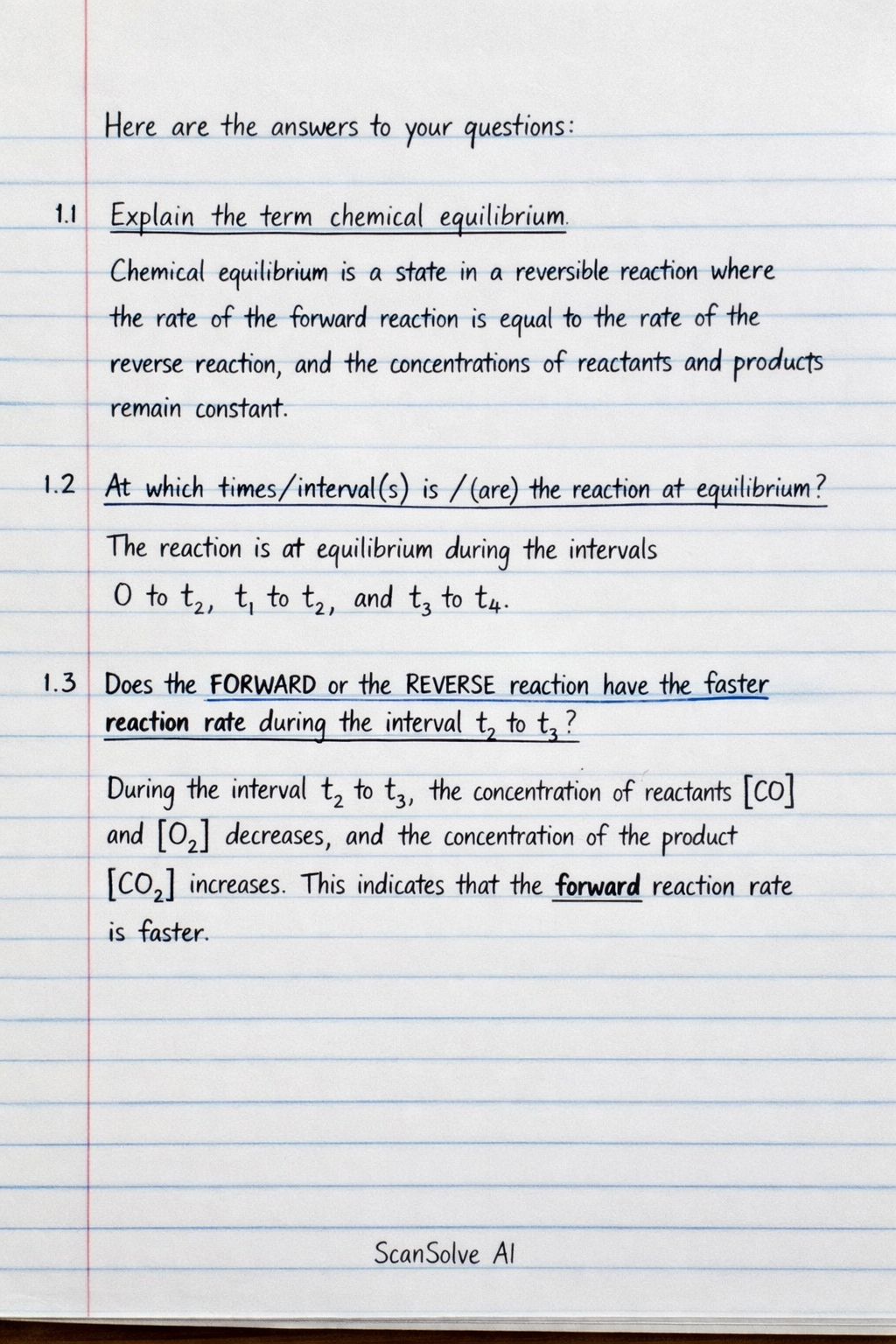
Part 1.1
Explain the term chemical equilibrium.
Chemical equilibrium is a state in a reversible reaction where the rate of the forward reaction is equal to the rate of the reverse reaction, and the concentrations of reactants and products remain constant.
Part 1.2
At which times/interval(s) is / (are) the reaction at equilibrium?
The reaction is at equilibrium during the intervals 0 to , to , and to .
Part 1.3
Does the FORWARD or the REVERSE reaction have the faster reaction rate during the interval to ?
During the interval to , the concentration of reactants ( and ) decreases, and the concentration of the product () increases. This indicates that the forward reaction rate is faster.
Part 1.4
The temperature is decreased at . Is the reaction EXOTHERMIC or ENDOTHERMIC?
At , the temperature is decreased. The graph shows that after this change, the concentrations of and decrease, while the concentration of increases. This means the equilibrium shifts to the right (forward reaction). According to Le Chatelier's principle, a decrease in temperature favors the exothermic reaction. Therefore, the forward reaction is exothermic.
Part 1.5
Explain the answer to QUESTION 1.4.
When the temperature is decreased at , the system shifts to counteract this change by favoring the reaction that releases heat. Since the equilibrium shifts to the right, increasing the concentration of and decreasing the concentrations of and , the forward reaction must be exothermic, as it releases heat.
Part 1.6
What change is made to at ?
At , there is an instantaneous increase in the concentrations of all reactants and products. This indicates a decrease in the volume of the container (or an increase in pressure).
Part 1.7
How will the change made at influence the value of for this reaction? Write only INCREASE, DECREASE or REMAIN THE SAME.
The change made at (a change in pressure/volume) does not affect the value of . is only influenced by temperature. Therefore, will remain the same.
Part 1.80.351
Initially 63 g of CO and 9.11 g of O is placed in a 2 dm container. At equilibrium, the concentration of CO is 0.15 mol·dm. Calculate the value for this reaction.
Calculate the initial moles and concentrations of reactants.
Molar mass of CO () =
Molar mass of O () =Initial moles of CO () =
Initial moles of O () =Volume of container () =
Initial concentration of CO () =
Initial concentration of O () =
Initial concentration of CO () =Set up an ICE (Initial, Change, Equilibrium) table using concentrations.
The balanced reaction is:
Species Initial (mol/dm) Change (mol/dm) Equilibrium (mol/dm) CO 1.1246 -2x 1.1246 - 2x O 0.1424 -x 0.1424 - x CO 0 +2x 2x Use the given equilibrium concentration of CO to find .
At equilibrium, .
From the table, .
So, .Calculate the equilibrium concentrations of all species.
Calculate the equilibrium constant .
The expression for is:
Substitute the equilibrium concentrations:
Rounding to three significant figures:
Try one yourself
A new problem that tests the same skill.
Still stuck on this one?
Ask a follow-up, and the answer starts from this question.
More Chemistry Questions
Handwritten Step-by-Step Solution
Get this as a handwritten image on WhatsApp — like a tutor wrote it for you.
Try on WhatsApp