
We read your photo as:
The previous question (Question 7) referred to a DNA diagram where 'a' indicated base pairs. In a DNA double helix, the 'b' label would typically refer to the sugar-phosphate backbone, which forms the
ScanSolve AI Answer
Step-by-step solution
8 stepsAnalyze Question 8.
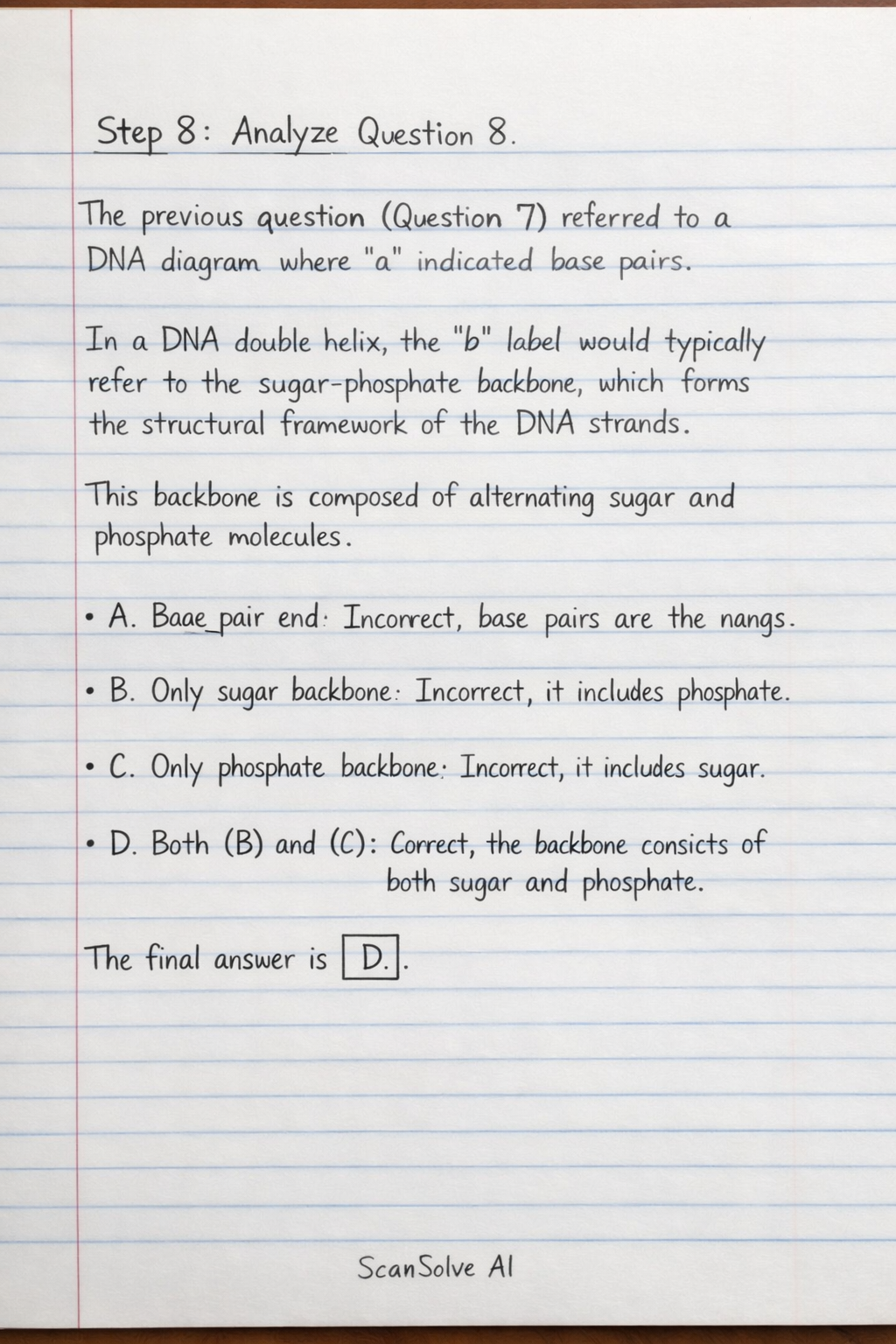
The previous question (Question 7) referred to a DNA diagram where 'a' indicated base pairs. In a DNA double helix, the 'b' label would typically refer to the sugar-phosphate backbone, which forms the structural framework of the DNA strands. This backbone is composed of alternating sugar and phosphate molecules.
- A. Base pair end: Incorrect, base pairs are the rungs.
- B. Only sugar backbone: Incorrect, it includes phosphate.
- C. Only phosphate backbone: Incorrect, it includes sugar.
- D. Both (B) and (C): Correct, the backbone consists of both sugar and phosphate.
The final answer is
Analyze Question 9.
Bryophytes (like mosses) and pteridophytes (like ferns) are primitive land plants. Their male gametes are flagellated and require a medium to swim to the female gametes for fertilization. This medium is water.
- A. Wind: Pollination by wind (anemophily) is common in gymnosperms and some angiosperms.
- B. Insects: Pollination by insects (entomophily) is common in many angiosperms.
- C. Birds: Pollination by birds (ornithophily) occurs in some flowering plants.
- D. Water: Essential for the transport of male gametes in bryophytes and pteridophytes.
The final answer is
Analyze Question 10.
The term syncarpous refers to the condition in a flower where multiple carpels (or pistils) are fused together to form a single compound pistil.
- A. Gynoecium containing single pistil: This describes a monocarpellary gynoecium, which can be syncarpous if it's a single carpel, but syncarpous specifically implies fusion of multiple.
- B. More than one pistil fused together: This is the correct definition of syncarpous.
- C. More than one pistil free from one another: This describes an apocarpous condition.
- D. Gynoecium containing many pistils: This could be apocarpous or syncarpous, depending on whether they are fused or free.
The final answer is
Analyze Question 11.
The figure shows a diagram of a pistil, the female reproductive organ of a flower.
- A points to the stigma, the receptive tip for pollen.
- B points to the style, the stalk connecting the stigma to the ovary.
- C points to the ovary, the swollen basal part containing ovules.
- D points to the thalamus (or receptacle), the part of the flower stalk where the parts of the flower are attached.
Comparing with the options:
- A. A: Thalamus, B: Style, C: Ovary, D: Stigma (Incorrect order)
- B. A: Style, B: Ovary, C: Stigma, D: Thalamus (Incorrect order)
- C. A: Stigma, B: Style, C: Ovary, D: Thalamus (Correct)
- D. A: Ovary, B: Stigma, C: Thalamus, D: Style (Incorrect order)
The final answer is
Analyze Question 12.
The question asks for the most common abiotic (non-living) pollinating agent.
- A. Anemophily: Pollination by wind. Wind is an abiotic agent.
- B. Hydrophily: Pollination by water. Water is an abiotic agent.
- C. Pollination by bees: Bees are biotic agents.
- D. Pollination by ants: Ants are biotic agents. Between wind and water, wind (anemophily) is a far more common abiotic pollinating agent for plants than water (hydrophily).
The final answer is
Analyze Question 13.
A human female with blood group 'A' has specific antigens on her red blood cells and specific antibodies in her serum.
-
Blood group A means that Antigen A is present on the surface of her red blood cells.
-
To prevent agglutination (clumping) if exposed to other blood types, her body produces antibody-anti-b (or anti-B antibody) in her blood serum.
-
A. Antibody-anti-b in the red blood cells and antigen A in the serum: Incorrect, antibodies are in serum, antigens on red blood cells.
-
B. Antigen A in the red blood cells and antibody-anti-b in the serum: Correct.
-
C. Antigen B in the red blood cells and antibody-anti-a in the serum: This describes blood group B.
-
D. Antigen A in the red blood cells and antibody-anti-a in the serum: Incorrect, a person with blood group A does not produce anti-A antibodies.
The final answer is
-
Analyze Question 14.
A Mendelian monohybrid cross typically refers to a cross between two heterozygous individuals for a single trait (e.g., ).
The genotypes produced are , , and .
The ratio of these genotypes is .- A. : This is the phenotypic ratio for a dominant-recessive monohybrid cross.
- B. : This is the genotypic ratio for a monohybrid cross.
- C. : This is the ratio for a test cross (e.g., ).
- D. : Not a standard Mendelian ratio.
The final answer is
Analyze Question 15.
A person with blood group 'O' has the genotype . This means they inherited an allele from each parent.
The mother has blood group 'A'. For her to pass an allele to her child, her genotype must be heterozygous .
The father has blood group 'B'. For him to pass an allele to his child, his genotype must be heterozygous .
Therefore, both the mother and the father must be heterozygous for their respective blood groups.- A. Mother is homozygous for 'A' blood group () and father is heterozygous for 'B' (). If the mother is , she cannot pass an allele. Incorrect.
- B. Mother is heterozygous for 'A' blood group () and father is homozygous for 'B' (). If the father is , he cannot pass an allele. Incorrect.
- C. Both mother and father are heterozygous for 'A' and 'B' blood group, respectively. Mother () and Father (). This combination can produce an (blood group O) child. Correct.
The final answer is
Still stuck on this one?
Ask a follow-up, and the answer starts from this question.
More Chemistry Questions
Handwritten Step-by-Step Solution
Get this as a handwritten image on WhatsApp — like a tutor wrote it for you.
Try on WhatsApp