
We read your photo as:
The provided image contains questions about the Ostwald process. Please answer the following: a) i) Name the catalyst used in step 1. ii) Explain why the catalyst is crushed into fine particles. iii)
ScanSolve AI Answer
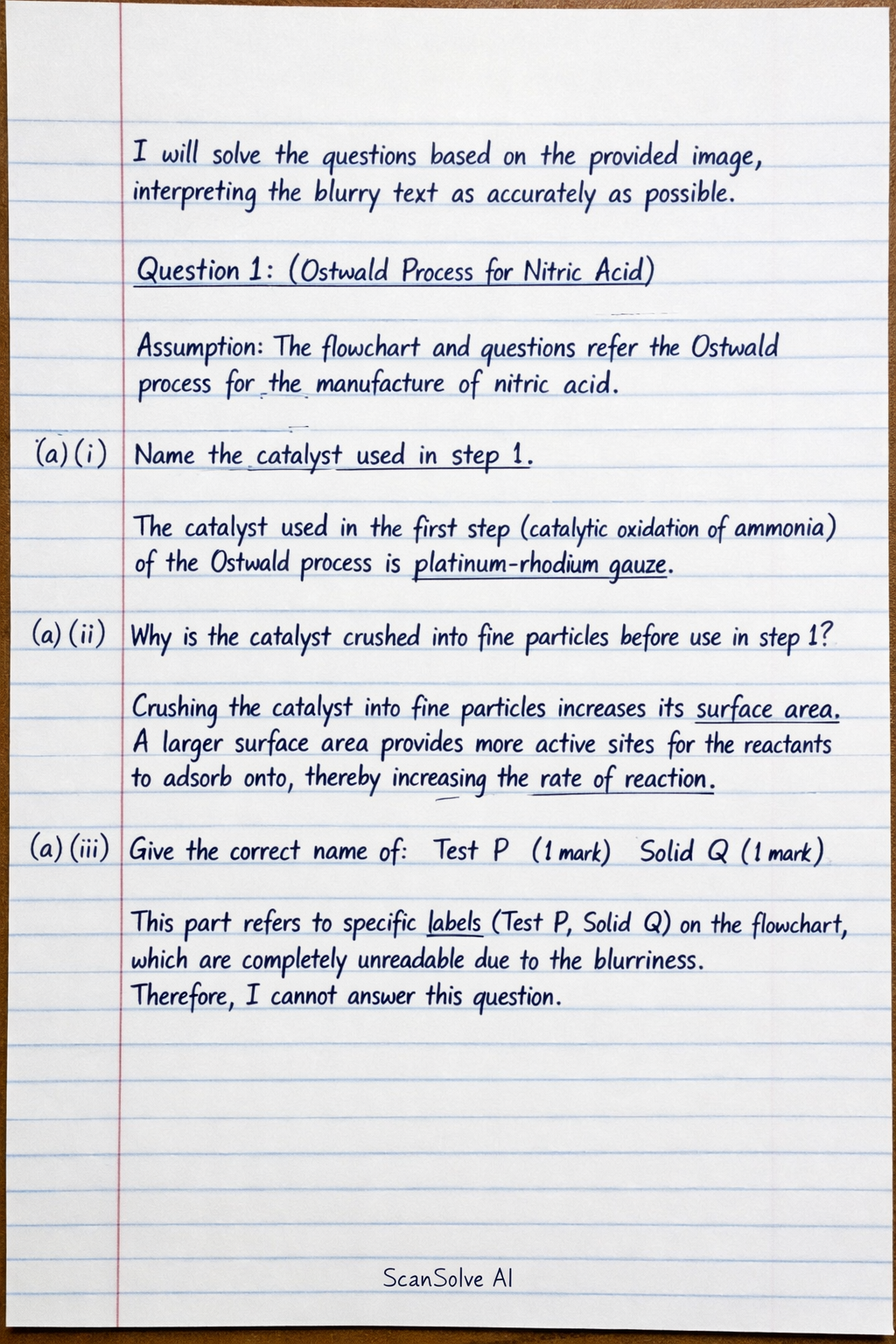
I will solve the questions based on the provided image, interpreting the blurry text as accurately as possible.
Question 1: (Ostwald Process for Nitric Acid)
Assumption: The flowchart and questions refer to the Ostwald process for the manufacture of nitric acid.
a) (i) Name the catalyst used in step 1.
The catalyst used in the first step (catalytic oxidation of ammonia) of the Ostwald process is platinum-rhodium gauze.
a) (ii) Why catalyst is crushed into fine particles before use in step 1.
Crushing the catalyst into fine particles increases its surface area. A larger surface area provides more active sites for the reactants to adsorb onto, thereby increasing the rate of reaction.
a) (iii) Give the correct name of, Test P (1 mark) Solid Q (1 mark)
This part refers to specific labels (Test P, Solid Q) on the flowchart, which are completely unreadable due to the blurriness. Therefore, I cannot answer this question.
a) (iv) Write chemical equation taking place in, Step 3 and Step 4.
Assuming the standard steps of the Ostwald process:
Step 3 is the absorption of nitrogen dioxide in water.
Step 4 is likely the overall absorption reaction in the presence of excess oxygen, which accounts for the recycling of NO.
a) (v) Why is concentrated nitric (V) acid transported in aluminium containers and not Copper containers?
Concentrated nitric acid passivates aluminium by forming a thin, tough, impervious layer of aluminium oxide () on its surface. This oxide layer prevents further reaction between the acid and the metal, making aluminium resistant to the acid. Copper, however, reacts with concentrated nitric acid, leading to corrosion of the container:
a) (vi) The acid produced by this process is 93% pure. Explain how the concentration can be increased.
To increase the concentration of nitric acid beyond approximately 68% (which is the maximum achievable by simple distillation with water), it must be distilled with a dehydrating agent. Concentrated sulfuric acid () is commonly used. The sulfuric acid absorbs water, allowing the more concentrated nitric acid to distill off.
Question 2 (Titration 1):
Given:
- Volume of hydrochloric acid () =
Still stuck on this one?
Ask a follow-up, and the answer starts from this question.
More Chemistry Questions
Handwritten Step-by-Step Solution
Get this as a handwritten image on WhatsApp — like a tutor wrote it for you.
Try on WhatsApp