
We read your photo as:
The provided table shows the first 11 elements of a new periodic system. Identify the elements based on their group and period. Specifically, answer: a) Which two elements are in the same group and ha
ScanSolve AI Answer
Answers
2 partsStep-by-step solution
2 stepsPart a
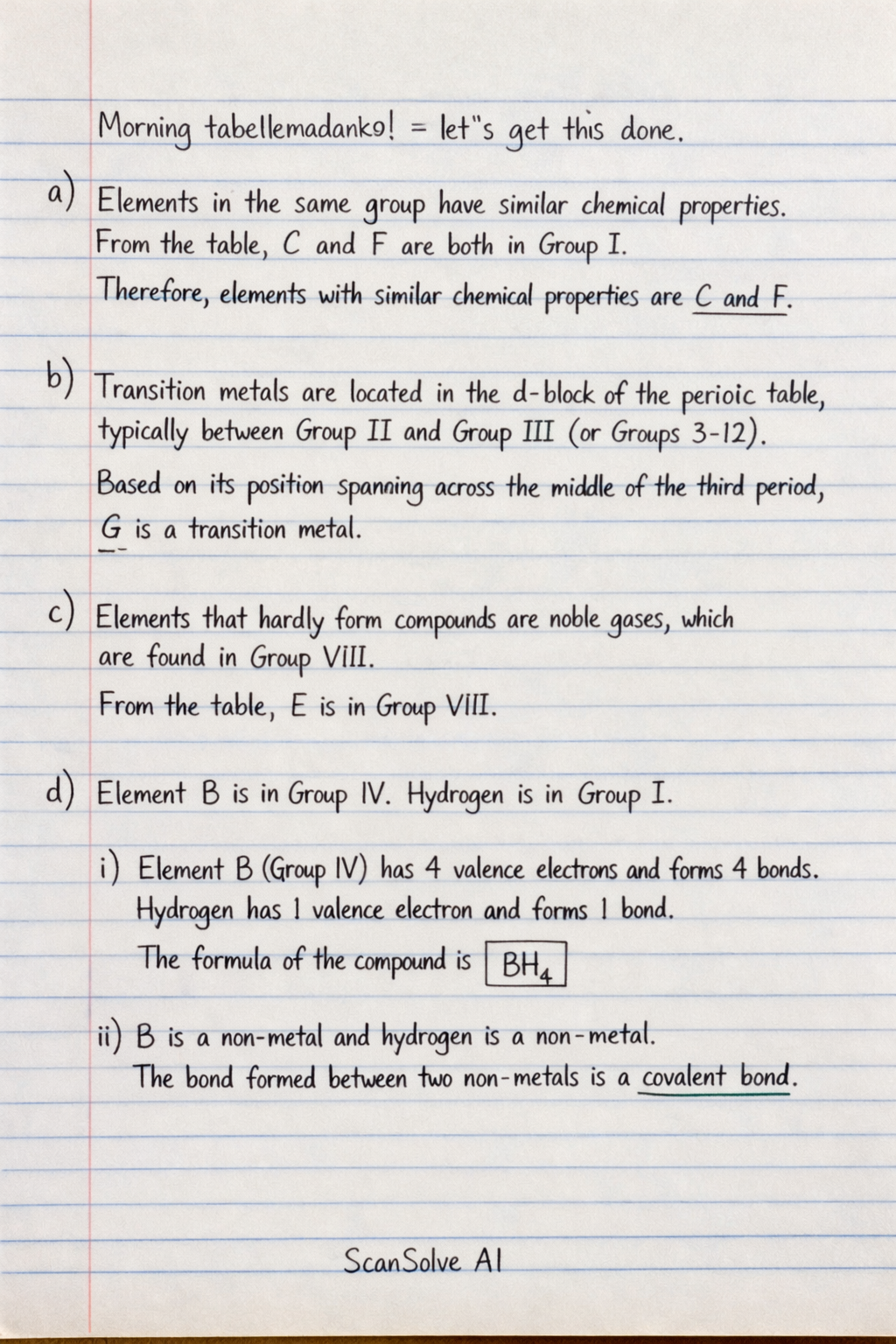
Elements in the same group have similar chemical properties.
From the table, C and F are both in Group I.
Therefore, elements with similar chemical properties are C and F.
Part b
Transition metals are located in the d-block of the periodic table, typically between Group II and Group III (or Groups 3-12).
Based on its position spanning across the middle of the third period, G is a transition metal.
Part c
Elements that hardly form compounds are noble gases, which are found in Group VIII.
From the table, E is in Group VIII.
Part d(i)
Element B (Group IV) has 4 valence electrons and forms 4 bonds. Hydrogen has 1 valence electron and forms 1 bond.
Element B is in Group IV. Hydrogen is in Group I.
The formula of the compound is .
Part d(ii)
B is a non-metal and hydrogen is a non-metal. The bond formed between two non-metals is a *covalent bond
Part d(iii)
Dot and cross diagram for
B is the central atom with 4 valence electrons (represented by dots). Each H atom has 1 valence electron (represented by crosses). Each H forms a single covalent bond with B.
More accurately, showing shared pairs:
Each bond is a shared pair of electrons, one from B and one from H.
Part e(i)
Atoms of the same element with different mass numbers are called *isotopes
Element D occurs naturally as and in the ratio 75 : 25 respectively.
Part e(ii)
Isotopes differ in the number of neutrons. Therefore, the neutron is the sub-atomic particle responsible for this phenomenon.
Part e(iii)10.5
To determine the relative atomic mass of D, we use the weighted average of the masses of its isotopes
Convert percentages to decimal abundances.
Abundance of
Abundance ofCalculate the relative atomic mass.
Try one yourself
A new problem that tests the same skill.
Still stuck on this one?
Ask a follow-up, and the answer starts from this question.
More Chemistry Questions
Handwritten Step-by-Step Solution
Get this as a handwritten image on WhatsApp — like a tutor wrote it for you.
Try on WhatsApp