
We read your photo as:
The provided text includes solutions for two questions: one about solubility in water and another about intermolecular forces in various substances. It seems the original prompt was a set of questions
ScanSolve AI Answer
Answer
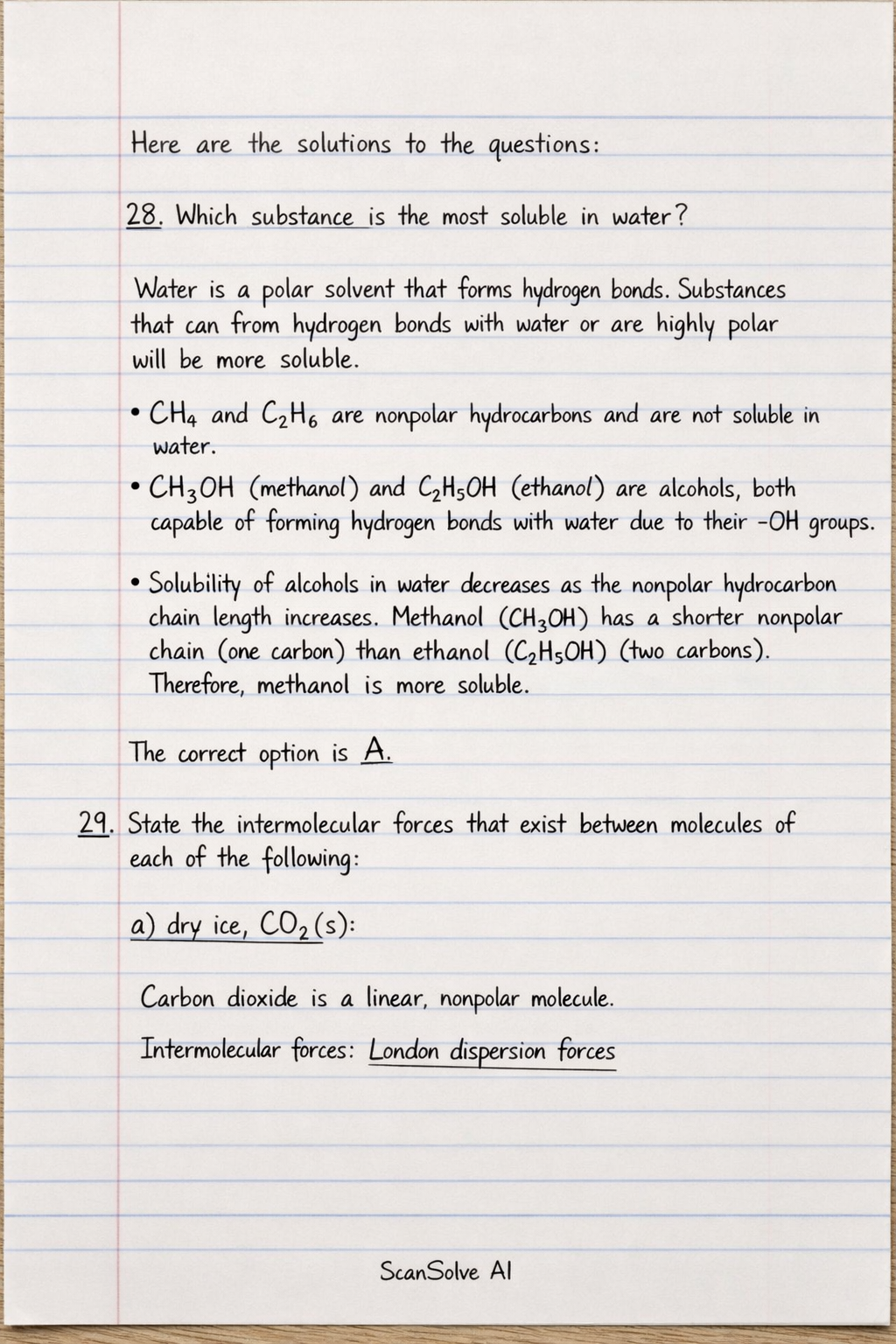
Here are the solutions to the questions:
28. Which substance is the most soluble in water?
Water is a polar solvent that forms hydrogen bonds. Substances that can form hydrogen bonds with water or are highly polar will be more soluble.
- and are nonpolar hydrocarbons and are not soluble in water.
- (methanol) and (ethanol) are alcohols, both capable of forming hydrogen bonds with water due to their -OH groups.
- Solubility of alcohols in water decreases as the nonpolar hydrocarbon chain length increases. Methanol () has a shorter nonpolar chain (one carbon) than ethanol () (two carbons). Therefore, methanol is more soluble.
The correct option is A.
29. State the intermolecular forces that exist between molecules of each of the following:
a) dry ice,
Carbon dioxide is a linear, nonpolar molecule.
Intermolecular forces: London dispersion forces
b)
Ammonia is a polar molecule with N-H bonds, and nitrogen has a lone pair.
Intermolecular forces: Hydrogen bonding, dipole-dipole forces, London dispersion forces
c)
Nitrogen gas is a diatomic, nonpolar molecule.
Intermolecular forces: London dispersion forces
d)
Dimethyl ether is a polar molecule due to the bent structure around the oxygen and polar C-O bonds, but it lacks an H atom bonded to O, N, or F.
Intermolecular forces: Dipole-dipole forces, London dispersion forces
30. Which of each pair has the lower boiling point?
Lower boiling points correspond to weaker intermolecular forces.
a) and
Both are nonpolar hydrocarbons with only London dispersion forces. has a smaller molecular mass and fewer electrons than , leading to weaker London dispersion forces.
Lower boiling point:
b) and
forms strong hydrogen bonds. is polar but does not form hydrogen bonds. The intermolecular forces in (dipole-dipole and London dispersion forces) are weaker than the hydrogen bonds in .
Lower boiling point:
c) and
Both are nonpolar diatomic halogens with only London dispersion forces. has a smaller molecular mass and fewer electrons than , leading to weaker London dispersion forces.
Lower boiling point:
d) and
forms strong hydrogen bonds. is polar but does not form hydrogen bonds. The intermolecular forces in (dipole-dipole and London dispersion forces) are weaker than the hydrogen bonds in .
Lower boiling point:
Try one yourself
A new problem that tests the same skill.
Still stuck on this one?
Ask a follow-up, and the answer starts from this question.
More Chemistry Questions
Handwritten Step-by-Step Solution
Get this as a handwritten image on WhatsApp — like a tutor wrote it for you.
Try on WhatsApp