
We read your photo as:
What is the purpose of lab coats, what should you do in case of an accident, what should not be poured down the sink, what type of fire extinguisher is suitable for all fires, what is the ideal pH for
ScanSolve AI Answer
-
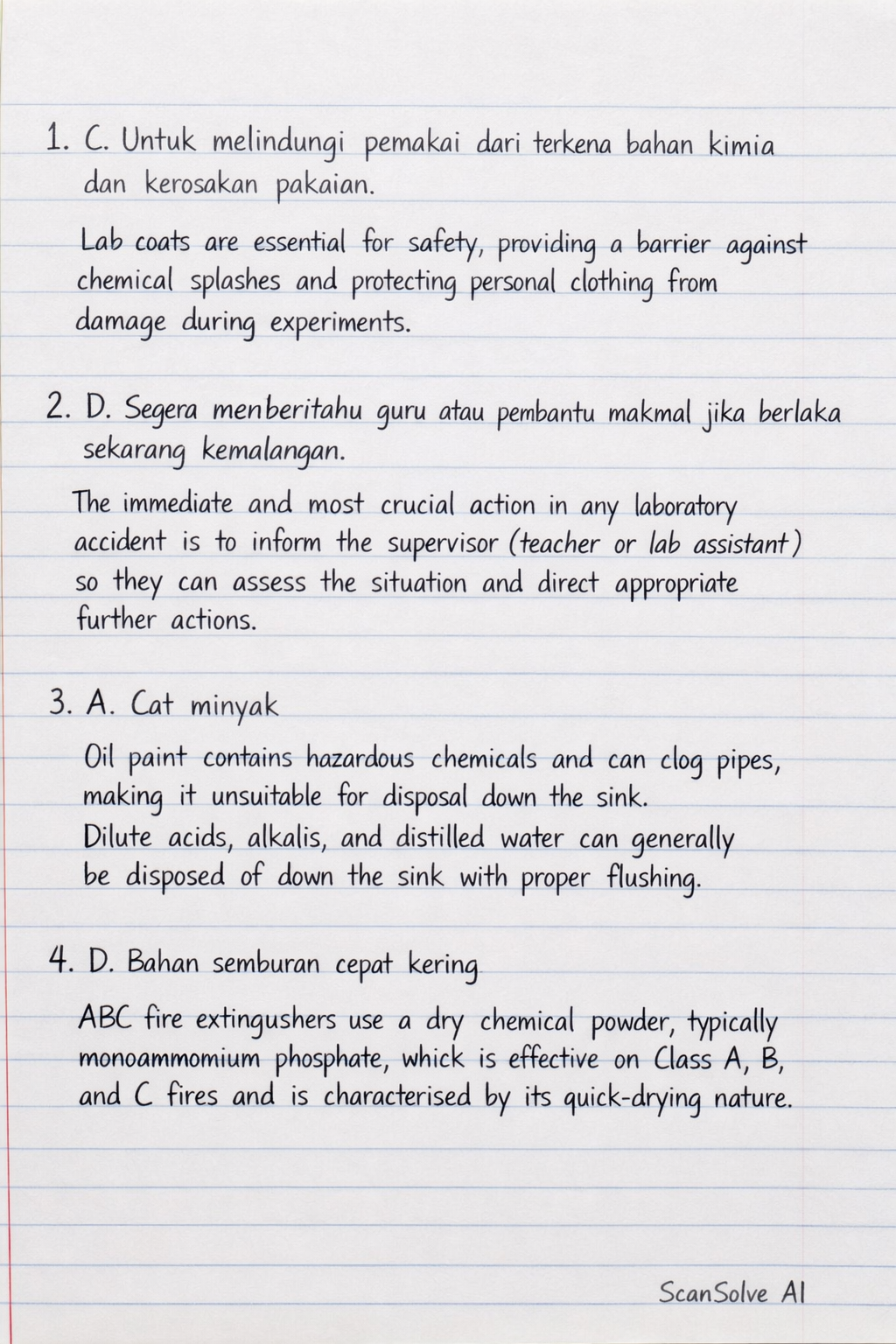
C. Untuk melindungi pemakai dari terkena bahan kimia dan kerosakan pakaian Lab coats are essential for safety, providing a barrier against chemical splashes and protecting personal clothing from damage during experiments.
-
D. Segera memberitahu guru atau pembantu makmal jika berlaku sebarang kemalangan. The immediate and most crucial action in any laboratory accident is to inform the supervisor (teacher or lab assistant) so they can assess the situation and direct appropriate further actions.
-
A. Cat minyak Oil paint contains hazardous chemicals and can clog pipes, making it unsuitable for disposal down the sink. Dilute acids, alkalis, and distilled water can generally be disposed of down the sink with proper flushing.
-
D. Bahan semburan cepat kering ABC fire extinguishers use a dry chemical powder, typically monoammonium phosphate, which is effective on Class A, B, and C fires and is characterized by its quick-drying nature.
-
B. Antara 5-9 Waste materials disposed of down the sink should ideally have a pH value close to neutral to prevent damage to plumbing and minimize environmental impact. A pH range of 5-9 is generally considered acceptable for discharge into municipal wastewater systems.
-
D. Pembekal pemadam kebakaran During an audit of fire extinguishers, inspectors typically check the expiry date, type, and number of extinguishers to ensure safety compliance. The supplier of the extinguishers is usually not a direct item of inspection for safety purposes.
-
B. II dan IV In fire classification, Class E fires involve live electrical equipment.
- I. Kertas (Paper) is a Class A fire.
- II. Komputer (Computer) is electrical equipment, thus a Class E fire.
- III. Gris (Grease) is typically a Class B (flammable liquids) or Class F/K (cooking oils/fats) fire.
- IV. Seterika (Iron) is electrical equipment, thus a Class E fire.
Therefore, materials involved in Class E fires are II (Komputer) and IV (Seterika).
Still stuck on this one?
Ask a follow-up, and the answer starts from this question.
More Chemistry Questions
Handwritten Step-by-Step Solution
Get this as a handwritten image on WhatsApp — like a tutor wrote it for you.
Try on WhatsApp