We read your photo as:

The sodium ion level in a urine specimen was measured using an ion-selective electrode. The following values were obtained: 102, 97, 99, 98, 101, 106 mM. Calculate the mean and standard deviation of t

Chemistry

ScanSolve AI Answer

Step-by-step solution

4 steps

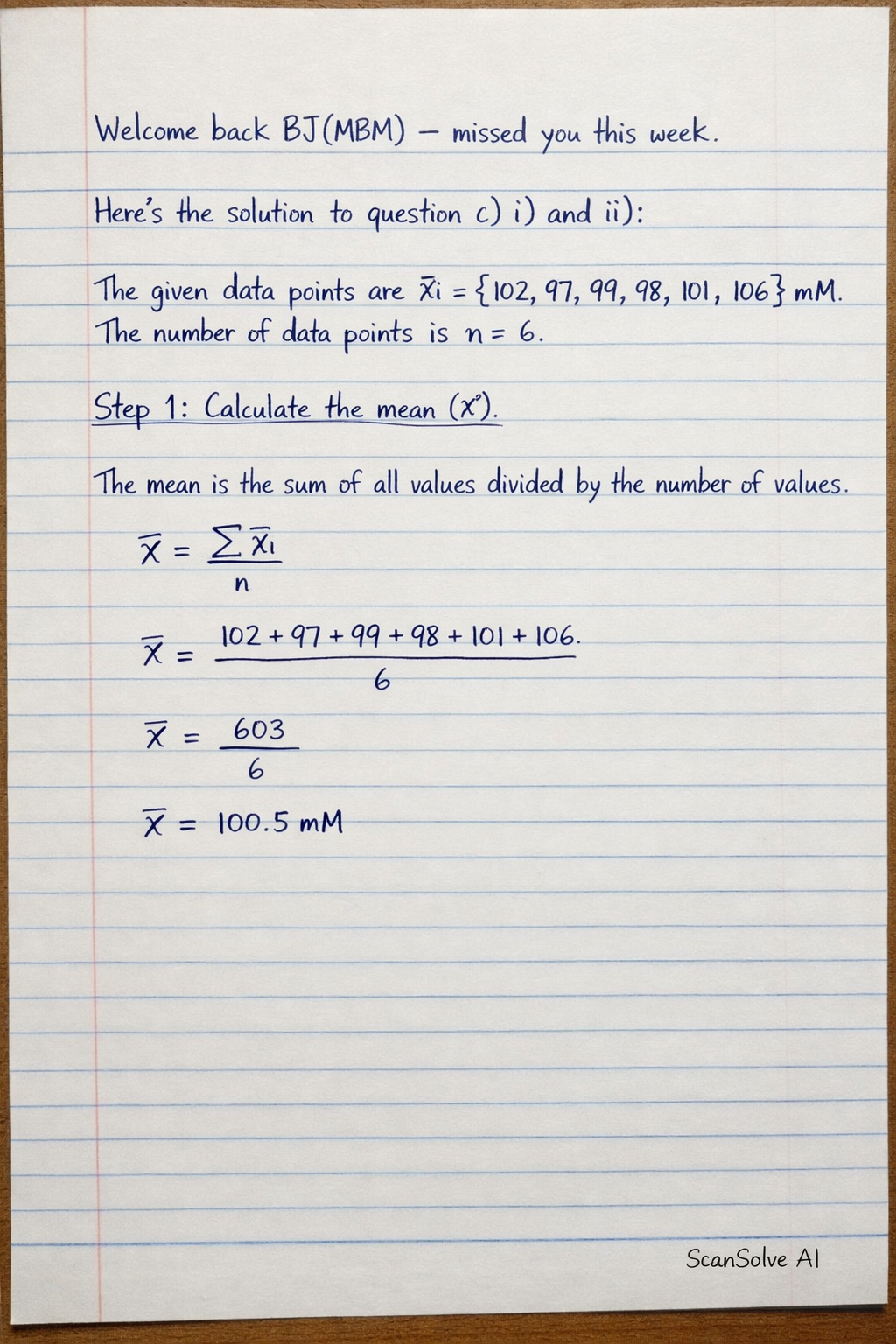
Here's the solution to question c) i) and ii):

c) The sodium ion level in a urine specimen was measured using an ion-selective electrode. The following values were obtained: 102, 97, 99, 98, 101, 106 mM. The value of tst_s for calculating the 95% confidence limit is 2.57 and 99% confidence limits is 4.03.

i) Calculate the mean and standard deviation of these values [2.5 marks]

ii) What are the 95% and 99% confidence limits for the sodium ion concentration? [2.5 marks]

The given data points are xi={102,97,99,98,101,106}x_i = \{102, 97, 99, 98, 101, 106\} mM.
The number of data points is n=6n = 6.

  1. Calculate the mean (xˉ\bar{x}).

    The mean is the sum of all values divided by the number of values.

    xˉ=∑xin\bar{x} = \frac{\sum x_i}{n} xˉ=102+97+99+98+101+1066\bar{x} = \frac{102 + 97 + 99 + 98 + 101 + 106}{6} xˉ=6036\bar{x} = \frac{603}{6} xˉ=100.5 mM\bar{x} = 100.5 \text{ mM}
  2. Calculate the standard deviation (ss).

    The formula for the sample standard deviation is:

    s=∑(xi−xˉ)2n−1s = \sqrt{\frac{\sum (x_i - \bar{x})^2}{n-1}}

    First, calculate (xi−xˉ)2(x_i - \bar{x})^2 for each data point:

    • (102−100.5)2=(1.5)2=2.25(102 - 100.5)^2 = (1.5)^2 = 2.25
    • (97−100.5)2=(−3.5)2=12.25(97 - 100.5)^2 = (-3.5)^2 = 12.25
    • (99−100.5)2=(−1.5)2=2.25(99 - 100.5)^2 = (-1.5)^2 = 2.25
    • (98−100.5)2=(−2.5)2=6.25(98 - 100.5)^2 = (-2.5)^2 = 6.25
    • (101−100.5)2=(0.5)2=0.25(101 - 100.5)^2 = (0.5)^2 = 0.25
    • (106−100.5)2=(5.5)2=30.25(106 - 100.5)^2 = (5.5)^2 = 30.25 Now, sum these values:
    ∑(xi−xˉ)2=2.25+12.25+2.25+6.25+0.25+30.25=53.5\sum (x_i - \bar{x})^2 = 2.25 + 12.25 + 2.25 + 6.25 + 0.25 + 30.25 = 53.5

    Substitute into the standard deviation formula:

    s=53.56−1=53.55=10.7s = \sqrt{\frac{53.5}{6-1}} = \sqrt{\frac{53.5}{5}} = \sqrt{10.7} s≈3.271 mMs \approx 3.271 \text{ mM}
  3. Calculate the 95% confidence limit.

    The formula for the confidence limit (CL) is:

    CL=xˉ±ts⋅sn\text{CL} = \bar{x} \pm \frac{t_s \cdot s}{\sqrt{n}}

    For 95% confidence, ts=2.57t_s = 2.57.

    CL95%=100.5±2.57×3.2716\text{CL}_{95\%} = 100.5 \pm \frac{2.57 \times 3.271}{\sqrt{6}} CL95%=100.5±8.415472.44949\text{CL}_{95\%} = 100.5 \pm \frac{8.41547}{2.44949} CL95%=100.5±3.435\text{CL}_{95\%} = 100.5 \pm 3.435 CL95%=(100.5−3.435,100.5+3.435)\text{CL}_{95\%} = (100.5 - 3.435, 100.5 + 3.435) CL95%=(97.065,103.935) mM\text{CL}_{95\%} = (97.065, 103.935) \text{ mM}
  4. Calculate the 99% confidence limit.

    For 99% confidence, ts=4.03t_s = 4.03.

    CL99%=100.5±4.03×3.2716\text{CL}_{99\%} = 100.5 \pm \frac{4.03 \times 3.271}{\sqrt{6}} CL99%=100.5±13.178132.44949\text{CL}_{99\%} = 100.5 \pm \frac{13.17813}{2.44949} CL99%=100.5±5.380\text{CL}_{99\%} = 100.5 \pm 5.380 CL99%=(100.5−5.380,100.5+5.380)\text{CL}_{99\%} = (100.5 - 5.380, 100.5 + 5.380) CL99%=(95.120,105.880) mM\text{CL}_{99\%} = (95.120, 105.880) \text{ mM}

    i) Mean and Standard Deviation:
    Mean (xˉ\bar{x}): 100.5 mM\boxed{\text{100.5 mM}}
    Standard deviation (ss): 3.271 mM\boxed{\text{3.271 mM}}

    ii) 95% and 99% Confidence Limits:
    95% Confidence Limit: (97.065, 103.935) mM\boxed{\text{(97.065, 103.935) mM}}
    99% Confidence Limit: (95.120, 105.880) mM\boxed{\text{(95.120, 105.880) mM}}

Was this helpful?

Still stuck on this one?

Ask a follow-up, and the answer starts from this question.

Got a different question?Ask your own question
Handwritten step-by-step solution preview

Handwritten Step-by-Step Solution

Get this as a handwritten image on WhatsApp — like a tutor wrote it for you.

Try on WhatsApp