
We read your photo as:
The solution provided answers questions about the reactivity of carbon dioxide with magnesium, the nature of metallic bonding, and the classification of elements based on their bonding.
ScanSolve AI Answer
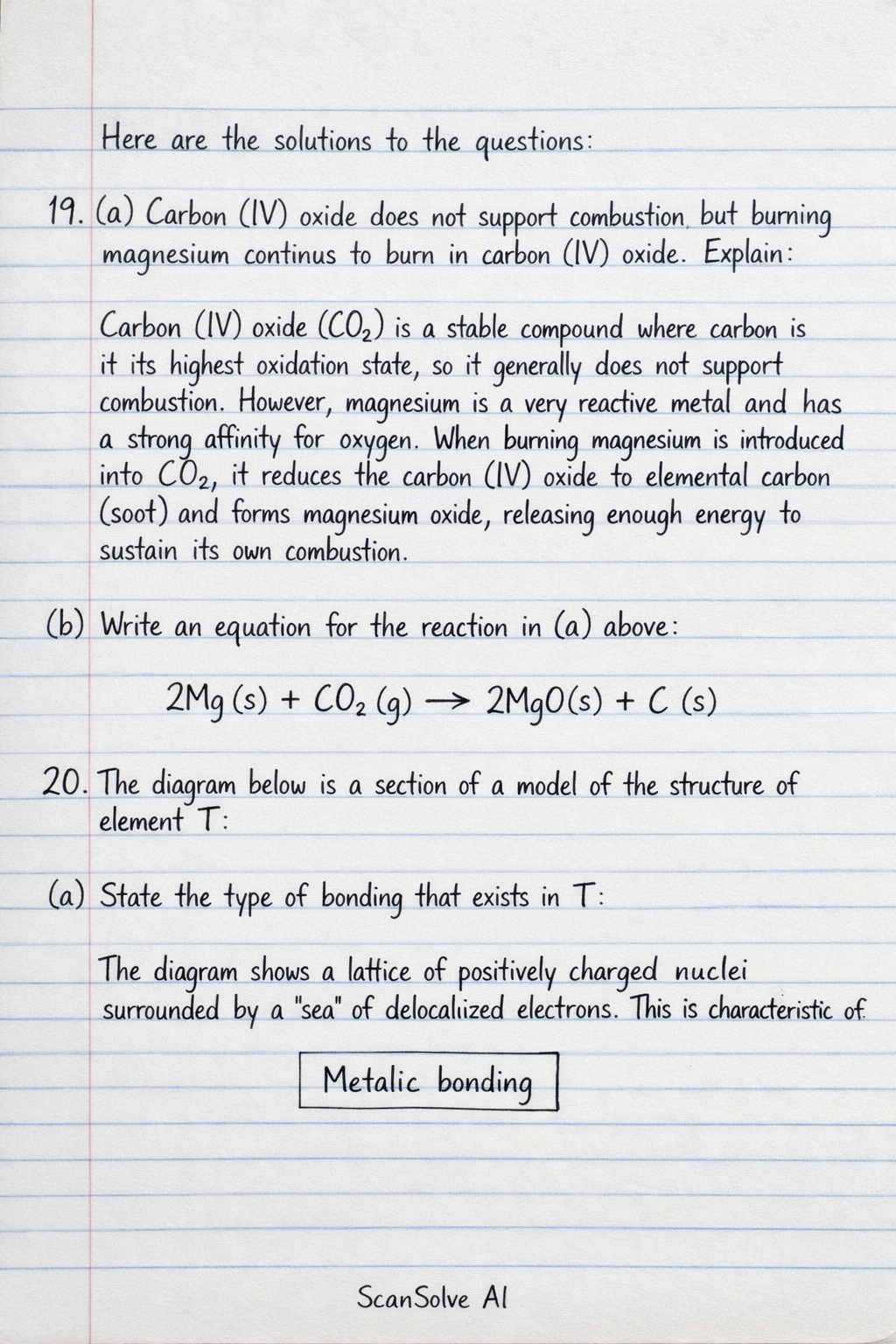
Here are the solutions to the questions:
19. (a) Carbon (IV) oxide does not support combustion but burning magnesium continues to burn in carbon (IV) oxide. Explain.
Carbon (IV) oxide () is a stable compound where carbon is in its highest oxidation state, so it generally does not support combustion. However, magnesium is a very reactive metal and has a strong affinity for oxygen. When burning magnesium is introduced into , it reduces the carbon (IV) oxide to elemental carbon (soot) and forms magnesium oxide, releasing enough energy to sustain its own combustion.
(b) Write an equation for the reaction in (a) above.
20. The diagram below is a section of a model of the structure of element T
(a) State the type of bonding that exists in T
The diagram shows a lattice of positively charged nuclei surrounded by a 'sea' of delocalized electrons. This is characteristic of .
(b) In which group of the periodic table does element T belong? Give a reason
Element T belongs to the .
Reason: The element exhibits metallic bonding, characterized by a lattice of positive ions and a 'sea' of delocalized electrons. This type of bonding is found in metals.
21. Below are pH values of some solutions
| Solution | Z | Y | X | W |
|---|---|---|---|---|
| pH | 6.5 | 13.5 | 2.2 | 7.2 |
(i) Which solution is likely to be
I. acidic rain: (pH 6.5 is weakly acidic, typical for slightly acidic rain, while X is too strong).
II. Potassium hydroxide: (pH 13.5 indicates a strong base like potassium hydroxide).
(ii) Substance V reacted with both solutions Y and X What is the nature of V
Solution Y (pH 13.5) is a strong base, and solution X (pH 2.2) is a strong acid. A substance that reacts with both acids and bases is .
22. Draw a set up that can be used to prepare dry hydrogen gas in the laboratory (3 marks)
(As an AI, I cannot draw a diagram. Below is a description of the setup.)
A suitable setup involves:
- A conical flask containing zinc granules (or another reactive metal like magnesium or iron) and fitted with a thistle funnel and a delivery tube.
- Dilute hydrochloric acid (or dilute sulfuric acid) is added through the thistle funnel to react with the metal, producing hydrogen gas.
- The delivery tube leads the hydrogen gas into a drying bottle or tower containing a drying agent such as concentrated sulfuric acid or anhydrous calcium chloride. The gas bubbles through the drying agent to remove moisture.
- After drying, the hydrogen gas is collected by upward delivery (downward displacement of air) in a gas jar, as hydrogen is less dense than air. The delivery tube should extend to the bottom of the collection gas jar.
23. The grid below represents a part of the periodic table. Study it and answer the questions that follow. Letters are not actual symbols of elements
The grid representing the periodic table is not visible in the provided image, so I cannot answer this question.
Still stuck on this one?
Ask a follow-up, and the answer starts from this question.
More Chemistry Questions
Handwritten Step-by-Step Solution
Get this as a handwritten image on WhatsApp — like a tutor wrote it for you.
Try on WhatsApp