Solve this chemistry question

Chemistry
Solve this chemistry question

ScanSolve AI Answer

4 steps

Answer

Calcium > Magnesium > Beryllium

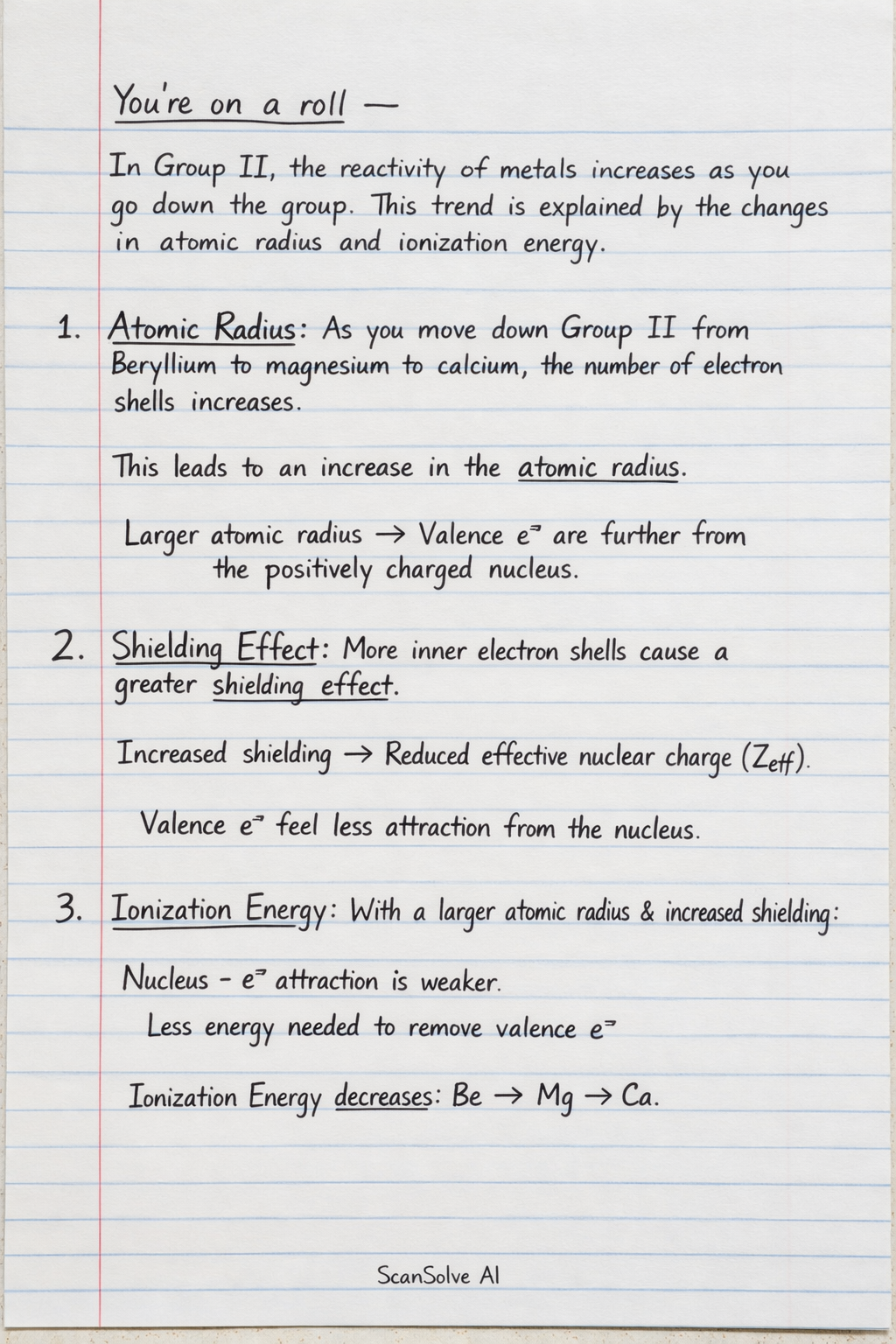
You're on a roll —

In Group II, the reactivity of metals increases as you go down the group. This trend is explained by the changes in atomic radius and ionization energy.

  1. Atomic Radius: As you move down Group II from beryllium to magnesium to calcium, the number of electron shells increases. This leads to an increase in the atomic radius. A larger atomic radius means the outermost valence electrons are further away from the positively charged nucleus.
  2. Shielding Effect: The increased number of inner electron shells also causes a greater shielding effect, reducing the effective nuclear charge experienced by the valence electrons.
  3. Ionization Energy: Due to the larger atomic radius and increased shielding, the attraction between the nucleus and the valence electrons becomes weaker down the group. Consequently, less energy is required to remove these outermost electrons, meaning the ionization energy decreases from beryllium to magnesium to calcium.
  4. Reactivity: For metals, reactivity is determined by their ability to lose valence electrons easily to form positive ions. Since calcium has a larger atomic radius and lower ionization energy compared to magnesium and beryllium, it loses its valence electrons most readily. This makes calcium the most reactive, followed by magnesium, and then beryllium.

Therefore, the reactivity order is Calcium>Magnesium>Beryllium\boxed{Calcium > Magnesium > Beryllium}.

Drop the next question.

Was this helpful?

Need help with your own homework?

Get instant step-by-step solutions to any question. Free to start.

Ask Your Question
Handwritten step-by-step solution preview

Handwritten Step-by-Step Solution

Get this as a handwritten image on WhatsApp — like a tutor wrote it for you.

Try on WhatsApp

Still have questions?

Quick Answer

You're on a roll — In Group II, the reactivity of metals increases as you go down the group.

Solve this chemistry question
Chemistry

This chemistry question involves key chemical concepts and calculations. The detailed solution below walks through each step, from identifying the reaction type to computing the final answer.

ScanSolve AI Answer
You're on a roll — In Group II, the reactivity of metals increases as you go down the group. This trend is explained by the changes in atomic radius and ionization energy. 1. Atomic Radius: As you move down Group II from beryllium to magnesium to calcium, the number of electron shells increases. This leads to an increase in the atomic radius. A larger atomic radius means the outermost valence electrons are further away from the positively charged nucleus. 2. Shielding Effect: The increased number of inner electron shells also causes a greater shielding effect, reducing the effective nuclear charge experienced by the valence electrons. 3. Ionization Energy: Due to the larger atomic radius and increased shielding, the attraction between the nucleus and the valence electrons becomes weaker down the group. Consequently, less energy is required to remove these outermost electrons, meaning the ionization energy decreases from beryllium to magnesium to calcium. 4. Reactivity: For metals, reactivity is determined by their ability to lose valence electrons easily to form positive ions. Since calcium has a larger atomic radius and lower ionization energy compared to magnesium and beryllium, it loses its valence electrons most readily. This makes calcium the most reactive, followed by magnesium, and then beryllium. Therefore, the reactivity order is Calcium > Magnesium > Beryllium. Drop the next question.