
We read your photo as:
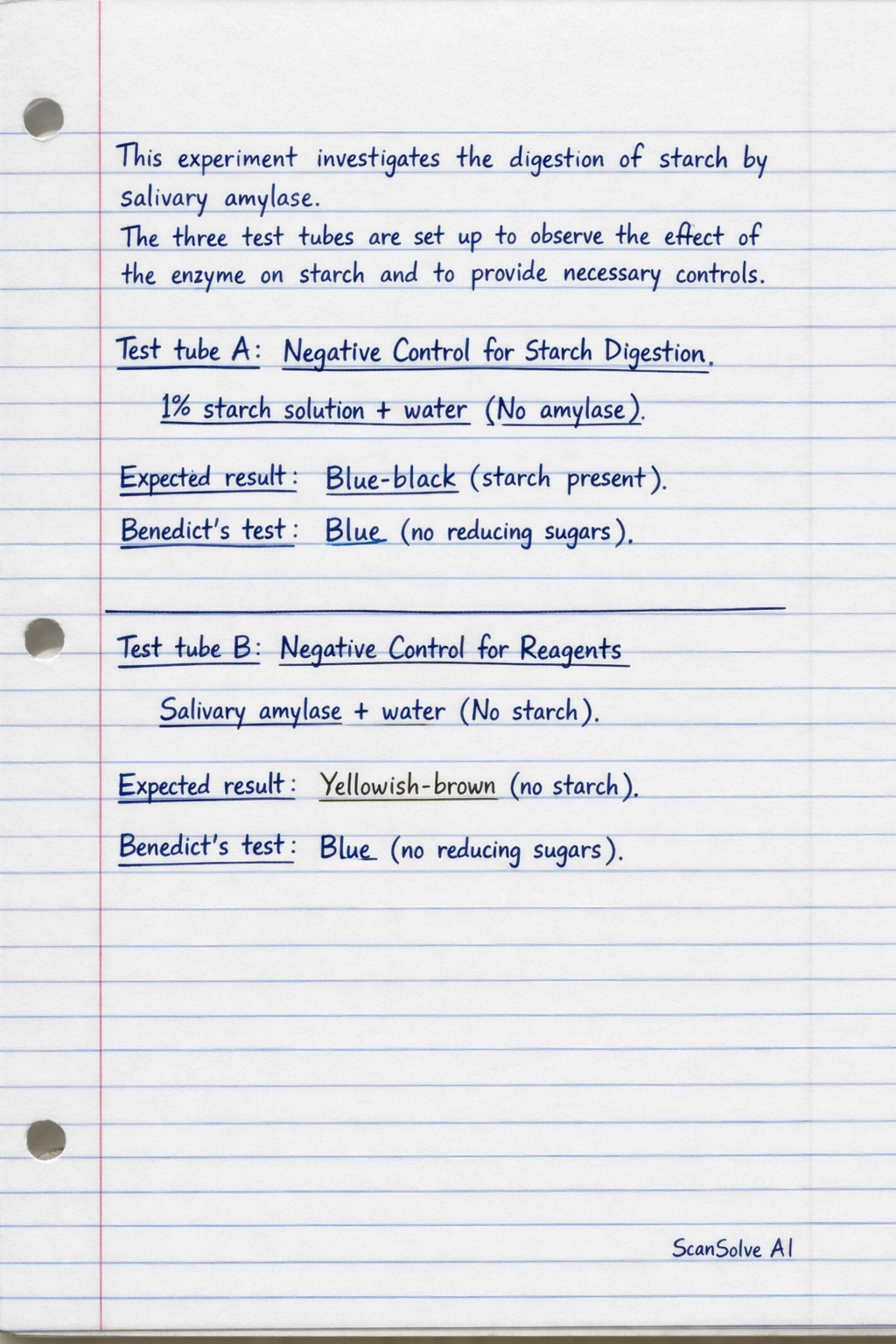
This experiment investigates the digestion of starch by salivary amylase. The three test tubes are set up to observe the effect of the enzyme on starch and to provide necessary controls.
ScanSolve AI Answer
This experiment investigates the digestion of starch by salivary amylase. The three test tubes are set up to observe the effect of the enzyme on starch and to provide necessary controls.
-
Test tube A: This serves as a negative control for starch digestion. It contains 1% starch solution and water, but no salivary amylase. This setup demonstrates that starch does not spontaneously break down in the presence of water alone.
- Expected result with Iodine test: Blue-black (starch present).
- Expected result with Benedict's test: Blue (no reducing sugars).
-
Test tube B: This serves as a negative control for the reagents themselves. It contains salivary amylase and water, but no starch solution. This ensures that any observed changes in the experimental tube are due to the digestion of starch and not due to pre-existing starch or reducing sugars in the amylase solution.
- Expected result with Iodine test: Yellowish-brown (no starch).
- Expected result with Benedict's test: Blue (no reducing sugars).
-
Test tube C: This is the experimental setup. It contains both 1% starch solution and salivary amylase. This tube is expected to show the digestion of starch into smaller reducing sugars (like maltose) by the enzyme amylase, given the appropriate incubation conditions (37°C for 10 minutes).
- Expected result with Iodine test: Yellowish-brown or reduced blue-black (starch digested).
- Expected result with Benedict's test: Green, yellow, orange, or brick-red precipitate upon heating (reducing sugars present).
Still stuck on this one?
Ask a follow-up, and the answer starts from this question.
More Chemistry Questions
Handwritten Step-by-Step Solution
Get this as a handwritten image on WhatsApp — like a tutor wrote it for you.
Try on WhatsApp