
We read your photo as:
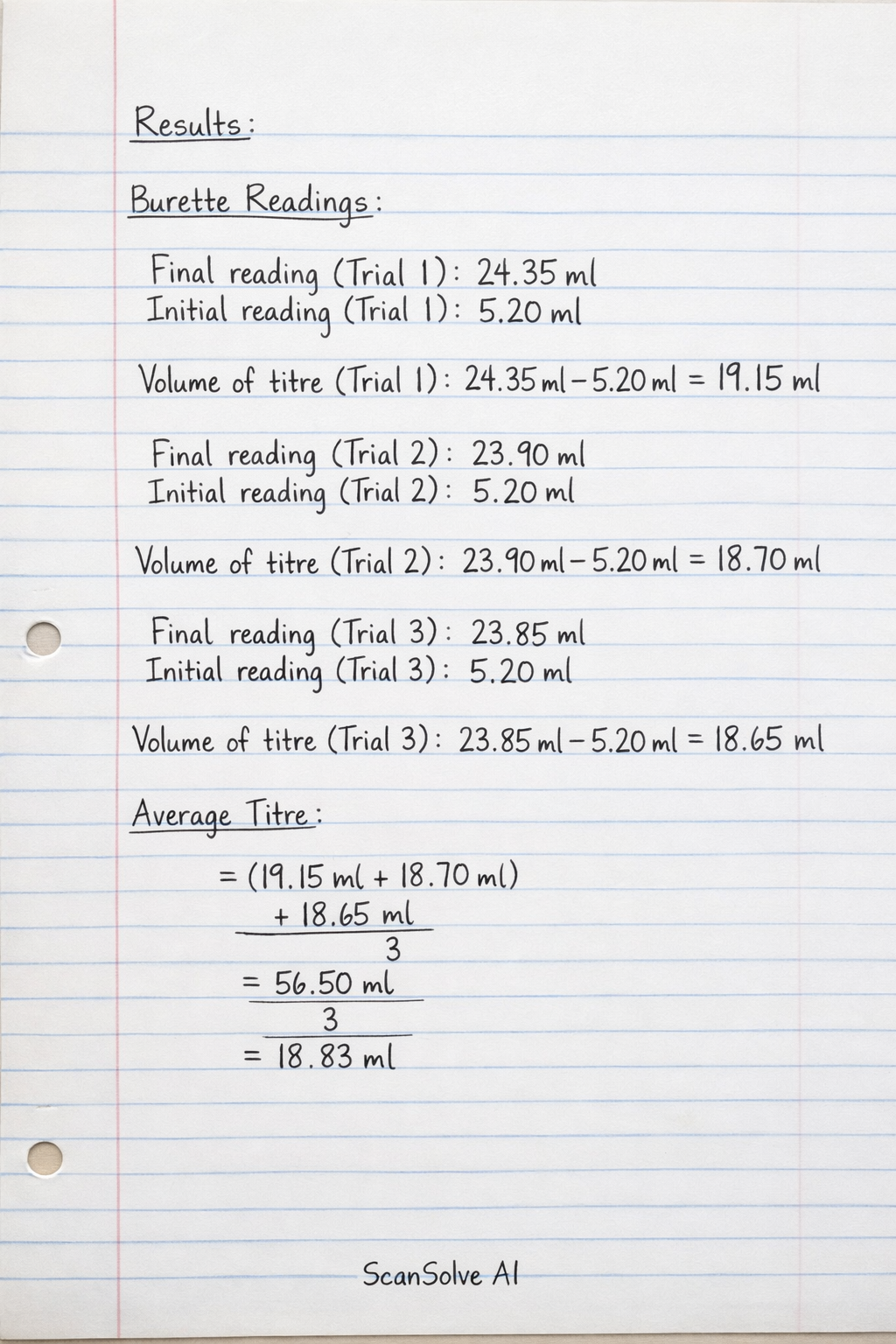
This image shows a template for a chemistry practical report. There are no specific questions to solve here, but I can explain what each section typically requires:
Chemistry
ScanSolve AI Answer
This image shows a template for a chemistry practical report. There are no specific questions to solve here, but I can explain what each section typically requires:
- Result:
- Burette reading: This table is for recording your experimental data during a titration.
- Final reading (ml): The volume reading on the burette after the titration is complete.
- Initial reading (ml): The volume reading on the burette before starting the titration.
- Volume of titre (ml): This is calculated by subtracting the initial reading from the final reading (Final reading - Initial reading). You would do this for each trial (First, Second, Third).
- Average titre (ml): You calculate this by summing the consistent volumes of titre (usually the second and third readings if they are close, or all if they are consistent) and dividing by the number of readings used.
- Burette reading: This table is for recording your experimental data during a titration.
- Calculation: This section is where you would perform all the necessary calculations based on your average titre and other given information (e.g., concentration of standard solution, volume of analyte). This typically involves using stoichiometry to find an unknown concentration.
- Precautions: Here, you list the steps taken to ensure the accuracy and safety of your experiment. Examples include ensuring the burette is clean, removing air bubbles, reading the meniscus at eye level, and wearing safety goggles.
- Pre laboratory questions: These are questions designed to test your understanding of the experiment's theory and procedure before you perform the lab.
- Post laboratory questions: These questions typically require you to analyze your results, explain observations, and relate them to chemical principles after completing the lab.
- Discussion: In this section, you interpret your results, discuss any sources of error, compare your findings to theoretical values (if applicable), and suggest improvements for future experiments.
- Conclusion: A brief summary of your findings, stating whether the objective of the experiment was met and what was determined.
- Reference: List any textbooks, manuals, or other sources you used to prepare for or understand the experiment.
If you have specific data or questions related to filling out this report, please provide them!
Was this helpful?
Still stuck on this one?
Ask a follow-up, and the answer starts from this question.
Got a different question?Ask your own question
More Chemistry Questions
QMake an organic chemistry practical report (20 marks)QSummarize the key instructions and statements from the Supervisor's Report for a practical chemistry…QWrite a chemistry lab reportQSummarize the key instructions for conducting practical chemistry exams, focusing on supervisor…QWhat are the key points and instructions regarding the supervisor's report and practical…
Handwritten Step-by-Step Solution
Get this as a handwritten image on WhatsApp — like a tutor wrote it for you.
Try on WhatsApp