
This chemistry question involves key chemical concepts and calculations. The detailed solution below walks through each step, from identifying the reaction type to computing the final answer.
ScanSolve AI Answer
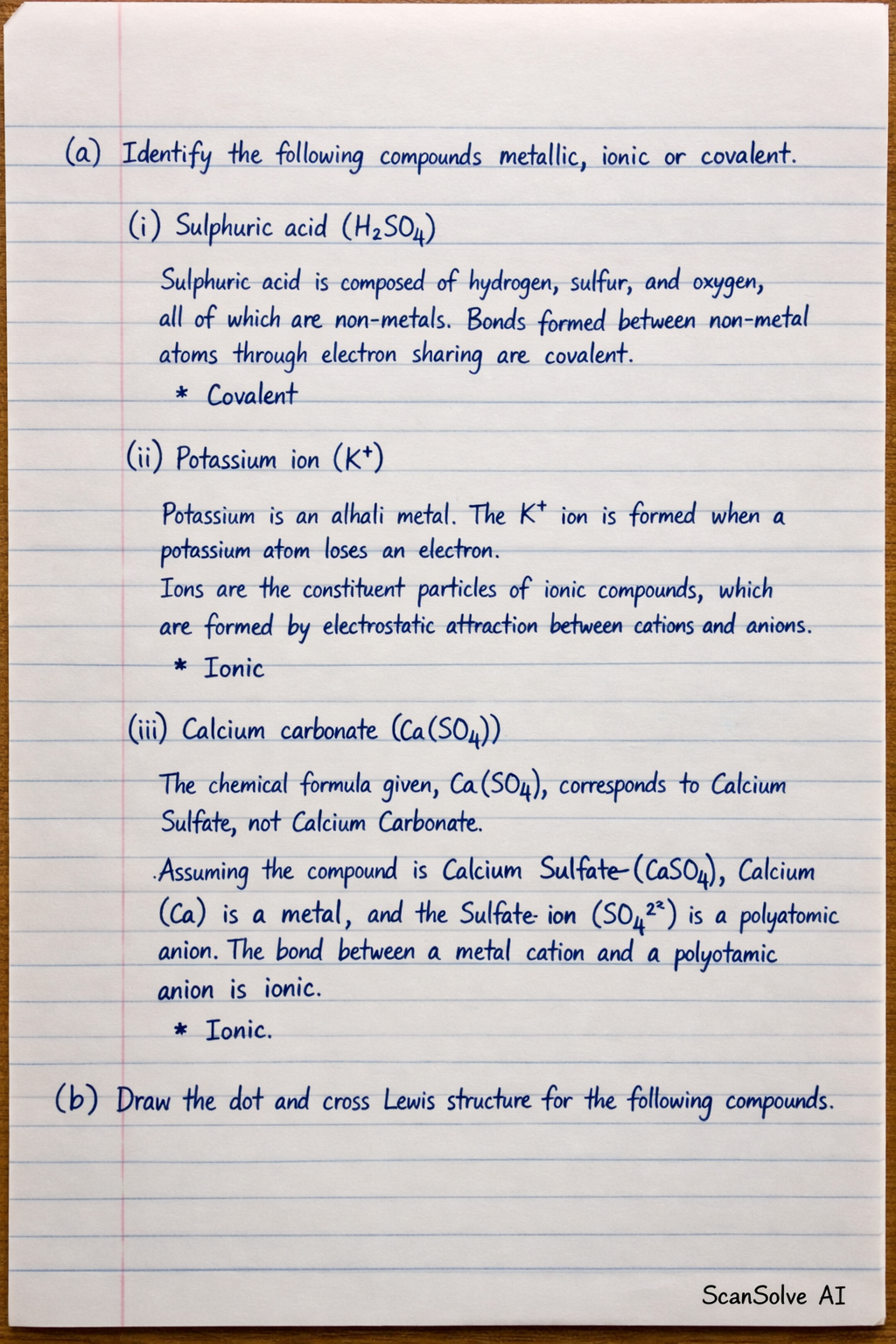
a) Identify the following compounds metallic, ionic or covalent. (i) Sulphuric acid (H₂SO₄) Sulphuric acid is composed of hydrogen, sulfur, and oxygen, all of which are non-metals. Bonds formed between non-metal atoms through electron sharing are covalent. Covalent (ii) Potassium ion (K⁺) Potassium is an alkali metal. The K⁺ ion is formed when a potassium atom loses an electron. Ions are the constituent particles of ionic compounds, which are formed by electrostatic attraction between cations and anions. Ionic (iii) Calcium carbonate (Ca(SO₄)) The chemical formula given, Ca(SO₄), corresponds to Calcium Sulfate, not Calcium Carbonate. Assuming the compound is Calcium Sulfate (CaSO₄), Calcium (Ca) is a metal, and the Sulfate ion (SO₄²⁻) is a polyatomic anion. The bond between a metal cation and a polyatomic anion is ionic. Ionic b) Draw the dot and cross Lewis structure for the following compounds. (i) Ca(SO₄) Calcium sulfate is an ionic compound. It consists of a calcium cation (Ca²⁺) and a sulfate anion (SO₄²⁻). Calcium loses two valence electrons to become Ca²⁺. The sulfate ion contains covalent bonds between sulfur and oxygen atoms, with an overall 2- charge. Ca^2+ · · \\ · · O ××S O · · \\ · · \\ · · \\ O \\ · · ^2- (Note: In the sulfate ion, sulfur's valence electrons are represented by crosses, and oxygen's valence electrons and the two extra electrons for the 2- charge are represented by dots. Each oxygen atom has three lone pairs, and sulfur forms four single bonds with the oxygen atoms.) (ii) NH₄(Cl) Ammonium chloride is an ionic compound. It consists of an ammonium cation (NH₄⁺) and a chloride anion (Cl⁻). The ammonium ion has covalent bonds between nitrogen and hydrogen atoms, with an overall +1 charge. The chloride ion is a chlorine atom that has gained an electron, resulting in a -1 charge. H \\ H ··N H \\ H ^+ · · \\ × Cl × \\ · · ^- (Note: In the ammonium ion, nitrogen's valence electrons are represented by dots, and hydrogen's valence electrons are represented by crosses. One electron is removed for the +1 charge. In the chloride ion, chlorine's original valence electrons are dots, and the gained electron is a cross, completing its octet.) c) Ammonia reacts with boron-trifluoride to form ammonia-boron-trifluoride. Use dot and cross to draw the molecular structure of the atoms to show the bonding of the following. (i) Ammonia (NH₃) Ammonia is a covalent molecule. Nitrogen shares electrons with three hydrogen atoms and has one lone pair of electrons. c H \\ × \\ H ··N · H \\ (Note: Nitrogen's valence electrons are shown as dots, and hydrogen's valence electrons are shown as crosses.) (ii) Boron-trifluoride (BF₃) Boron trifluoride is a covalent molecule. Boron shares electrons with three fluorine atoms. Boron typically has an incomplete octet in BF₃. c \ ✂️ _That answer was long and got cut off. Reply continue and I'll finish it._