
We read your photo as:
This table represents a segment of the periodic table of elements. It is organized by groups (vertical columns, indicated by Roman numerals at the bottom) and periods (horizontal rows, though no
ScanSolve AI Answer
This table represents a segment of the periodic table of elements. It is organized by groups (vertical columns, indicated by Roman numerals at the bottom) and periods (horizontal rows, though not explicitly numbered here, they correspond to increasing atomic number down each group).
Let's orient the table correctly and analyze its contents:
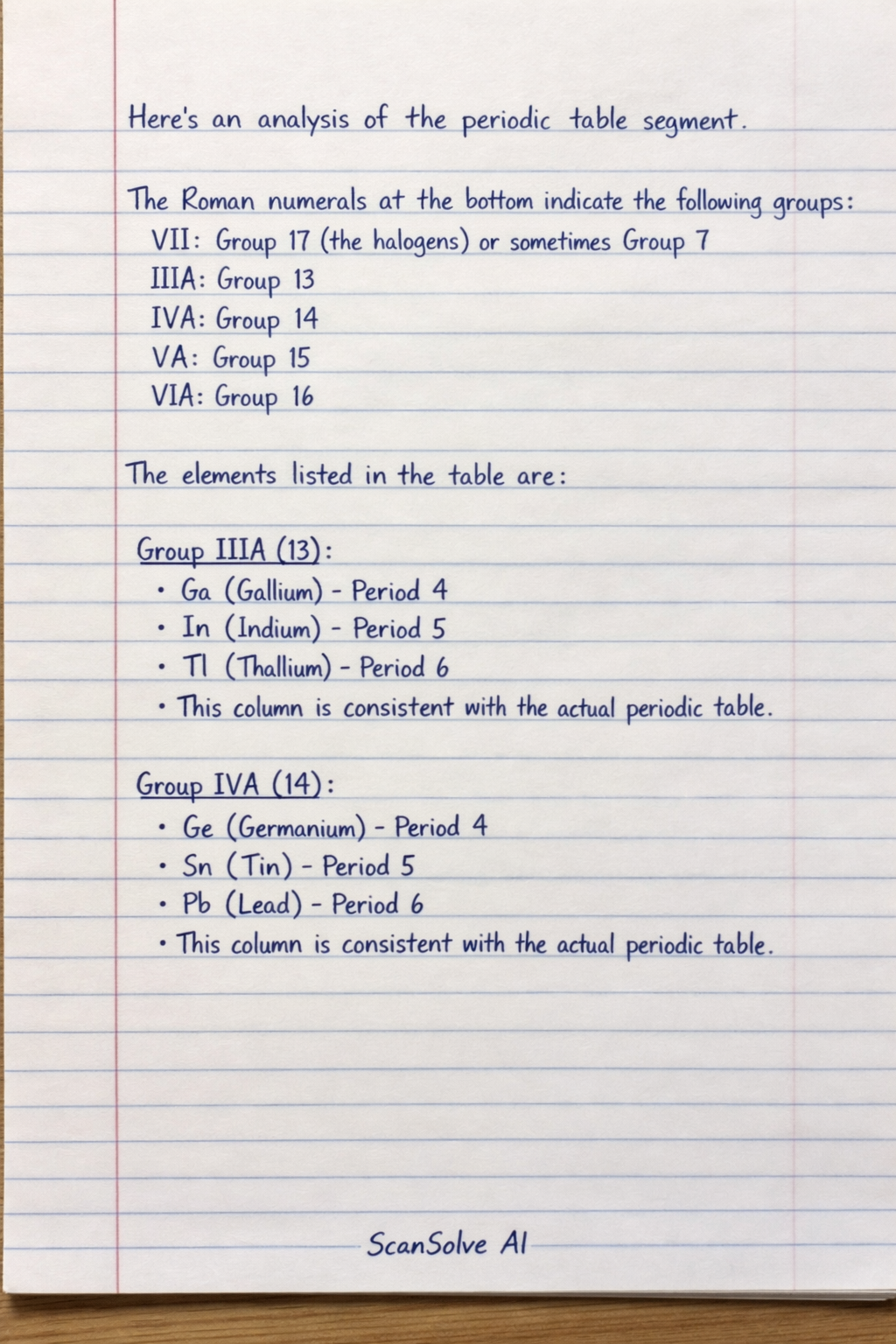
The Roman numerals at the bottom indicate the following groups:
- VII (This typically refers to Group 17, the halogens, or sometimes Group 7 transition metals)
- IIIA (Group 13)
- IVA (Group 14)
- VA (Group 15)
- VIA (Group 16)
The elements listed in the table are:
-
Group IIIA (13):
- Ga (Gallium) - Period 4
- In (Indium) - Period 5
- Tl (Thallium) - Period 6
- This column is consistent with the actual periodic table.
-
Group IVA (14):
- Ge (Germanium) - Period 4
- Sn (Tin) - Period 5
- Pb (Lead) - Period 6
- This column is consistent with the actual periodic table.
-
Group VA (15):
- Sb (Antimony) - Period 5
- Bi (Bismuth) - Period 6
- (Arsenic, As, from Period 4 is missing)
- This column is consistent with the actual periodic table for the elements shown.
-
Group VIA (16):
- Te (Tellurium) - Period 5
- (Selenium, Se, from Period 4 and Polonium, Po, from Period 6 are missing)
- This column is consistent with the actual periodic table for the element shown.
-
Column labeled VII:
- Hg (Mercury) - Period 6
- This column shows an inconsistency. Mercury (Hg) is located in Group 12 (IIB) of the periodic table, not Group 17 (VIIA) or Group 7 (VIIB). If the label "VII" refers to Group 17, then Hg is misplaced. If it's meant to be Group 12, the label is incorrect.
In summary, the table displays a portion of the periodic table, primarily focusing on main group elements from Group 13 to Group 16 across periods 4, 5, and 6. However, the placement of Mercury (Hg) under the Group VII label is incorrect, as Mercury belongs to Group 12.
Still stuck on this one?
Ask a follow-up, and the answer starts from this question.
More Chemistry Questions
Handwritten Step-by-Step Solution
Get this as a handwritten image on WhatsApp — like a tutor wrote it for you.
Try on WhatsApp