

This chemistry question involves key chemical concepts and calculations. The detailed solution below walks through each step, from identifying the reaction type to computing the final answer.
ScanSolve AI Answer
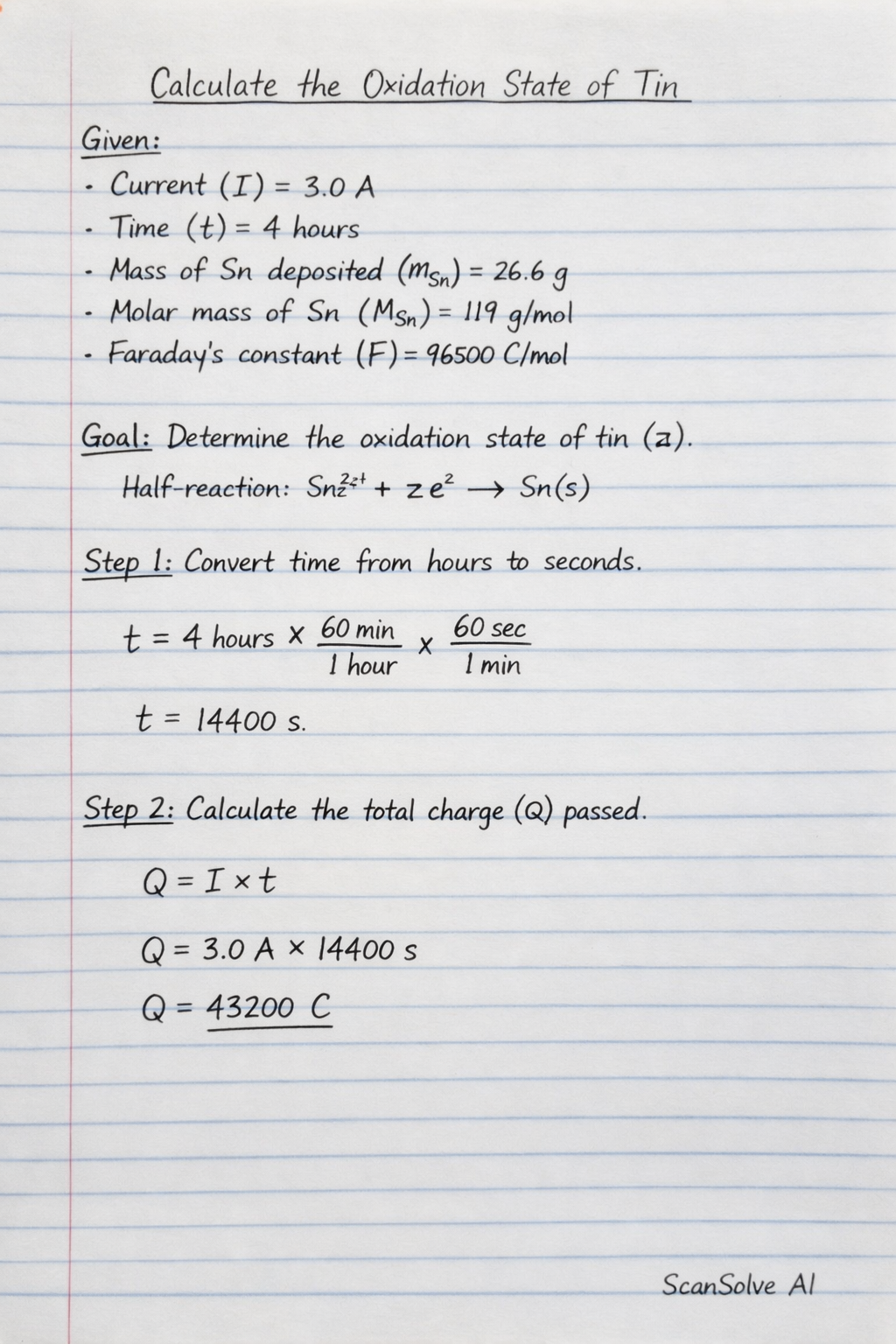
Here's the solution using a method commonly found in chemistry textbooks, breaking down the steps to calculate the oxidation state. Given: Current (I) = 3.0 A Time (t) = 4 hours Mass of tin deposited (m_Sn) = 26.6 g Molar mass of tin (M_Sn) = 119 g/mol Faraday's constant (F) = 96500 C/mol Goal: Determine the oxidation state of tin, which is the number of electrons (z) involved in the reduction of tin ions to tin metal. The general half-reaction is Sn^z+ + ze^- Sn(s). Step 1: Convert time from hours to seconds. t = 4 hours × 60 minutes1 hour × 60 seconds1 minute t = 14400 s Step 2: Calculate the total quantity of electricity (charge, Q) passed. The formula for charge is Q = I × t. Q = 3.0 A × 14400 s Q = 43200 C Step 3: Calculate the moles of tin (Sn) deposited. The formula for moles is n = massmolar mass. n_Sn = 26.6 g119 g/mol n_Sn ≈ 0.223529 mol Step 4: Calculate the moles of electrons (n_e) transferred. One mole of electrons carries a charge equal to Faraday's constant (F). n_e = (Q)/(F) n_e = 43200 C96500 C/mol n_e ≈ 0.447668 mol Step 5: Determine the oxidation state (z) of tin. From the half-reaction Sn^z+ + ze^- Sn(s), we know that z moles of electrons are required to deposit 1 mole of tin. Therefore, the ratio of moles of electrons to moles of tin gives the oxidation state. z = (n_e)/(n_Sn) z = 0.447668 mol0.223529 mol z ≈ 2.0027 Rounding to the nearest whole number, as oxidation states are typically integers: z = 2 The oxidation state of tin in the salt is +2.