
We read your photo as:
Calculate the total volume of hydrogen gas that was liberated at S.T.P conditions (Zn = 65.4, molar gas volume = 22.4 litres at S.T.P) assuming one mole of zinc reacted.
ScanSolve AI Answer
Step-by-step solution
8 stepsHere are the solutions to your questions.
b) Calculate the total volume of hydrogen gas that was liberated at S.T.P conditions (Zn = 65.4, molar gas volume = 22.4 litres at S.T.P)
To calculate the volume of hydrogen gas liberated, we need to know the amount of zinc that reacted. Since no specific mass of zinc is provided, we will assume that one mole of zinc reacts.
Write the balanced chemical equation for the reaction of zinc with an acid to produce hydrogen gas.
A common reaction is zinc reacting with hydrochloric acid:
From the stoichiometry, 1 mole of produces 1 mole of .
Determine the moles of liberated.
Assuming 1 mole of reacts, then 1 mole of is produced.
Calculate the volume of at S.T.P.
At S.T.P., 1 mole of any gas occupies 22.4 litres.
The total volume of hydrogen gas liberated, assuming one mole of zinc reacted, is .
- Calculate the mass of nitrogen (IV) oxide gas that would occupy the same volume as 10g of hydrogen gas at the same temperature and pressure. (H = 1.0, N = 14.0, O = 16.0)
Calculate the molar mass of hydrogen gas ().
Calculate the moles of hydrogen gas ().
Determine the moles of nitrogen (IV) oxide gas ().
According to Avogadro's Law, at the same temperature and pressure, equal volumes of all gases contain the same number of moles. Since nitrogen (IV) oxide gas occupies the same volume as hydrogen gas at the same temperature and pressure, they must have the same number of moles.
Calculate the molar mass of nitrogen (IV) oxide gas ().
Calculate the mass of nitrogen (IV) oxide gas ().
The mass of nitrogen (IV) oxide gas is .
Still stuck on this one?
Ask a follow-up, and the answer starts from this question.
More Chemistry Questions
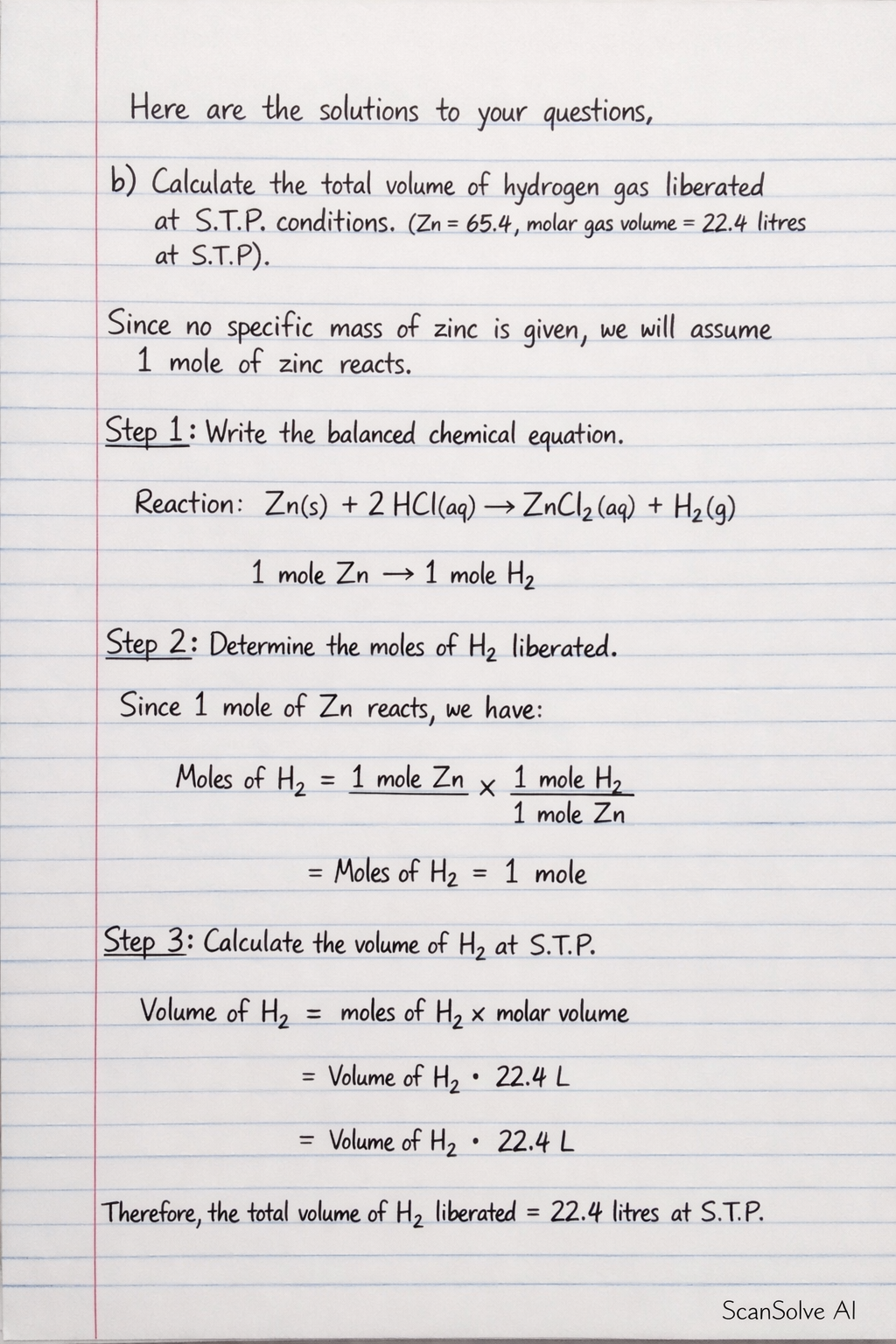
Handwritten Step-by-Step Solution
Get this as a handwritten image on WhatsApp — like a tutor wrote it for you.
Try on WhatsApp