
We read your photo as:
Explain the trends in melting points, reactivity, and bonding for elements based on their position in the periodic table.
ScanSolve AI Answer
Answer
Step-by-step solution
4 stepsHere are the solutions to questions 17 and 18.
Part 17
Elements and their properties
Part a
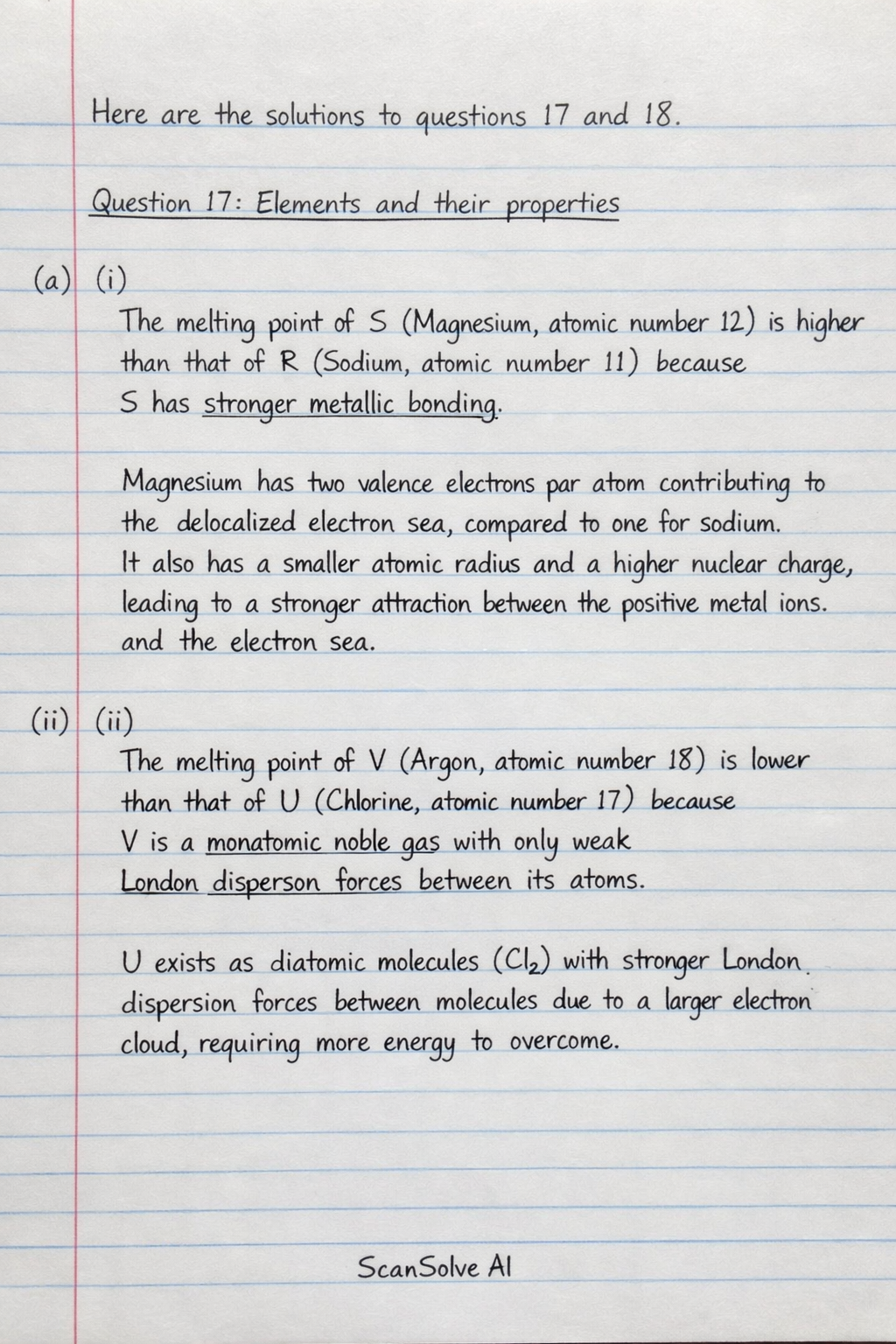
- (i) The melting point of S (Magnesium, atomic number 12) is higher than that of R (Sodium, atomic number 11) because S has stronger metallic bonding. Magnesium has two valence electrons per atom contributing to the delocalized electron sea, compared to one for sodium. It also has a smaller atomic radius and a higher nuclear charge, leading to a stronger attraction between the positive metal ions and the electron sea.
- (ii) The melting point of V (Argon, atomic number 18) is lower than that of U (Chlorine, atomic number 17) because V is a monatomic noble gas with only weak London dispersion forces between its atoms. U exists as diatomic molecules () with stronger London dispersion forces between molecules due to a larger electron cloud, requiring more energy to overcome.
b) The reactivity of W (Potassium, atomic number 19) with chlorine is higher than that of R (Sodium, atomic number 11) with chlorine. This is because W is below R in Group 1 of the periodic table. As you go down Group 1, the atomic radius increases, and the outermost electron is further from the nucleus, experiencing less effective nuclear charge. This makes it easier to lose the valence electron, thus increasing reactivity.
Part c
The equation for the reaction between T (Phosphorus, atomic number 15) and excess oxygen is
Part d23
To determine the relative atomic mass of R (Sodium)
Calculate the moles of hydrogen gas produced.
Write the balanced chemical equation for the reaction of R with water.
Use stoichiometry to find the moles of R.
From the equation, produce .
Calculate the relative atomic mass of R.
Part e
One use of element V (Argon, atomic number 18) is as an inert atmosphere for welding (or filling light bulbs).
Part f
The chloride of element M vaporizes easily while its oxide has a high melting point.
- The chloride of M has a simple molecular structure with weak intermolecular forces (van der Waals forces). Little energy is required to overcome these forces, so it vaporizes easily.
- The oxide of M has a giant ionic structure (or giant covalent network structure) with strong electrostatic forces of attraction between ions (or strong covalent bonds throughout the network). A large amount of energy is required to overcome these strong forces, resulting in a high melting point.
d) (This part refers to a separate table for elements L and M, which are not explicitly defined by atomic number in the provided text. Assuming L is a Group 1 metal like Sodium and M is a non-metal like Phosphorus for typical comparison):
| Element | Formula of chloride | Nature of chloride
Try one yourself
A new problem that tests the same skill.
Still stuck on this one?
Ask a follow-up, and the answer starts from this question.
More Chemistry Questions
Handwritten Step-by-Step Solution
Get this as a handwritten image on WhatsApp — like a tutor wrote it for you.
Try on WhatsApp