
We read your photo as:
State two hazards in the school laboratory.
Chemistry
ScanSolve AI Answer
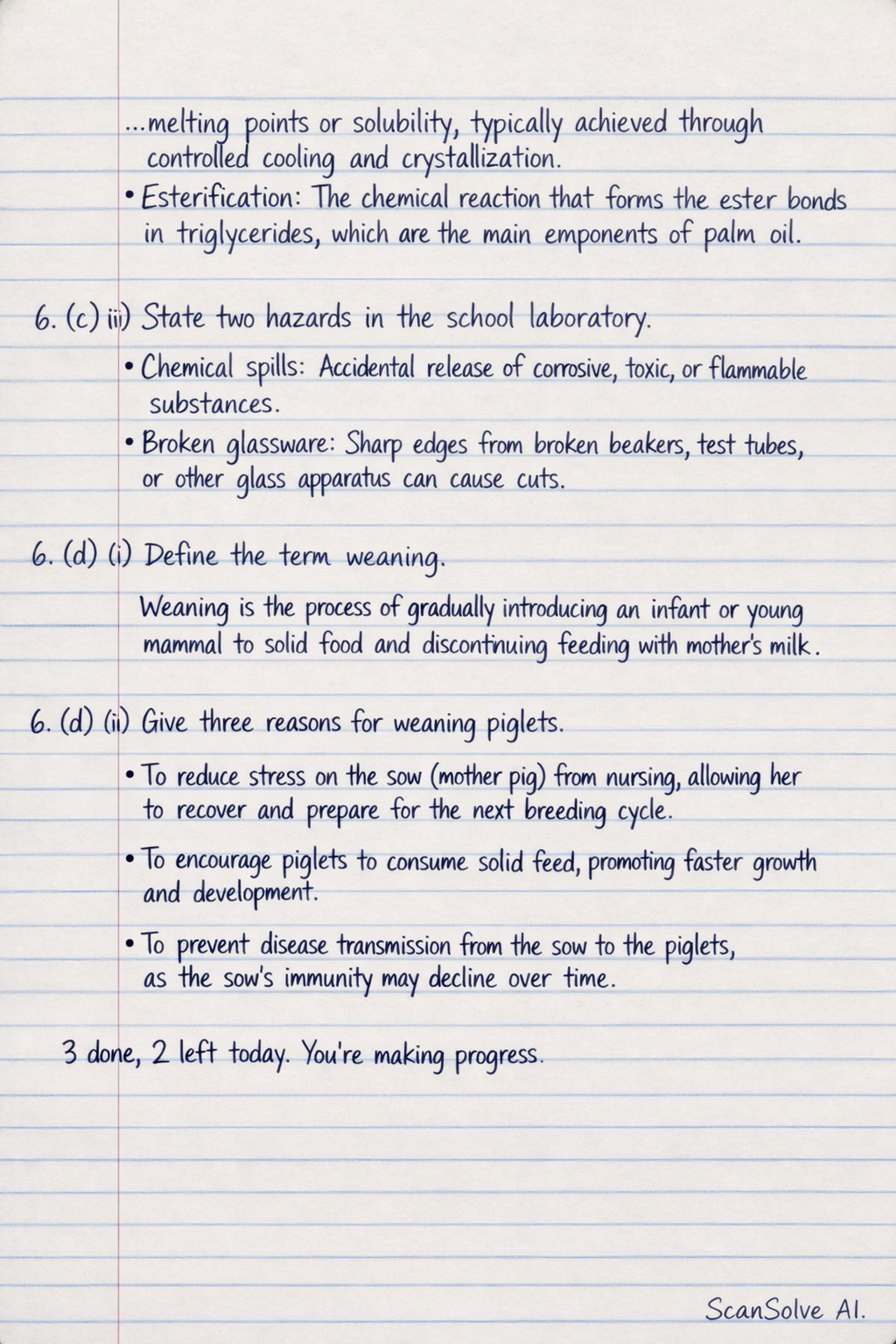
...melting points or solubility, typically achieved through controlled cooling and crystallization.
- Esterification: The chemical reaction that forms the ester bonds in triglycerides, which are the main components of palm oil.
6. (c) (ii) State two hazards in the school laboratory.
- Chemical spills: Accidental release of corrosive, toxic, or flammable substances.
- Broken glassware: Sharp edges from broken beakers, test tubes, or other glass apparatus can cause cuts.
6. (d) (i) Define the term weaning.
Weaning is the process of gradually introducing an infant or young mammal to solid food and discontinuing feeding with mother's milk.
6. (d) (ii) Give three reasons for weaning piglets.
- To reduce stress on the sow (mother pig) from nursing, allowing her to recover and prepare for the next breeding cycle.
- To encourage piglets to consume solid feed, promoting faster growth and development.
- To prevent disease transmission from the sow to the piglets, as the sow's immunity may decline over time.
Was this helpful?
Still stuck on this one?
Ask a follow-up, and the answer starts from this question.
Got a different question?Ask your own question
More Chemistry Questions
QQ1. Define the term “hazard” and identify four (4) different types of hazards that can occur in your…QQuestion 2: Describe five (5) possible causes of hazards in a science laboratory. For each cause…QIdentify the apparatus shown in figure 21, its uses and labelled parts. List three hazards in a…QWhat are the safety precautions and hazard symbols related to chemicals in a laboratory setting?QWhat are the health risks associated with pesticides, and how should hazardous substances be stored…
Handwritten Step-by-Step Solution
Get this as a handwritten image on WhatsApp — like a tutor wrote it for you.
Try on WhatsApp