
We read your photo as:
Using Graham's Law of Diffusion and the given atomic masses (H=1.0, C=12.0, N=14.0, O=16.0), determine which of the following gases has the lowest rate of diffusion: A. Nitrogen (N2), B. Ammonia (NH3)
ScanSolve AI Answer
Answer
Step-by-step solution
3 stepsTo determine which gas has the lowest rate of diffusion, we use Graham's Law of Diffusion, which states that the rate of diffusion of a gas is inversely proportional to the square root of its molar mass. This means that the gas with the highest molar mass will have the lowest rate of diffusion.
We need to calculate the molar mass for each gas given the atomic masses: H=1.0, C=12.0, N=14.0, O=16.0.
Calculate the molar mass for each gas.
-
A. Nitrogen () Molar mass of Molar mass of
-
B. Ammonia () Molar mass of Molar mass of
-
C. Oxygen () Molar mass of Molar mass of
-
D. Methane () Molar mass of Molar mass of
-
Compare the molar masses.
- Nitrogen (): 28.0 g/mol
- Ammonia (): 17.0 g/mol
- Oxygen (): 32.0 g/mol
- Methane (): 16.0 g/mol
Oxygen () has the highest molar mass (32.0 g/mol) among the given options.
Determine the gas with the lowest rate of diffusion.
According to Graham's Law, the gas with the highest molar mass will have the lowest rate of diffusion. Therefore, Oxygen () has the lowest rate of diffusion.
The correct option is C.
The final answer is
Try one yourself
A new problem that tests the same skill.
Still stuck on this one?
Ask a follow-up, and the answer starts from this question.
More Chemistry Questions
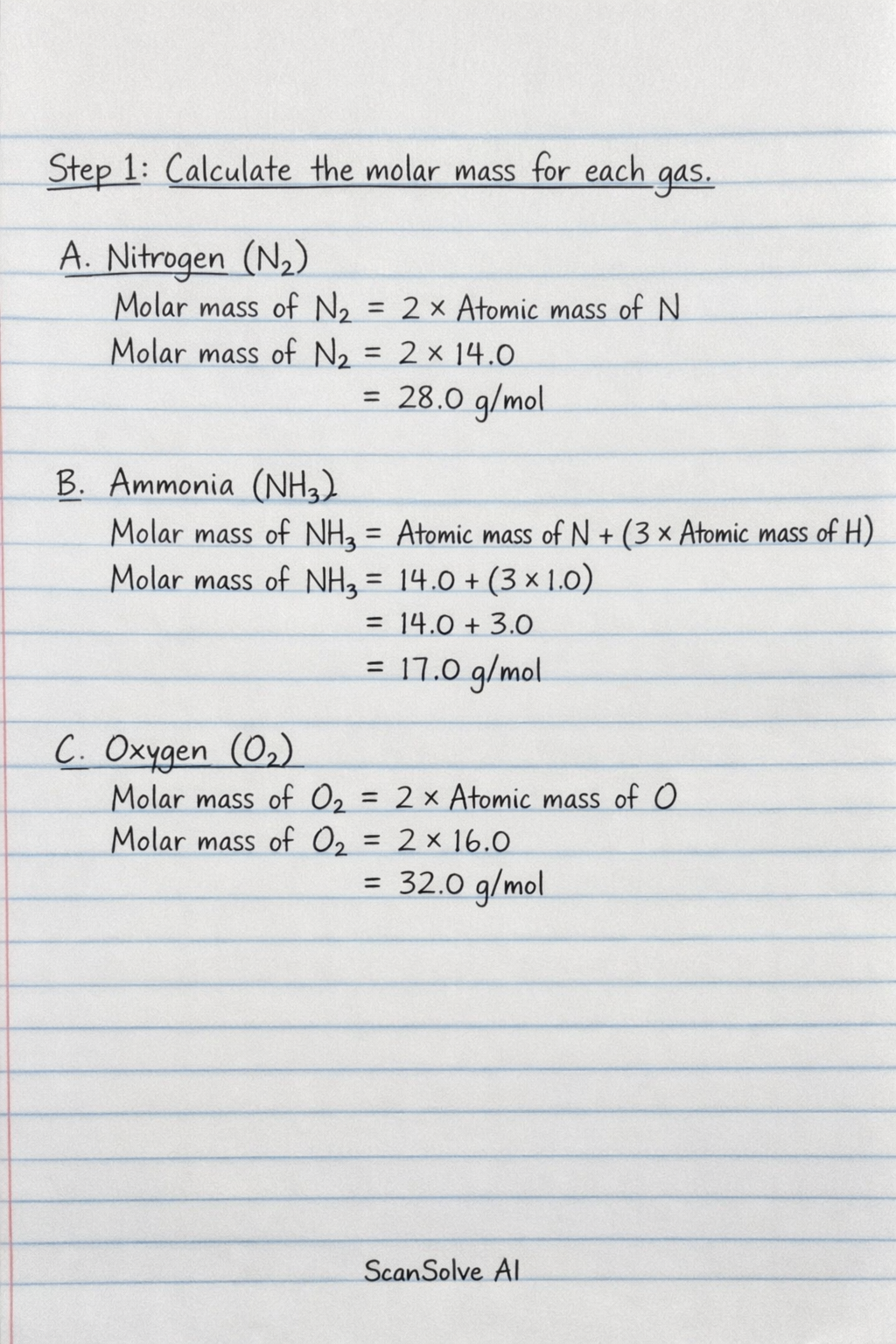
Handwritten Step-by-Step Solution
Get this as a handwritten image on WhatsApp — like a tutor wrote it for you.
Try on WhatsApp