
We read your photo as:
Using Graham's Law of Diffusion, calculate the time it takes for 60 cm³ of chlorine gas to diffuse if 30 cm³ of oxygen gas diffuses in 7 s?
ScanSolve AI Answer
Answer
Step-by-step solution
6 stepsC
Identify the given values and the unknown.
We are given:
- Volume of oxygen () = 30 cm³
- Time for oxygen to diffuse () = 7 s
- Volume of chlorine () = 60 cm³
- Time for chlorine to diffuse () = ?
Determine the molar masses of oxygen () and chlorine ().
- Molar mass of Oxygen (O) = 16.00 g/mol
- Molar mass of () =
- Molar mass of Chlorine (Cl) = 35.45 g/mol
- Molar mass of () =
Apply Graham's Law of Diffusion.
Graham's Law states that the rate of diffusion of a gas is inversely proportional to the square root of its molar mass. The rate of diffusion can be expressed as volume diffused per unit time ().
Substituting the rate with volume and time:
Substitute the known values into the equation.
Simplify both sides of the equation.
First, simplify the right side:
Next, simplify the left side:
Solve for .
Rounding to the nearest whole number, the time taken for chlorine to diffuse is approximately 21 s.
Comparing this result with the given options:
A 12s
B 14s
C 21s
D 30sThe calculated value is closest to option C.
The final answer is .
Try one yourself
A new problem that tests the same skill.
Still stuck on this one?
Ask a follow-up, and the answer starts from this question.
More Chemistry Questions
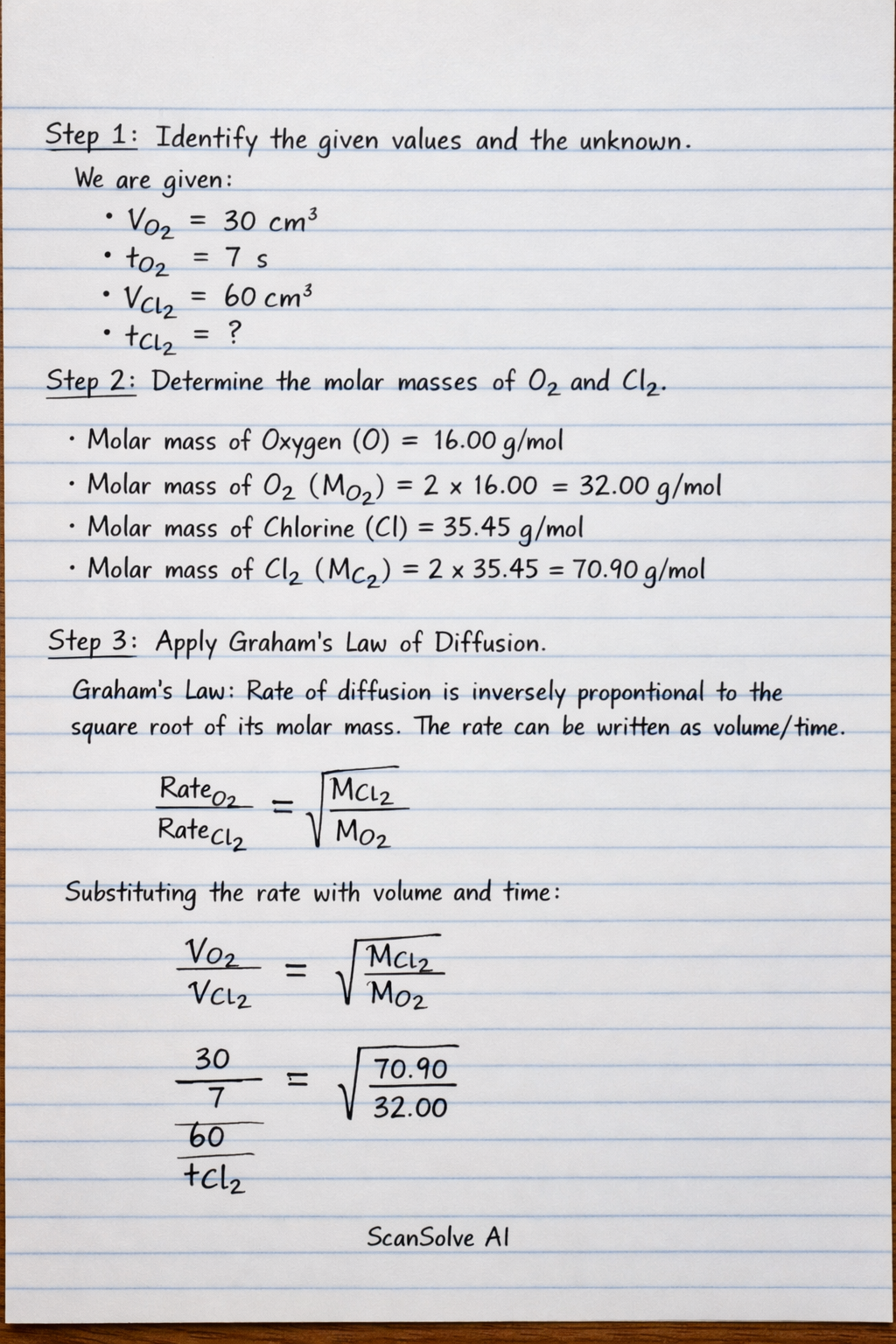
Handwritten Step-by-Step Solution
Get this as a handwritten image on WhatsApp — like a tutor wrote it for you.
Try on WhatsApp