
We read your photo as:
Using the provided data, plot a graph of temperature against time for the exothermic reaction described.
ScanSolve AI Answer
Answer
Step-by-step solution
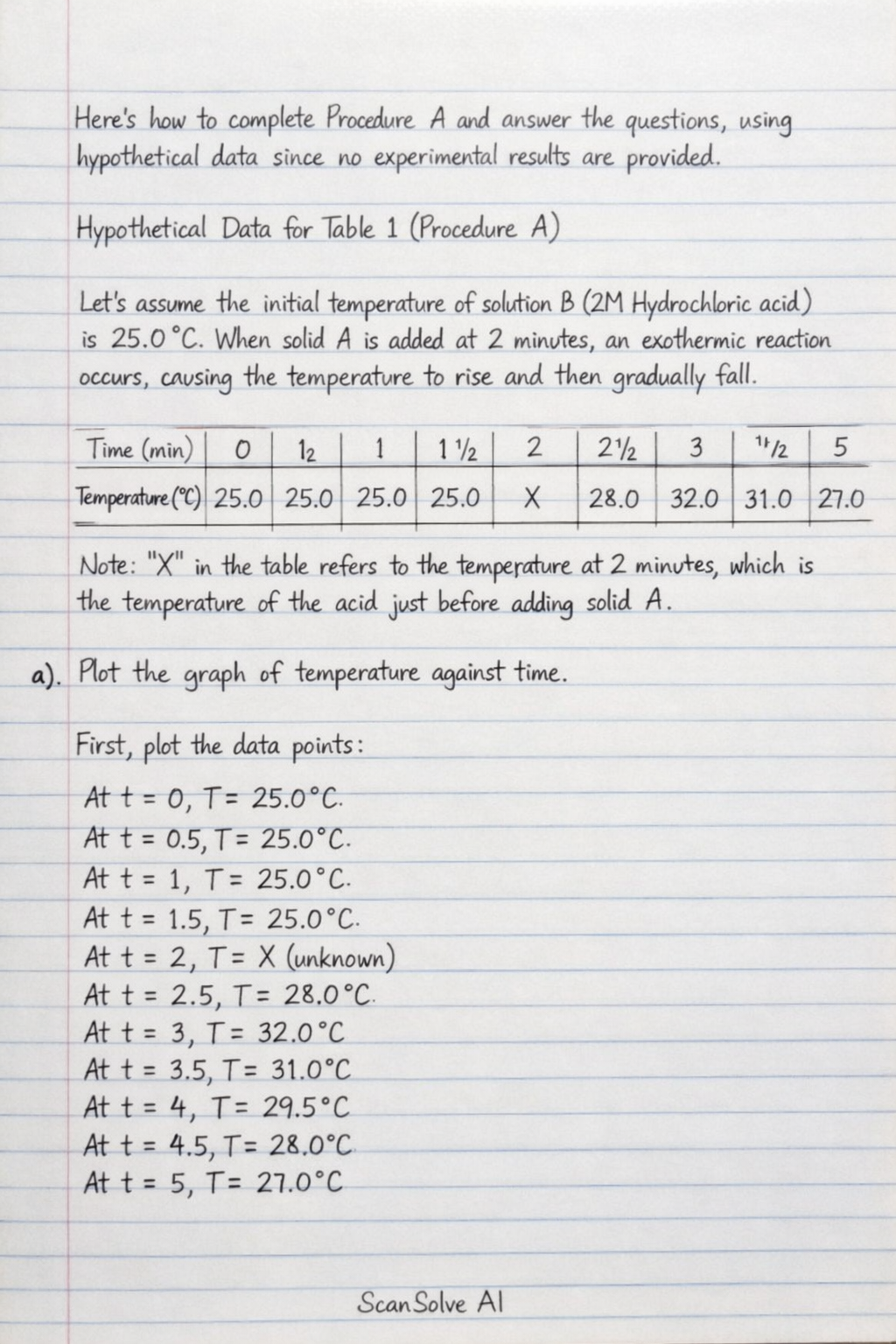
6 stepsHere's how to complete Procedure A and answer the questions, using hypothetical data since no experimental results are provided.
Hypothetical Data for Table 1 (Procedure A)
Let's assume the initial temperature of solution B (2M Hydrochloric acid) is . When solid A is added at , an exothermic reaction occurs, causing the temperature to rise and then gradually fall.
| Time (min) | 0 | 1 | 2 | 3 | 4 | 5 | |||||
|---|---|---|---|---|---|---|---|---|---|---|---|
| Temperature (°C) | 25.0 | 25.0 | 25.0 | 25.0 | 25.0 | 28.0 | 32.0 | 31.0 | 29.5 | 28.0 | 27.0 |
Note: 'X' in the table refers to the temperature at , which is the temperature of the acid just before adding solid A.
Part a· 3 steps
Plot the graph of temperature against time
Set up the axes.
- Draw a horizontal axis (x-axis) and label it "Time / min". Choose a scale that accommodates your range of times (e.g., from to ).
- Draw a vertical axis (y-axis) and label it "Temperature / °C". Choose a scale that accommodates your range of temperatures (e.g., from to ).
Plot the data points.
- For each time value in Table 1, plot a point corresponding to the "Time / min" on the x-axis and the "Temperature / °C" on the y-axis.
- Using the hypothetical data above, you would plot: $(0, 25.0)$, $(0.5, 25.0)$, $(1, 25.0)$, $(1.5, 25.0)$, $(2, 25.0)$, $(2.5, 28.0)$, $(3, 32.0)$, $(3.5, 31.0)$, $(4, 29.5)$, $(4.5, 28.0)$, $(5, 27.0)$.
- For each time value in Table 1, plot a point corresponding to the "Time / min" on the x-axis and the "Temperature / °C" on the y-axis.
Draw a smooth curve.
- Draw a smooth curve or connect the points with straight lines to show the trend of temperature change over time. The initial points (0 to 2 min) should form a horizontal line, followed by a rise and then a fall.
Part b
Using the graph determine the temperature change
Identify the initial temperature.
- From the graph, read the temperature just before solid A was added (at ). This is the initial temperature.
- Using the hypothetical data, the initial temperature is .
- From the graph, read the temperature just before solid A was added (at ). This is the initial temperature.
Identify the maximum temperature.
- From the graph, locate the highest point on the curve after solid A was added. This is the maximum temperature reached during the reaction.
- Using the hypothetical data, the maximum temperature is (at ).
- From the graph, locate the highest point on the curve after solid A was added. This is the maximum temperature reached during the reaction.
Calculate the temperature change.
- Subtract the initial temperature from the maximum temperature.
Try one yourself
A new problem that tests the same skill.
Still stuck on this one?
Ask a follow-up, and the answer starts from this question.
More Chemistry Questions
Handwritten Step-by-Step Solution
Get this as a handwritten image on WhatsApp — like a tutor wrote it for you.
Try on WhatsApp