
We read your photo as:
Using the provided information about element P (forms P³⁺, in Period 3, not actual symbol, atomic mass 27), answer the following: a) Write the electron arrangement of P³⁺. b) Draw the structure of the
ScanSolve AI Answer
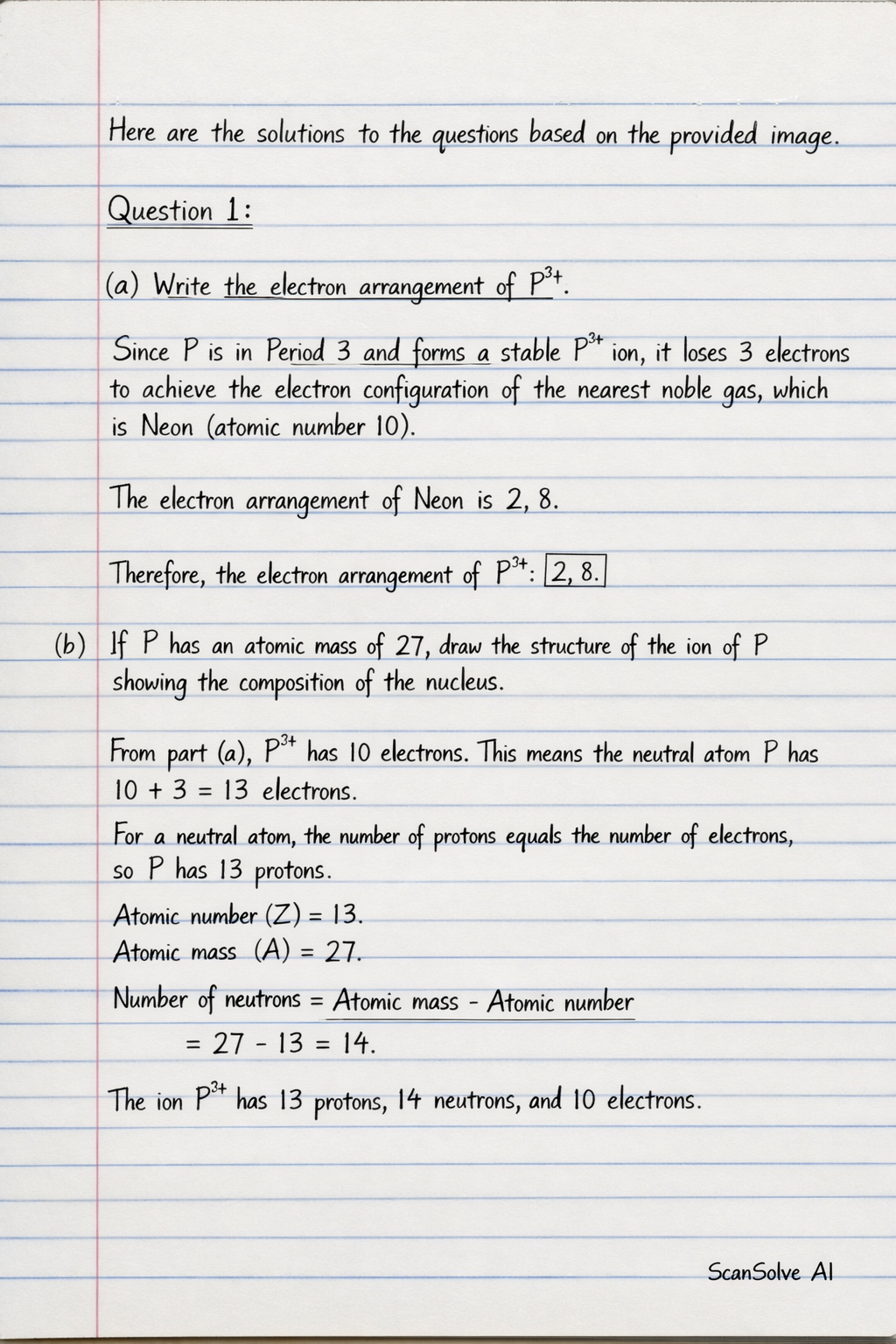
Here are the solutions to the questions based on the provided image.
Question 1:
- Information given: Element P forms a stable ion P³⁺. P is in Period 3 of the periodic table. P is not the actual symbol. Atomic mass of P = 27.
a) Write the electron arrangement of P³⁺.
Since P is in Period 3 and forms a stable P³⁺ ion, it loses 3 electrons to achieve the electron configuration of the nearest noble gas, which is Neon (atomic number 10).
The electron arrangement of Neon is 2.8.
Therefore, the electron arrangement of P³⁺ is .
b) If P has an atomic mass of 27, draw the structure of the ion of P showing the composition of the nucleus.
From part (a), P³⁺ has 10 electrons. This means the neutral atom P has 10 + 3 = 13 electrons.
For a neutral atom, the number of protons equals the number of electrons, so P has 13 protons.
Atomic number (Z) = 13.
Atomic mass (A) = 27.
Number of neutrons = Atomic mass - Atomic number = .
The ion P³⁺ has 13 protons, 14 neutrons, and 10 electrons.
Structure of the ion P³⁺:
- Nucleus:
- 13 protons
- 14 neutrons
- Electron shells:
- First shell: 2 electrons
- Second shell: 8 electrons
c) Write the formula of the chloride of P.
Element P forms a P³⁺ ion.
The chloride ion is Cl⁻.
To form a neutral compound, three chloride ions are needed for every one P³⁺ ion.
The formula of the chloride of P is .
Question 2:
a) Explain why the number of protons remains the same during ion formation.
The number of protons remains the same during ion formation because protons are located within the nucleus of an atom. Ion formation involves the gain or loss of electrons in the electron shells, which does not affect the composition of the nucleus. The number of protons defines the element.
b) Explain why an atom is electrically neutral.
An atom is electrically neutral because it contains an equal number of positively charged protons in its nucleus and negatively charged electrons orbiting the nucleus. The positive charges from the protons cancel out the negative charges from the electrons, resulting in a net charge of zero.
c) Explain why Carbon is placed in group IV and period 2 of the periodic table.
Carbon (atomic number 6) has an electron configuration of 2.4.
- It is in Group IV (or 14) because it has 4 valence electrons in its outermost shell.
- It is in Period 2 because it has 2 occupied electron shells.
Question 3:
The information provided for Question 3 is too blurry and incomplete to answer. Only the beginning of a statement about element H is visible: "H is in group VI. H is the atomic number...". Without the full details about elements E, F, G, H, I, J, K, and L, this question cannot be solved.
Still stuck on this one?
Ask a follow-up, and the answer starts from this question.
More Chemistry Questions
Handwritten Step-by-Step Solution
Get this as a handwritten image on WhatsApp — like a tutor wrote it for you.
Try on WhatsApp