We read your photo as:

Calculate the work done by an ideal gas during an irreversible expansion from 5 atm to 1 atm at 25°C with n=1 mol and P_ext=1 atm.

Chemistry

ScanSolve AI Answer

Answer

−1983.10 J-1983.10 \text{ J}

Step-by-step solution

7 steps
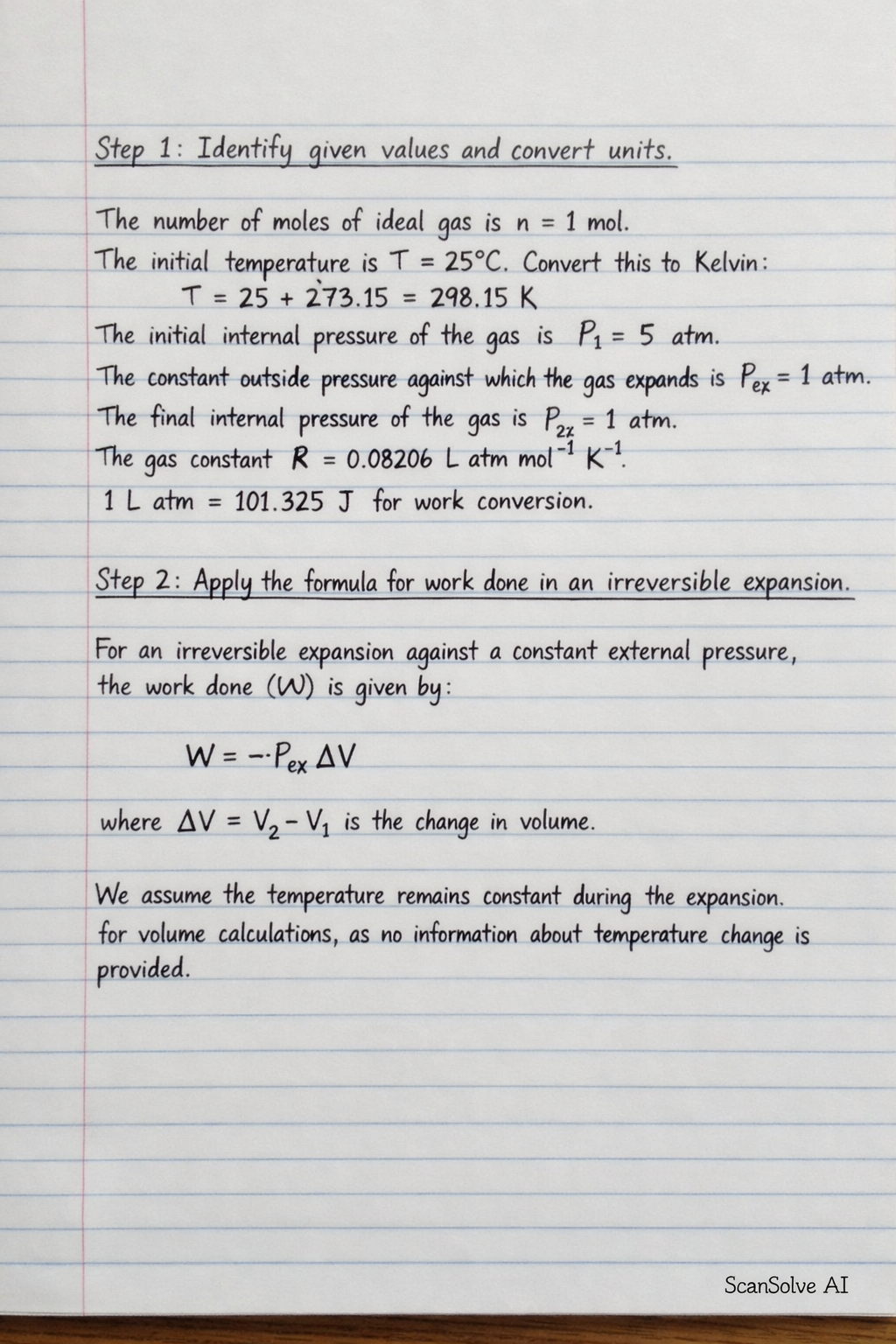
  1. Identify given values and convert units.

    The number of moles of ideal gas is n=1 moln = 1 \text{ mol}.
    The initial temperature is T=25∘CT = 25^\circ\text{C}. Convert this to Kelvin:

    T=25+273.15=298.15 KT = 25 + 273.15 = 298.15 \text{ K}

    The initial internal pressure of the gas is P1=5 atmP_1 = 5 \text{ atm}.
    The constant outside pressure against which the gas expands is Pext=1 atmP_{ext} = 1 \text{ atm}.
    The final internal pressure of the gas is P2=1 atmP_2 = 1 \text{ atm}.
    The gas constant R=0.08206 L atm mol−1 K−1R = 0.08206 \text{ L atm mol}^{-1}\text{ K}^{-1} will be used for volume calculations, and 1 L atm=101.325 J1 \text{ L atm} = 101.325 \text{ J} for work conversion.

  2. Apply the formula for work done in an irreversible expansion.

    For an irreversible expansion against a constant external pressure, the work done (WW) is given by:

    W=−PextΔVW = -P_{ext} \Delta V

    where ΔV=V2−V1\Delta V = V_2 - V_1 is the change in volume. We assume the temperature remains constant during the expansion for volume calculations, as no information about temperature change is provided.

  3. Calculate the initial volume (V1V_1) using the ideal gas law.

    The ideal gas law is PV=nRTPV = nRT. So, V=nRTPV = \frac{nRT}{P}.

    V1=nRTP1V_1 = \frac{nRT}{P_1} V1=(1 mol)(0.08206 L atm mol−1 K−1)(298.15 K)5 atmV_1 = \frac{(1 \text{ mol})(0.08206 \text{ L atm mol}^{-1}\text{ K}^{-1})(298.15 \text{ K})}{5 \text{ atm}} V1=24.466 L atm5 atmV_1 = \frac{24.466 \text{ L atm}}{5 \text{ atm}} V1=4.8932 LV_1 = 4.8932 \text{ L}
  4. Calculate the final volume (V2V_2) using the ideal gas law.

    V2=nRTP2V_2 = \frac{nRT}{P_2} V2=(1 mol)(0.08206 L atm mol−1 K−1)(298.15 K)1 atmV_2 = \frac{(1 \text{ mol})(0.08206 \text{ L atm mol}^{-1}\text{ K}^{-1})(298.15 \text{ K})}{1 \text{ atm}} V2=24.466 L atm1 atmV_2 = \frac{24.466 \text{ L atm}}{1 \text{ atm}} V2=24.466 LV_2 = 24.466 \text{ L}
  5. Calculate the change in volume (ΔV\Delta V).

    ΔV=V2−V1\Delta V = V_2 - V_1 ΔV=24.466 L−4.8932 L\Delta V = 24.466 \text{ L} - 4.8932 \text{ L} ΔV=19.5728 L\Delta V = 19.5728 \text{ L}
  6. Calculate the work done (WW) in L atm.

    W=−PextΔVW = -P_{ext} \Delta V W=−(1 atm)(19.5728 L)W = -(1 \text{ atm})(19.5728 \text{ L}) W=−19.5728 L atmW = -19.5728 \text{ L atm}
  7. Convert the work done from L atm to Joules.

    Using the conversion factor 1 L atm=101.325 J1 \text{ L atm} = 101.325 \text{ J}:

    W=−19.5728 L atm×101.325 J1 L atmW = -19.5728 \text{ L atm} \times \frac{101.325 \text{ J}}{1 \text{ L atm}} W=−1983.10 JW = -1983.10 \text{ J}

    The work done is:

    −1983.10 J-1983.10 \text{ J}
Was this helpful?

Try one yourself

A new problem that tests the same skill.

Still stuck on this one?

Ask a follow-up, and the answer starts from this question.

Got a different question?Ask your own question
Handwritten step-by-step solution preview

Handwritten Step-by-Step Solution

Get this as a handwritten image on WhatsApp — like a tutor wrote it for you.

Try on WhatsApp