
We read your photo as:
Explain y sulphur can show valencies of 2, 4, 6 whereas oxygen is restricted to a valency of 2. [O=8, S=16]
ScanSolve AI Answer
Here are the solutions to your questions:
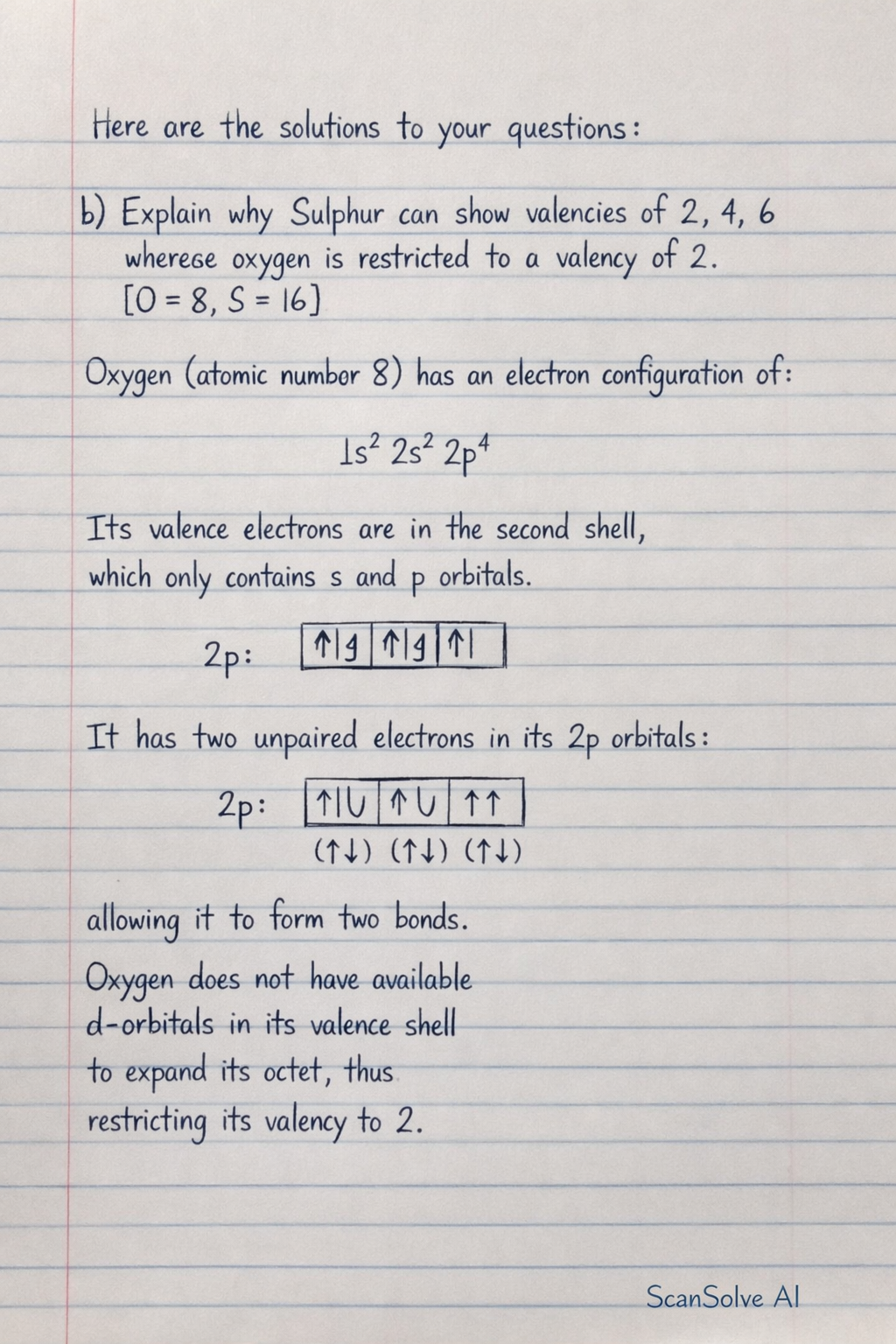
b) Explain why Sulphur can show valencies of 2, 4, 6 whereas oxygen is restricted to a valency of 2. [O=8, S=16]
Oxygen (atomic number 8) has an electron configuration of . Its valence electrons are in the second shell, which only contains and orbitals. It has two unpaired electrons in its orbitals, allowing it to form two bonds. Oxygen does not have available -orbitals in its valence shell to expand its octet, thus restricting its valency to 2.
Sulphur (atomic number 16) has an electron configuration of . Its valence electrons are in the third shell, which contains , , and empty -orbitals. In its ground state, sulphur has two unpaired electrons in its orbitals, allowing it to form two bonds. However, sulphur can promote electrons from its and orbitals to the empty orbitals. Promoting one electron from to creates four unpaired electrons (valency 4), and promoting one electron from to (in addition to the previous promotion) creates six unpaired electrons (valency 6). This ability to expand its octet using -orbitals allows sulphur to exhibit valencies of 2, 4, and 6.
c) i) Define the term enthalpy of combustion.
The enthalpy of combustion is the enthalpy change that occurs when one mole of a substance is completely burned in excess oxygen under standard conditions (usually and ).
c) ii) Naturally occurring nuclides emit 3 types of radiations. Name each of the radiation. State the nature of each of the radiations.
- Alpha () radiation: Consists of helium nuclei (), which are positively charged particles.
- Beta () radiation: Consists of electrons (), which are negatively charged particles.
- Gamma () radiation: Consists of high-energy electromagnetic waves, which have no charge and no mass.
d) i) Write down the electronic configuration of Fe +2 and +3 oxidation states of iron.
The atomic number of iron (Fe) is 26.
- Neutral Fe:
- Fe²⁺ (loses 2 electrons from ):
- Fe³⁺ (loses 2 electrons from and 1 electron from ):
d) ii) State with reason which of the oxidation states would be more stable.
The Fe³⁺ oxidation state is more stable.
- Reason: The electron configuration of Fe³⁺ is . A half-filled -subshell () is a particularly stable electronic configuration due to its symmetrical distribution of electrons and maximized exchange energy.
e) i) The electron configuration of carbon may be written as . Explain each of the symbols in .
- 2: This is the principal quantum number (), indicating that the electron is in the second electron shell.
- p: This is the azimuthal or angular momentum quantum number (), indicating that the electron is in a p-orbital, which has a dumbbell shape.
- x: This indicates the orientation of the p-orbital in space, specifically along the x-axis.
- 1: This is the number of electrons occupying that specific orbital.
e) ii) Consider the configuration of carbon stated, explain why carbon forms four equivalent bonds.
The given ground state electron configuration for carbon () shows only two unpaired electrons in the orbitals, which would suggest a valency of 2. However, to form four equivalent bonds, carbon undergoes hybridization.
First, one electron from the orbital is promoted to the empty orbital, resulting in an excited state configuration of . Now there are four unpaired electrons.
Next, these four atomic orbitals (one and three orbitals) mix and redistribute their energy to form four new, identical hybrid orbitals called hybrid orbitals. These orbitals are equivalent in energy and shape and are oriented tetrahedrally around the carbon atom. This allows carbon to form four equivalent covalent bonds, as seen in molecules like methane ().
Still stuck on this one?
Ask a follow-up, and the answer starts from this question.
More Chemistry Questions
Handwritten Step-by-Step Solution
Get this as a handwritten image on WhatsApp — like a tutor wrote it for you.
Try on WhatsApp