
We read your photo as:
Conflict is a dynamic process in which the - and - are constantly changing and influencing one another.
ScanSolve AI Answer
Answer
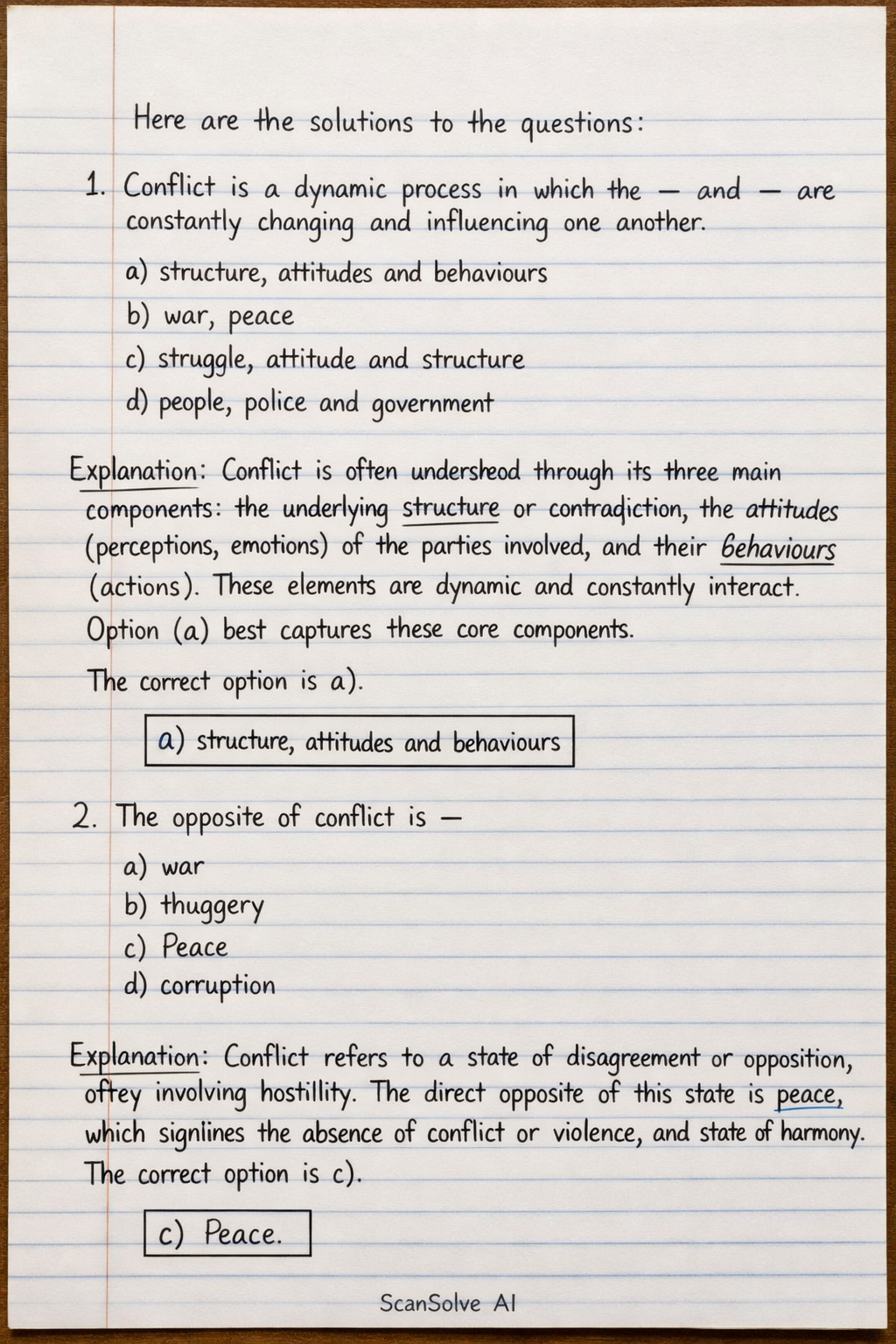
Here are the solutions to the questions:
1. Conflict is a dynamic process in which the - and - are constantly changing and influencing one another.
a) structure, attitudes and behaviours
b) war, peace
c) struggle, attitude and structure
d) people, police and government
Explanation: Conflict is often understood through its three main components: the underlying structure or contradiction, the attitudes (perceptions, emotions) of the parties involved, and their behaviours (actions). These elements are dynamic and constantly interact. Option (a) best captures these core components.
The correct option is a).
2. The opposite of conflict is -
a) war
b) thuggery
c) Peace
d) corruption
Explanation: Conflict refers to a state of disagreement or opposition, often involving hostility. The direct opposite of this state is peace, which signifies the absence of conflict or violence, and a state of harmony.
The correct option is c).
3. Economically-based groupings are called -
a) groups
b) regions
c) factions
d) classes
Explanation: In social sciences, particularly sociology and political economy, classes refer to groupings of individuals based on their economic position, wealth, income, and access to resources.
The correct option is d).
Try one yourself
A new problem that tests the same skill.
Still stuck on this one?
Ask a follow-up, and the answer starts from this question.
More Computer Science Questions
Handwritten Step-by-Step Solution
Get this as a handwritten image on WhatsApp — like a tutor wrote it for you.
Try on WhatsApp