
We read your photo as:
Which of the following process does not occur during photosynthesis?
Computer Science
ScanSolve AI Answer
-
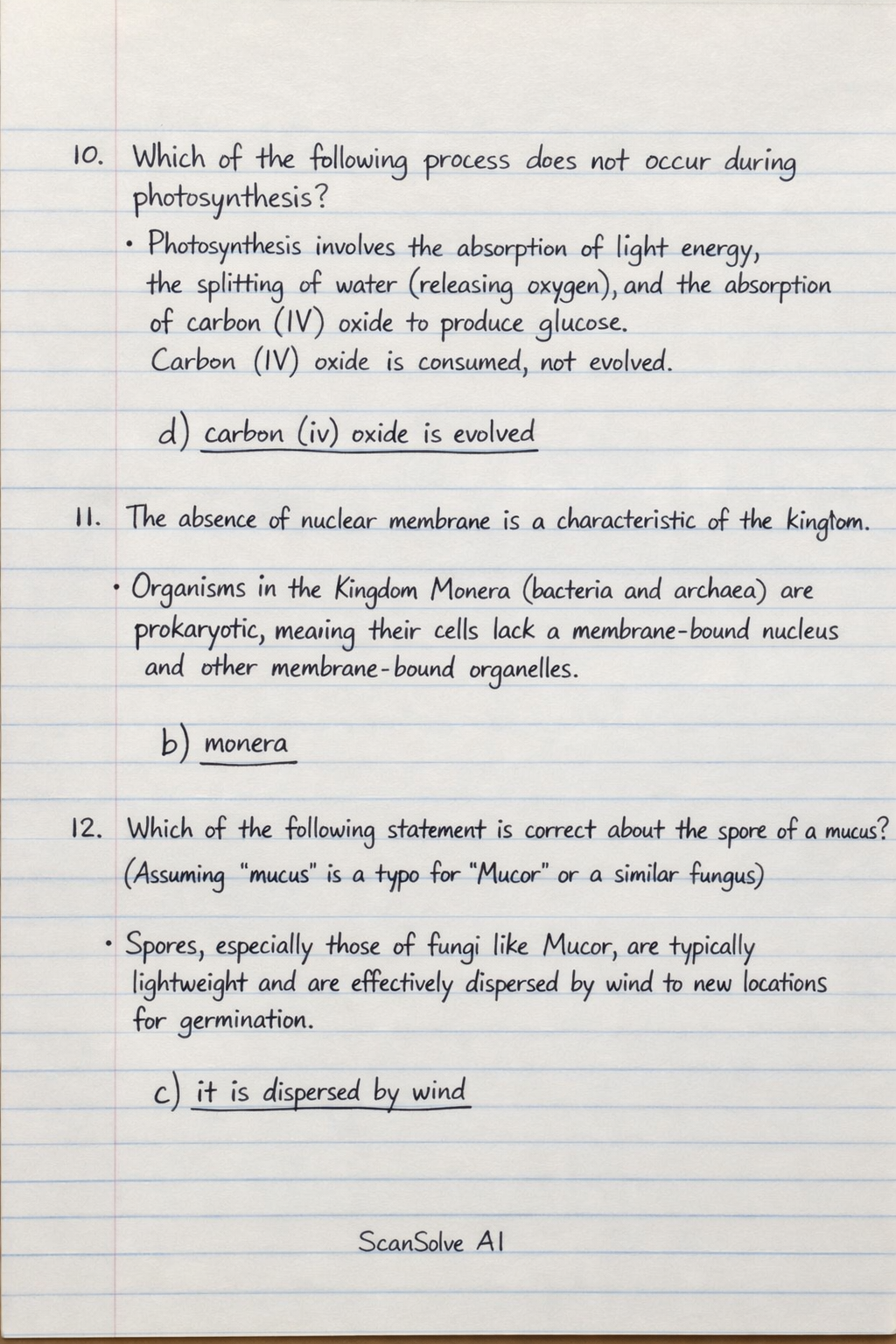
Which of the following process does not occur during photosynthesis?
- Photosynthesis involves the absorption of light energy, the splitting of water (releasing oxygen), and the absorption of carbon (IV) oxide to produce glucose. Carbon (IV) oxide is consumed, not evolved.
- d) carbon (iv) oxide is evolved
-
The absence of nuclear membrane is a characteristic of the kindom.
- Organisms in the Kingdom Monera (bacteria and archaea) are prokaryotic, meaning their cells lack a membrane-bound nucleus and other membrane-bound organelles.
- b) monera
-
Which of the following statement is correct about the spore of a mucus? (Assuming "mucus" is a typo for "Mucor" or a similar fungus)
- Spores, especially those of fungi like Mucor, are typically lightweight and are effectively dispersed by wind to new locations for germination.
- c) it is dispersed by wind
-
An organism which exhibits extracellular digestion is.
- Rhizopus (a type of fungus) secretes digestive enzymes onto its food source outside its body, breaking down complex molecules into simpler ones, which are then absorbed. This is known as extracellular digestion.
- a) Rhizopus
-
The prothallus of a fern is equivalent to the gametophyte generation of a moss because it.
- Both the fern prothallus and the moss gametophyte are the haploid, sexual generation that produces gametes. A key characteristic of this stage is that it bears sexual organs (antheridia and archegonia) where gametes are formed.
- b) bear sexual organs
-
The dominant phase in the life cycle of a bryophyte is.
- Bryophytes (mosses, liverworts, and hornworts) are characterized by a life cycle where the gametophyte generation is the dominant, free-living, and photosynthetic stage. The sporophyte is dependent on the gametophyte.
- c) gametophyte
-
Which of these worm is beneficial to man?
- Earthworms are highly beneficial to humans and ecosystems. They improve soil structure, aeration, drainage, and nutrient cycling, which enhances agricultural productivity. Flatworms, hookworms, and many roundworms are often parasitic and harmful.
- c) Earthworm
Was this helpful?
Still stuck on this one?
Ask a follow-up, and the answer starts from this question.
Got a different question?Ask your own question
More Computer Science Questions
QDuring photosynthesis, plants use carbon dioxide and release:QThe following life processes are common to both plants and animal except ___ A. Respiration B…QDuring the dark stage of photosynthesis (Calvin cycle), carbon dioxide is fixed and converted into…QPlants make their own food through: A. Respiration B. Photosynthesis C. Digestion D. Transpiration
Handwritten Step-by-Step Solution
Get this as a handwritten image on WhatsApp — like a tutor wrote it for you.
Try on WhatsApp