

This computer science problem involves algorithmic thinking and programming concepts. The solution below explains the approach, logic, and implementation step by step.
ScanSolve AI Answer
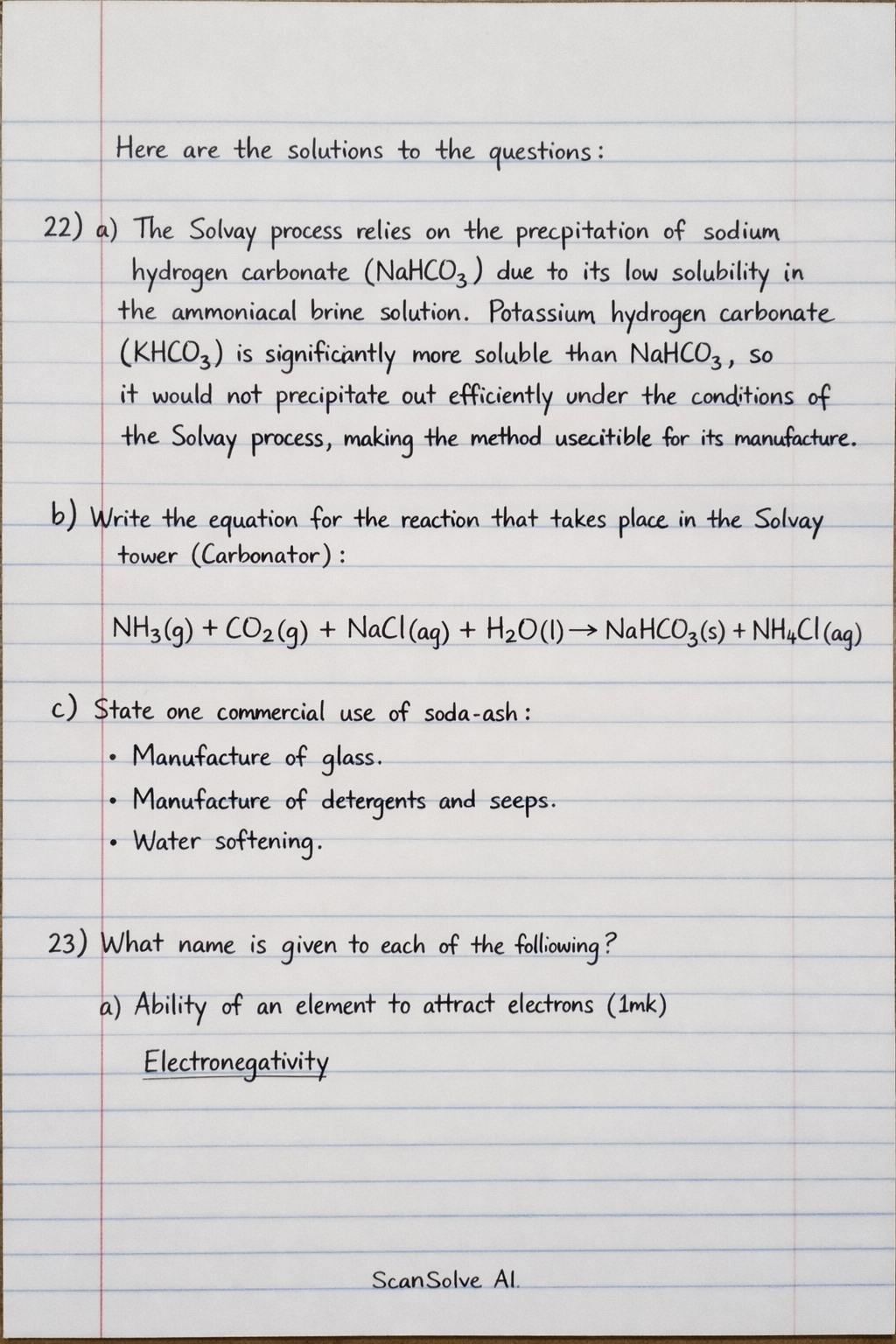
Here are the solutions to the questions: 22) a) Explain why potassium carbonate cannot be manufactured by the Solvay process. The Solvay process relies on the precipitation of sodium hydrogen carbonate (NaHCO_3) due to its low solubility in the ammoniacal brine solution. Potassium hydrogen carbonate (KHCO_3) is significantly more soluble than NaHCO_3, so it would not precipitate out efficiently under the conditions of the Solvay process, making the method unsuitable for its manufacture. b) Write the equation for the reaction that takes place in the Solvay tower (Carbonator). NH_3(g) + CO_2(g) + NaCl(aq) + H_2O(l) → NaHCO_3(s) + NH_4Cl(aq) c) State one commercial use of soda-ash. Manufacture of glass*. Manufacture of detergents* and soaps. Water softening*. 23) What name is given to each of the following? a) Ability of an element to attract electrons (1mk) Electronegativity b) Types of forces that holds the atoms of Neon together (1mk) Van der Waals forces (specifically, London dispersion forces) 24) Zinc sulphate was prepared by adding excess Zinc oxide to dilute sulphuric (VI) acid in a beaker. The mixture was warmed until no more effervescence occurred. Excess Zinc oxide was filtered and the filtrate evaporated and then cooled. Fine crystals were obtained. a) Write an equation for the above reaction (1mk) ZnO(s) + H_2SO_4(aq) → ZnSO_4(aq) + H_2O(l) b) Why was excess zinc oxide used (1mk) Excess zinc oxide was used to ensure that all the dilute sulphuric (VI) acid reacted completely. This prevents unreacted acid from contaminating the zinc sulphate crystals. c) How would you know that the reaction is over (1mk) The reaction is over when no more solid zinc oxide dissolves and a residue of unreacted zinc oxide remains at the bottom of the beaker. (Note: The question mentions "no more effervescence occurred," but the reaction between zinc oxide and sulfuric acid does not produce gas/effervescence. If zinc carbonate were used, effervescence would be observed.) 25) Hydrogen sulphide was passed through a solution of Iron (III) chloride i) State the observation made (1mk) The yellow/brown solution turns pale green, and a yellow precipitate is formed. That's 2 down. 3 left today — send the next one.